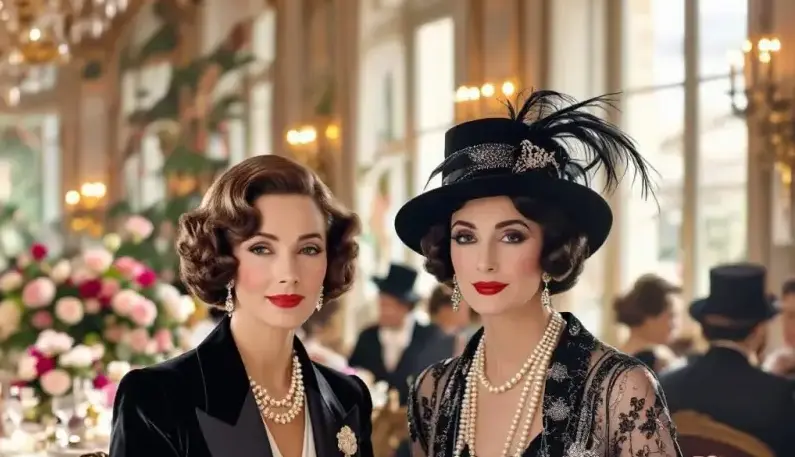
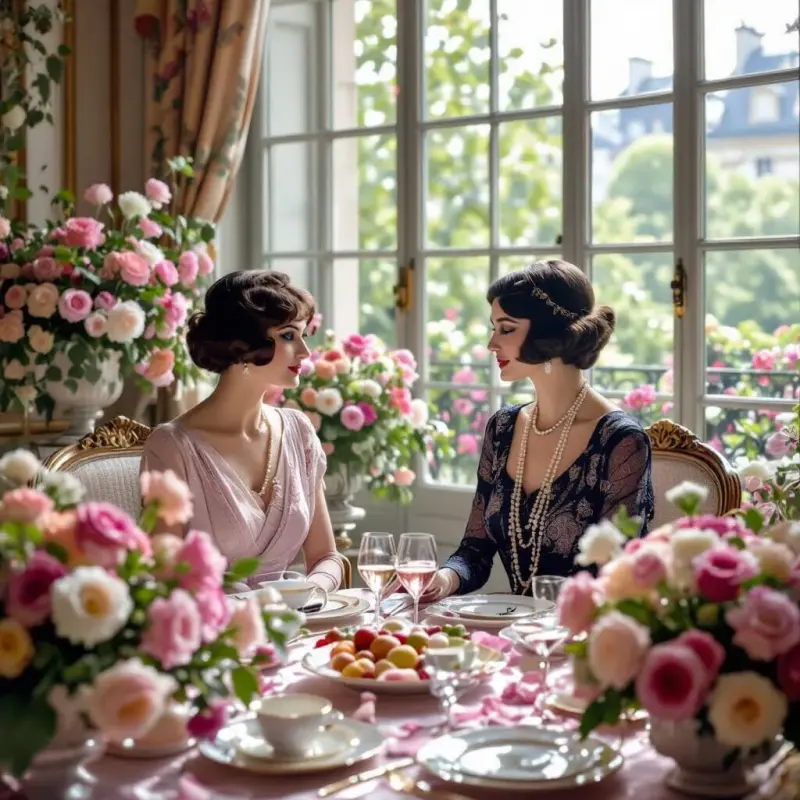
In the spring of 1925, in the exclusive lounge of the Hotel Ritz in Paris, a meeting took place between two of the most influential women of the 20th century, Coco Chanel and Gala Dalí, an event that could easily be called a chance. Gabrielle Coco Chanel was in the middle of the Roaring Twenties, which gave the main impulse to her fashionable boutique. In a narrow black skirt and a fitted white shirt, the slim, elegant woman stood next to a fountain, where beautiful guests dipped their glasses in the champagne flowing from a golden pipe. Elena Diakonova, a short, imposing woman, known in Paris bohemia as Gala, recently arrived from Moscow, the divorced wife of the poet Paul Éluard, approached the glass of champagne, her strong black eyes looking over the crowd of champagne revelers and cigarette smoke rings. The two women had met before at receptions and literary evenings, but had never really spoken. Coco Chanel was a rising star in the world of fashion, and Galas already had her own network of creative Paris bohemia, surrealists and abstract artists. But both had in common that they did not look for sympathy and influence, having a rare drive to control the world around them, in particular the famous men in their lives.
‘Mademoiselle Chanel,’ a voice with a strange accent called to her, and a slender man with an exotically dressed in a silk kurta with a bright crimson turban appeared by her side. ‘And Madame Éluard, what a pleasure.’
The two women turned to him at the same time. Coco Chanel with curiosity, Gala with a mix of interest and restraint. The man was dressed in the Indian national costume, an embroidered silk shirt with a brightly colored wide silk belt at the waist and a turban with a single big ruby sparkling in the light of the chandelier. His slim figure was perfect: an elegant beard, a long neck, strong high cheekbones, and dark intense eyes.
‘Pardon for the intrusion,’ the guest continued, bowing in front of them. ‘My name is Rajiv Mehta, a merchant from Bombay. I couldn’t help but notice two of the most interesting women in Paris, standing here all alone.’
Chanel raised her beautiful eyebrow: suspicious but interested.
‘And what is an Indian merchant doing in Paris, in the middle of the boisterous 1920s, at a party full of champagne and cigarette smoke?’
‘Business and pleasure, of course,’ the man replied with a smile, showing a row of perfect white teeth. ‘I deal with rare and exotic textiles, spices, and sometimes …’ he lowered his voice, ‘other more mystical things.’
Gala’s eyes had never left the vial in his hands. ‘Mystical? So this is why you have come to Paris? I, too, have always been interested in all kinds of occult and alchemy, being born in Russia.’
‘I have come to Paris with a unique elixir,’ the stranger continued, reaching into his embroidered waistband and pulling out a small vial with a stopper in the shape of a tear drop. ‘An ancient remedy made from herbs grown on the shores of the sacred Himalayan lakes that grant those who drink it, a vision of their distant future.’
Chanel snorted dismissively. ‘Mr. Mehta, you are probably an educated man from one of the Indian colleges, but I don’t think it’s possible that these two educated women have even a moment’s interest in your fantasies.’
‘Ah, but I have already mentioned business, did I not?’ Rajiv smiled again, amused by the delicate black woman with perfectly waved hair. ‘I charge for it, and what you decide to do with the vision is entirely up to you. But as the future is concerned, what can be more fun at a party full of champagne than a sip of this unusual and exotic liquid?’
‘Interesting,’ Gala said decisively. ‘I would like to try.’
‘Try what? And do you really expect me to believe in all this?’ Coco reacted indignantly. ‘Why, Mr. Mehta, we are at a party with French champagne, not an Indian fakir doing a sideshow in a funfair.’
‘Call me Gala, please, Coco,’ she said, turning to her. ‘And you will have to try it, just to see what my new friend has in that little vial, and whether it lives up to his claims. If you are not satisfied, you will have to throw it back, won’t you?’
Curiosity got the better of her or the mood of the springtime party: in any case, Coco shrugged and nodded. ‘Very well. If Gala wants to drink this mystical potion of your, Mr. Mehta, then I will, too.’
The Indian merchant led the two women to a corner by a wall away from the crowd at the party. He produced two tiny crystal glasses and poured a few drops of the liquid into each.
‘It does not work the same for everyone, ladies,’ he explained. ‘Some see what is waiting for them in the very distant future, some only a glimpse of what is just around the corner. But the vision is short, only a few moments, though, they say, the clarity is unforgettable.’
The two women met each other’s gaze, recognizing the experience they were about to go through.
‘To your health, Mademoiselle Chanel,’ Gala said, lifting her glass to the other woman.
‘And yours, Gala,’ Coco returned the gesture with a smile.
Both women raised their glasses and swallowed the liquid.
To Chanel’s vision, the world went black, then white, and a new series of kaleidoscopic colors and images rose like an ecstatic reverie in front of her, driving her mad with desire and fear.
The first thing she saw was her own name on the large gold and black label on bottles of perfume hanging on the counters of elegant department stores from New York to Tokyo. Chanel No. 5, she read, and for a moment she felt embarrassed, the name sounding like a movie star or a pop singer to her still unpretentious and sober self. She also saw black and white outfits and those simple little black dresses that women all over the world would covet, emblazoned with her CC initials on handbags, shoes, and jewelry. Chanel dresses, she saw over and over again in department stores, in nightclubs, and at fashion shows in countries she had not yet thought of traveling to. She caught sight of her timeless black dress and white shirt on women of all nationalities and ages, and her own dress and suit on black and white film stills. She also saw young men trying to copy her and angry colleagues calling her a tyrant behind her back, but her own work and influence had already spread to most of the world, an empire of fashion and couture in Paris, in London, and New York, but also in Moscow and Constantinople, Shanghai and New Delhi. And in history books, art galleries and museums dedicated to her work, and glossy film reels of her life and influence: Coco Chanel, one of the most celebrated women in the world.
She also saw darker things: faraway war years, whispers of collaboration and treachery, a long self-imposed exile in Switzerland. She saw houses, hotels, and tiny apartments across Paris as she was forced to make the difficult decision to shut down her fashion business at the height of her fame and influence, and walk away from her greatest love in the world: fashion and couture. But in the new century, in the roaring ‘20s and colorful ‘30s, she saw her return: an old Coco Chanel making a comeback at the age of 70, staging a triumph that shocked even her hardened heart, her style reinvented and redesigned for new audiences who had yet to be born. She also saw battles over her creative independence with perfumers, actors, and hangers-on, some of them dangerous, but through it all, she continued to control the people in her life and her work, a true goddess of fashion, her reputation fully restored and enshrined in history by the time of her death, in bed in her private suite at the Hotel Ritz with one of her famous little black dresses and a leather Chanel jacket, surrounded by luxury but at peace with the end of her life at last.
Gala’s vision took her to sun-drenched hills and plains and vivid orange poppies in a country she instantly recognized as Spain, but had not yet been to. She also saw, in the distance, a tall, thin man with an upturned moustache that curled flamboyantly at the end. Aha, she knew he was Salvador Dalí, and she knew it the moment she saw him.
In her vision, she saw herself not only as Dalí’s wife, as he would later be but, more importantly, as his business manager and agent, the wife who had saved his work, but also as his sole focus and inspiration, his creative obsession and muse. She also saw paintings of her in museums and exhibitions all over the world: Gala as madonna, Gala as a loaf of bread, Gala as the many, her unmistakable eyes staring back from the multiple images both reproaching and demanding all that was Salvador’s. She also saw an extravagant castle with Diego Rivera frescoes, an entire estate by the sea in Spain that Dali had given her as a wedding gift: Púbol, where he would stay and wait for written permission to visit while she received other lovers. She also saw the decadent dinner parties, a jet-set of royalty and Hollywood glitterati where Gala presided, and with whom she traded stories and secrets at art auctions or while walking their dogs on the beaches of Cadaqués or Port Lligat. She also saw wealth and power that were almost too good to be true: the magnificent surrealist paintings adorning the walls, an extensive art collection featuring Dali’s paintings, gifts of items, and watches, an endless turnover of charming and talented men in her world, and her own influence growing larger and more formidable even than that of her husband. She also saw rumors and whispers of manipulative, ambitious, cold-hearted Gala, and her own complete and utter lack of care about what other people thought.
The visions both women had were over in moments. The kaleidoscope of images, colors and shapes swirling by as if on a technicolor carousel subsided in an instant, and both women blinked in the hotel lounge, the Indian merchant still holding his vial between them.
‘What did you see?’ he asked, lowering his voice.
Coco blinked again, regaining her composure, her clothes and position suddenly becoming her armor. ‘Nothing of any particular importance, Monsieur Mehta. Merely a pleasant hallucination, no more.’
But Gala’s expression was completely different, a strange satisfied smirk that Coco did not know the enigmatic Russian had within her. ‘I have seen everything I ever wanted, and more.’
Rajiv nodded and bowed in turn, the colorful silk of his kurta moving like an exotic snake.
‘The elixir does not create futures, ladies, it only makes it possible to look into the crystal ball of fate. What you will do with your vision, ladies, is entirely up to you.’
The Indian merchant bowed again and went back to the party among the now-distant partygoers. Coco turned to Gala, already aware of the conversation in her mind.
‘Do you really think we will have the futures that we just saw?’
The Russian woman only smiled, her expression inscrutable. ‘Whether this is a real vision or just a mystical fantasy, it doesn’t matter, does it, Coco? All that matters is that now we know what to do.’
‘You sound like an artist, not a businesswoman,’ Chanel observed with a smile.
‘And you think more like a businesswoman, but we both have the same goal,’ Gala returned the compliment with her own.
In the next moment, the two women were lost among the other guests at the party again. Gala never mentioned the incident to her new friends and acquaintances from the surrealist movement and abstract artists; all they could say was that they had met a colorful Indian merchant who was either a fakir from a funfair or a genuine shaman. Coco Chanel, for her part, mentioned it to no one, not even to her own friends and partners in business.
The next morning, Coco inquired about the mysterious Mr. Rajiv Mehta at the hotel reception, where they assured her he had not been registered. Gala asked her new surrealist friends about Indian merchants with bottles of mystical elixirs, and they all laughed and painted portraits of mystical merchants. Later, in the 1930s and 1940s, Chanel opened her fashion empire, opening new stores in London, New York and Paris; and Gala became the woman at the center of Dalí’s creative and professional life, the lover, business manager, fixer and muse who made sure Dalí never needed for anything and was inspired by every new project they worked on together. But on quiet mornings in later years, when they found time to think, both women sometimes remembered what they had seen on that night in Paris, the day of Gala Dalí’s 30th birthday, and could not help wondering if they had shaped those futures themselves with their own drive and hard work or if, as the Indian merchant had said, the vision was true, a confirmation of what the stars had already written in the sky.
When Coco Chanel died at the age of 87 in 1971, surrounded by cats, gardenias and her trademark black dress and jacket, she had one of the most valuable couture businesses in the world and a net worth in the millions of dollars, and her name was synonymous with chic and elegance. When Gala Dalí died on January 10, 1982, on the bed she had chosen for her in the castle of Púbol that her husband had given her years before, she had not only secured her husband’s legacy but had also made her mark on art history as one of the most important muses of the 20th century. But they never mentioned this night again to anyone or the incredible coincidence that brought two women of the most incredible destinies together for the space of an evening, and in a magical moment granted them by an Indian merchant with a bottle of mystical elixir and a stranger’s help that only they know if they had a choice at all.
Whether this event was merely predicted or inspired by the elixir, by fate, by otherworldly forces or merely by their own ambition and drive, only the two of them could say, and they never did. Their destinies were tied to each other like threads in an endless tapestry, winding around and around and around to infinity, and it is impossible to say if the magic of that springtime night in Paris was real or just a moment in time remembered, retold and embellished over the years and decades. But one thing is certain: both women lived the lives that any woman could only dream of: their names were on the tongues of everyone who had ever thought about high fashion or pop art or surrealist abstraction, and in their hearts, Coco Chanel and Gala Dalí were the richest, most influential, and most elegant women of the 20th century.
[attractive-donation donation=”1″]