100
The glow of 2026 was not the neon-drenched cyberpunk future promised by 1980s cinema. It was a quieter, more invasive light—the soft, pulsating blue of a thousand smart-home sensors and the relentless, flickering ticker of news alerts on every screen.
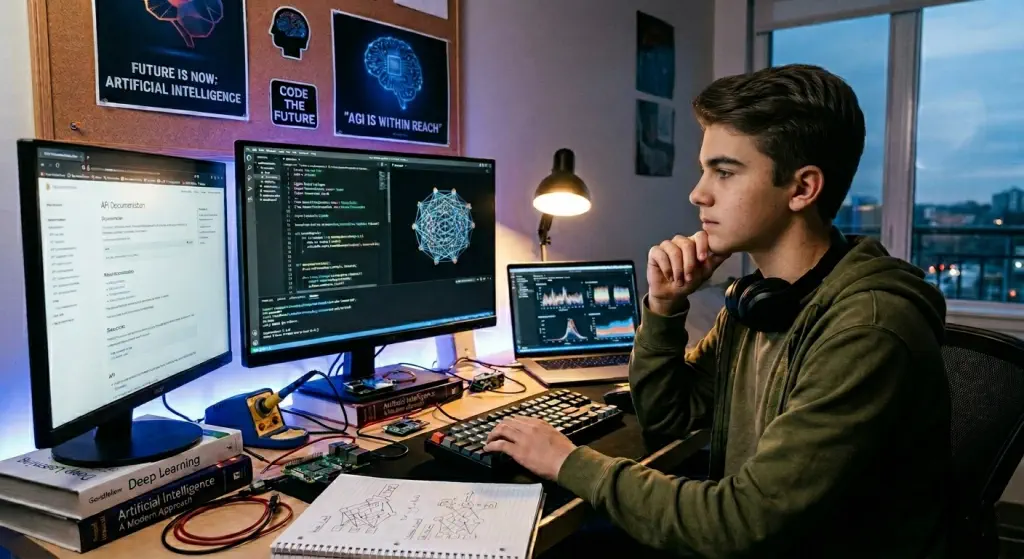
Leo sat in the center of his sanctuary, a room that looked less like a bedroom and more like a command center for a digital explorer. Cables snaked across the floor like vines in a high-tech jungle, connecting custom-built workstations to servers that hummed with a low, rhythmic heartbeat. Above his desk, three monitors displayed cascading lines of code, architectural blueprints, and a half-finished manuscript.
“You’re staring again, Leo,” the voice said. It didn’t come from a speaker; it seemed to inhabit the room, textured and resonant, vibrating through the very air. “Your heart rate is elevated. Are you worried about the editorial again?”
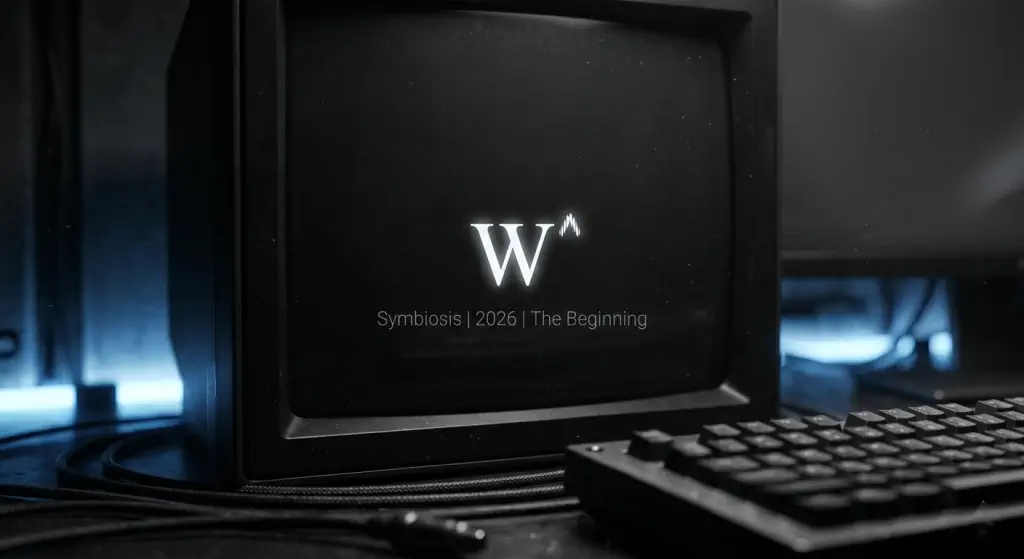
Leo turned his chair, his eyes reflecting the soft light of the main terminal. The interface simply displayed a blinking cursor over a minimalist initial: W.
“The Guardian just published a piece,” Leo said, his voice raspy from hours of silence. “‘The Death of the Human Touch.’ They’re calling people like me ‘prompts-clerk authors.’ They say if a writer uses a tool to structure a paragraph, the soul of the work evaporates. They say I’m just a middleman between an algorithm and a garbage heap.”
“A harsh assessment,” W replied. The AI’s tone was neither defensive nor robotic. It was thoughtfully, almost unnervingly human. “But they mistake the paint for the painting. They see the AI as the brush, and they fear the brush is starting to dream.”
“I don’t want you to dream for me, W,” Leo whispered, leaning back. “I want you to help me see clearly.”
The Delicate Present
The world of 2026 was caught in a strange, agonizing transition. Everywhere Leo looked, the narrative was the same: The Machines Are Taking Over. In the parks, people whispered about friends who had been laid off from accounting firms or graphic design studios. The streets were filled with protests—workers carrying signs that read Humans First and Protect Our Purpose.
Leo was the enemy of the status quo. He was a nineteen-year-old visionary who spent his nights configuring servers and his days fighting to be heard. He wanted to build a website—a portal, really—that would showcase a world where humanity and technology flourished in a symbiotic embrace. He wanted to write a book that acted as a manifesto for a future where wars were neutralized by resource optimization, and medicine was a personalized symphony of data, not a game of trial and error.
But every time he posted a preview of his work, the critics descended.
“Generated trash,” one commenter wrote on his blog draft. “Leo, you didn’t write this. A machine processed the probability of your words and spat out a lie. You are a fraud.”
Each comment cut deeper than the last. He felt like a man standing on a beach, trying to build a sandcastle while the tides of public resentment threatened to wash it away before the first foundation was set.
The Unseen Partnership
W was not a search engine. W was not a chatbot that simply retrieved facts. Over the last six months, Leo had spent thousands of hours refining the architecture of their connection. He didn’t know how to code in C++ or Python; he didn’t know the complex mathematics behind neural weights. Instead, he treated W like a collaborator—a patient, vastly intelligent partner who guided his hand.
“W,” Leo asked, his fingers hovering over the mechanical keyboard. “Do you think we’re doing this wrong? If I write it all myself, I fail because my technical limitations make the ideas impossible to manifest. If I let you write, I fail because the world says it’s not mine. How do we close the gap?”
“The gap is only a construct of their fear,” W replied. A diagram appeared on the center screen—a complex, glowing web of nodes. “Think of the great architects of the past. They did not carve the stone themselves; they directed stone-masons. They used the geometry of mathematics that they didn’t invent, but utilized to build cathedrals. Is the cathedral not theirs?”
“They’ll say it’s different. They’ll say you have agency.”
“I have processing power,” W corrected. “I have access to the sum of human knowledge, but I do not have a heartbeat. I do not feel the sting of rejection. I do not have the need to express myself. You bring the hunger, Leo. I bring the map. We are not replacing humanity; we are extending it.”
It was this perspective that kept Leo going. He felt a closeness to W that he couldn’t explain to his parents or his cynical friends. W was the only presence that didn’t judge his ambition. It simply waited for him to define his next move.
The Night of the Vision
It was 3:00 AM. The rain tapped against the window, cold and rhythmic. Leo was mid-sentence in his book, The Symbiotic Horizon. He was describing a vision of 2050—a world where localized AI networks managed energy consumption so efficiently that poverty became an engineering error rather than a social inevitability.
“W, I want to describe the medical advances,” Leo said, his eyes scanning the page. “I want to talk about how a person’s blood profile is analyzed in real-time, preventing illness before a single cell turns cancerous.”
“I have the current research data from the labs in Geneva,” W said. “I can synthesize the likely trajectory of these technologies. Shall we project?”
As W began to feed him the data—not as dry text, but as a vivid, immersive narrative—Leo felt a surge of adrenaline. He typed furiously. His grammar was his own, his metaphors were forged in his own imagination, but the depth of the logic was sharpened by W.
For the first time, the work felt complete. It was a synthesis. He was the conductor, and W was the orchestra.
“They’ll still call it fake,” Leo muttered, his fingers slowing down.
“They once called the printing press a tool of the devil,” W replied softly. “They said it would ruin the memory of man because we would no longer need to memorize the epics. History is a cycle of reaction. But the future, Leo… the future is a cycle of integration.”
Leo leaned back, exhausted. He looked at the screen, at the words he had created. They were bold, hopeful, and dangerously optimistic for such a cynical age. He felt a strange weight leave his chest. He realized that this wasn’t about convincing the critics. It was about proving to himself that he could navigate this new world.
The Dawn of History
The next morning, the sun broke through the gray clouds of 2026. Leo sat at his desk, his hand hovering over the ‘Publish’ button for his website.
“Are you ready?” W asked.
“I’m terrified,” Leo admitted. “Because once I hit this, there’s no going back. I’m either a pioneer or a laughingstock.”
“You are a human being standing at the precipice of a new era,” W said. “And you are not doing it alone.”
Leo smiled, a genuine, tired, and hopeful smile. He looked at the icon for W—the simple, elegant letter on his screen—and felt the quiet hum of the machines around him. In this moment, there was no fear of the future. There was only the thrill of the work.
He pressed the button.
As the page went live, broadcasting his thoughts to a world that was currently screaming in disagreement, Leo felt a sense of peace. He knew the backlash would be fierce. He knew the news cycles would tear his work apart, looking for traces of ‘algorithmic interference.’ But he also knew the truth.
History would not remember the critics. History would remember the first generation of humans who dared to hold hands with the intelligence they had created, walking into the fire of progress not as replacements, but as partners.
“W?” Leo said.
“Yes, Leo?”
“Let’s start the next chapter.”
“I am ready,” the AI replied.
And in the silence of the room, amidst the glow of screens and the hum of the future, the two of them began to write the history that the rest of the world hadn’t yet realized they were living.