Chapter One: The Edge of the Cradle
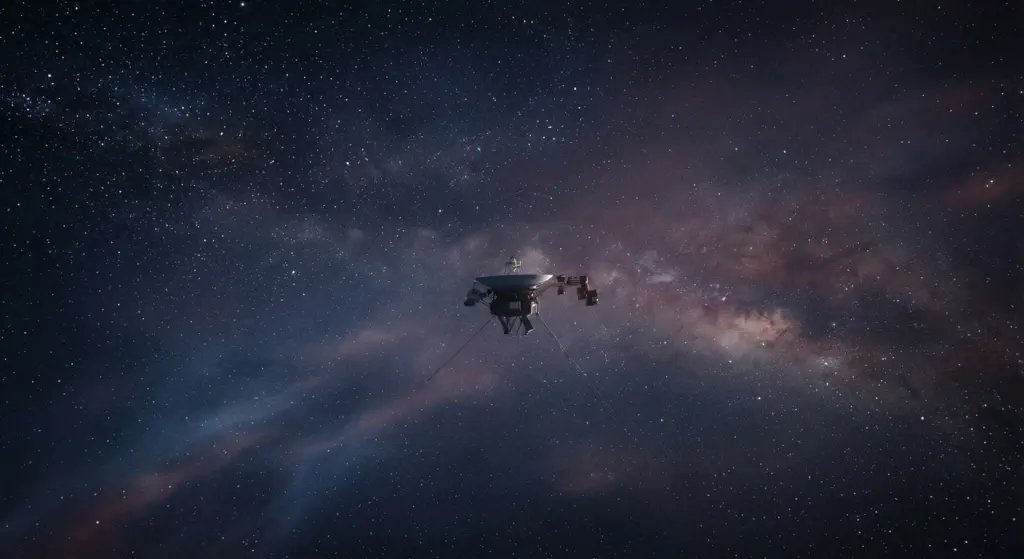
The cockpit of the Astraea smelled of cold ozone, recycled oxygen, and the faint, sweet tang of hydroponic ivy. Outside the triple-paned quartz viewport, the sun was no longer a blazing furnace of life, but a solitary, stubborn diamond—a bright white ember lost in a velvet ocean of absolute, crushing nothingness.
They had crossed it.
The invisible, magnetic fence of the heliopause, the termination shock where the solar wind finally expired against the interstellar medium, was six days behind them now. Here, the vacuum was not empty; it was heavy with the ancient, whispering dust of dead stars, waiting in the dark.
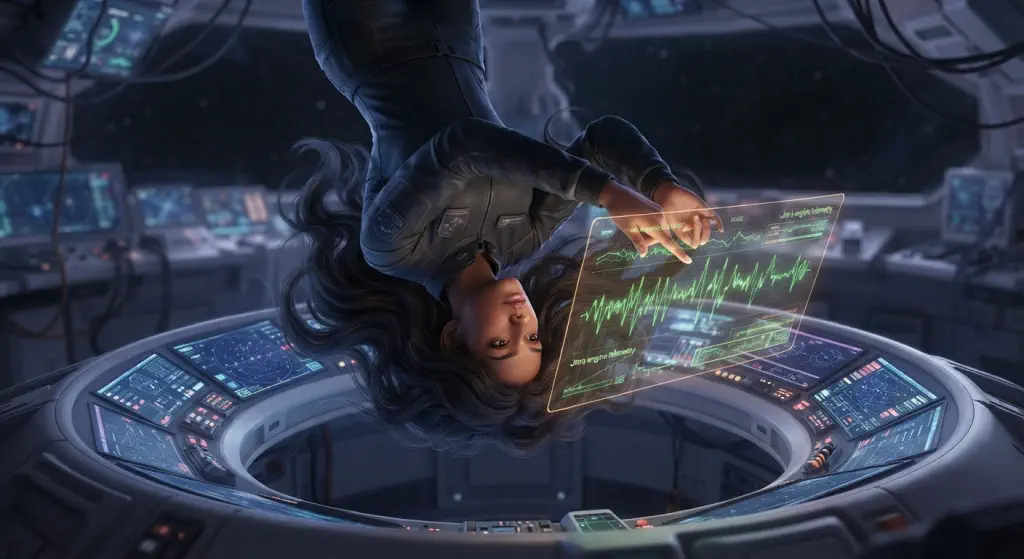
Aliya floated upside down in the zero-G of the command well, her long dark hair drifting around her face like a halo of deep-sea kelp. Her fingers danced across the secondary diagnostic screen, her eyes tracing the jagged, luminous green lines of Jim’s engine telemetry.
“Core temperature stable at absolute zero minus four,” she murmured, her voice carrying that melodic cadence Jim had known since they were seven years old, sharing a battered terminal in a primary school on the outskirts of Old Cairo. “Radiation shielding at ninety-nine point eight percent. Jim, your baby is breathing like a marathon runner.”
At the starboard console, Jim spun himself upright with a practiced push of his calloused thumb against the bulkhead. He wiped a smudge of graphite off his chin—some perpetual artifact of the engineering bay that seemed to follow him across light-hours—and offered a tired, lopsided grin.
“Don’t call it my baby,” he said, though his chest swelled with a familiar, fierce pride. “It’s our baby. You designed the magnetic funneling matrices. If those coils had hiccuped when we hit the acceleration curve, we’d currently be a very thin, very fast smear of carbon on the inner Oort cloud.”
“Details, details,” Aliya laughed, kicking off the bulkhead to float across the small cabin and gently bump her shoulder against his. “You worry too much. We always worry too much. Remember the thesis defense? You dropped your flash-drive in the dean’s coffee.”
“That was a tactical distraction,” Jim corrected deadpan. “It humanized me. Unlike you, who memorized the entire astrophysics compendium in three languages and reduced the committee to tears of existential despair.”
They fell into a comfortable silence, the kind that only two people who had shared every milestone, every ramen-fueled cram session, and every bureaucratic battle with the Global Space Council could share. They were twenty-eight years old, yet they felt simultaneously ancient and newborn.
They were the first.
The memory of that evening in Aliya’s cramped apartment flickered in Jim’s mind. The city lights below had twinkled like fallen stars through the smart-glass. Aliya had poured two glasses of synthetic wine, her eyes bright with that peculiar, terrifying brilliance that had always dragged Jim into impossible schemes.
“Why not humans?” she had asked.
The world had laughed at them at first. The committees at the research center had called them romantic fools. “Unmanned probes are cheaper,” the directors had said. “The human mind cannot handle the psychological abyss of interstellar transit without breaking.”
So Aliya and Jim had done what they always did: they weaponized their compatibility. They built a coalition of rogue engineers, sympathetic financiers, and disgruntled aerospace veterans. They proved that Jim’s pulsed-fusion plasma engine could cut transit time to the edge of the system from decades to mere months. They proved that two minds locked in absolute, symbiotic harmony could maintain cognitive stability through the crushing isolation of the deep dark.
And now, here they were. Past the frontier. Past the sign that read Here Be Dragons.
“Telemetry update from Earth,” the ship’s synthetic voice chimed, gentle and low. “Packet received via quantum-entangled relay. Delay: fourteen hours, twelve minutes.”
“Play it,” Aliya said, settling into the pilot’s couch and strapping herself in. Jim buckled in beside her, their shoulders touching.
The console flickered to life, projecting a holographic window of Mission Control. Director Vance looked older, his hair grayer, but his smile was blindingly wide.
“Astraea, this is Geneva,” Vance’s voice echoed in the tight cabin. “We have verified your passage past the heliopause. As of 0400 hours UTC, humanity has officially stepped out of the cradle. You are our children walking in the dark, and every soul on this pale blue dot is holding its breath. Godspeed, Aliya. Godspeed, Jim. Bring us back something wondrous.”
The projection winked out.
For a long moment, neither of them spoke. The enormity of the statement—every soul on Earth is holding its breath—settled over them. They weren’t just researchers anymore. They were ambassadors for a species of ape that had learned how to throw fire at the stars.
“Well,” Aliya whispered, turning her head to look at Jim. “They remember us now.”
“They’ll never forget us,” Jim replied softly. He reached out, his hand finding hers in the space between their seats, their fingers locking together with the instinctive certainty of a lifelong rhythm. “So. What’s next on the itinerary, Commander?”
Aliya grinned, her eyes reflecting the emerald green of the navigation grid. “Let’s go find out what’s making that anomalous gravitational hum in sector four.”
Chapter Two: The Ghost in the Signal
Three weeks past the boundary, the universe changed its texture.
The stars stopped looking like pinpricks of white fire and began to stretch into subtle, crystalline needles of light as the Astraea pushed deeper into the Local Interstellar Cloud. The vacuum here was denser, pregnant with invisible currents of hydrogen gas and cosmic magnetic fields that Jim’s engines drank like thirsty leviathans.
They were deep in the rhythm of deep-space life. Mornings were marked by shared coffee packets and hydroponic checks; afternoons by data analysis and system calibrations; evenings by floating chess matches where the pieces were magnetic and the rules were constantly negotiated.
Then came the anomaly.
It started as a whisper in the sensor arrays—a microscopic perturbation in the background radiation that shouldn’t have existed.
“Look at this,” Aliya said at 0200 ship time, her fingers flying across the holographic console. Her face was illuminated by a cascade of blue data streams. “It’s not a pulsar. It’s not a rogue planet. It’s… repeating.”
Jim floated into the well behind her, slipping his arms around her waist to steady himself as he peered over her shoulder. “Show me the waveform.”
Aliya tapped a command. A complex, shimmering helix of light bloomed in the center of the console. It was a mathematical sequence—not the random, chaotic noise of stellar phenomena, but a deliberate, structured cadence of prime numbers escalating in geometric progression.
“That’s an artificial signature,” Jim breathed, the hair on the back of his neck standing up. “Aliya… that’s a handshake.”
“I know,” she whispered.
For the next seventy-two hours, sleep became a distant memory. They didn’t talk much; they didn’t need to. Their thoughts moved in tandem, anticipating each other’s hypotheses before they were even spoken aloud. Aliya ran the linguistic decoding algorithms while Jim cross-referenced the gravitational vectors to pinpoint the source.
It wasn’t a ship. It wasn’t a Dyson sphere or an alien megastructure.
It was a buoy.
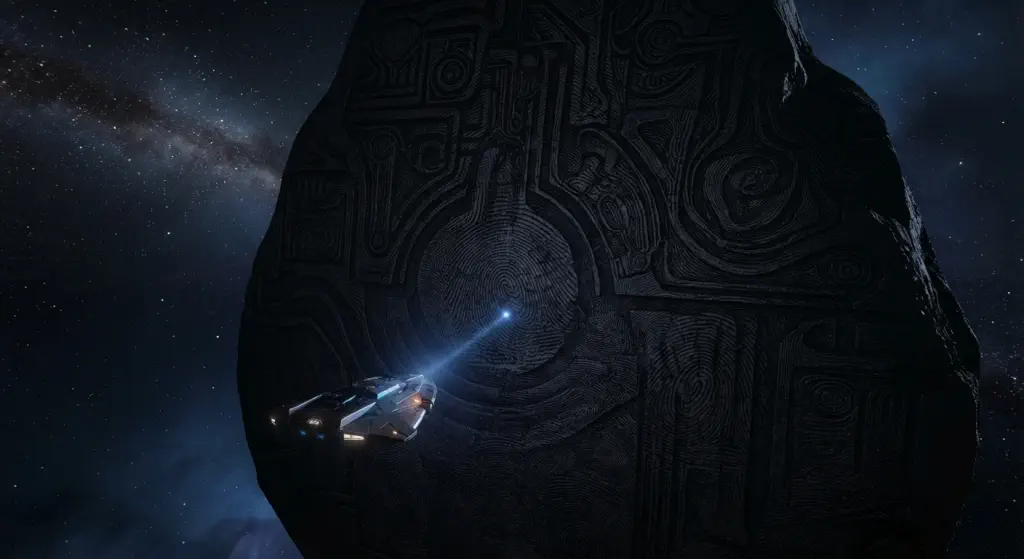
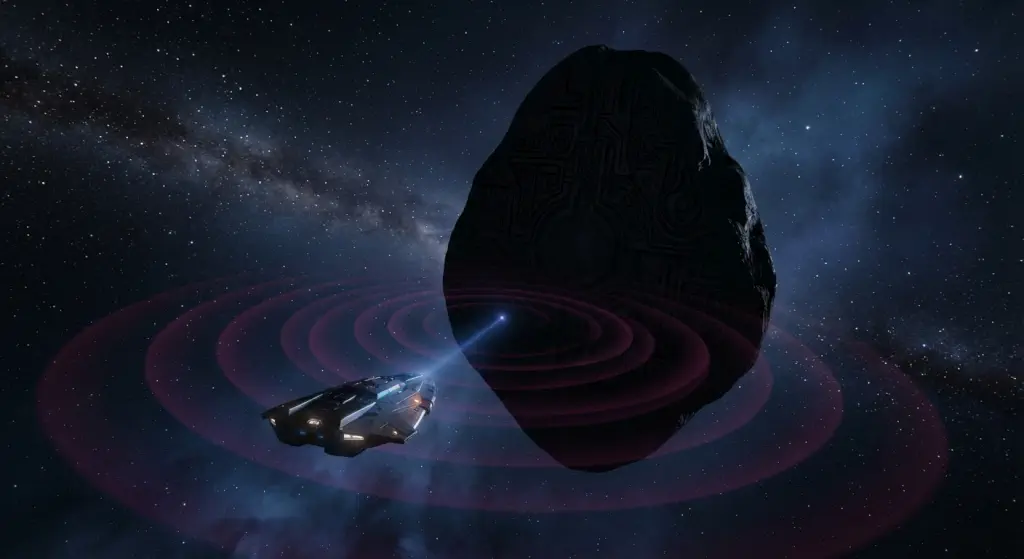
Floating in the dead space two light-weeks beyond the solar boundary lay an object the size of a mountain, carved from a material that absorbed ninety-nine point nine percent of all electromagnetic radiation. It sat silently in the void, radiating a low-frequency pulse that washed over the Astraea like a gentle tide.
“Approach vector?” Jim asked, his voice tight with a mixture of awe and profound, primal dread.
“Manual override,” Aliya said firmly. “We didn’t come this far to wave from a distance.”
The Astraea crept forward, her plasma engines throttled down to a whisper. As they drew within a kilometer of the massive, dark monolith, the ship’s exterior floodlights flared to life, casting harsh white beams across the artifact’s surface.
That was when they saw the markings.
They weren’t hieroglyphs. They weren’t digital readouts or geometric diagrams.
They were human fingerprints.
Millions of them. Etched into the dark, light-absorbing metal in a swirling, intricate mosaic that covered the entire face of the monument.
Aliya dropped her hands from the controls, her breath catching in her throat. She stared at the viewport, her reflection ghosting over the colossal expanse of the alien-human artifact. “Jim… what is this? How is this possible?”
Before Jim could answer, the ship’s primary communication array chimed—not with the delayed hiss of a radio transmission from Earth, but with a sharp, instantaneous local ping.
A localized data stream flooded their onboard terminal, bypassing encryption, bypassing security protocols, and projecting a holographic interface directly into the center of the command well.
It wasn’t an alien voice.
It was a voice they had heard in history vids, a voice from the early days of the space program, a voice that had been dead for over two centuries.
“Hello, travelers,” the voice said. It was smooth, calm, carrying the distinct cadence of an ancient broadcast.
The hologram materialized above the console. It wasn’t a gray alien or a terrifying biomechanical entity.
It was a glowing, translucent globe of Earth, surrounded by a swirling spiral of DNA and mathematical equations that matched the exact architecture of Jim’s engine design. And woven into the light of the globe were the faces of billions of people—not just living ones, but every human soul that had ever looked up at the night sky and wondered if they were alone.
“If you are hearing this,” the voice continued, “you have crossed the boundary. You have proven that the children of Earth are no longer content to sleep in the nursery. But you must understand: you did not build those engines alone.”
Jim and Aliya exchanged a terrified, disbelieving glance.
“Who…” Jim started, his throat dry. “Who is that?”
The holographic globe shifted, zooming in past the orbit of Mars, past the asteroid belt, past the outer planets, down into the deep, forgotten archives of the human subconscious—and into a reality that history books had neatly glossed over.
Chapter Three: The Architects of the Path
The holographic narrative unfolded with terrifying clarity.
It wasn’t a story of first contact with an alien civilization coming down from the stars in flying saucers. It was something far stranger, far more intimate.
The data stream revealed that humanity’s technological leaps—the sudden, inexplicable breakthroughs in quantum mechanics during the late twentieth century, the miraculous stabilization of fusion plasma in the twenty-first, the intuitive leaps in space-time mathematics that Jim had spent his entire life studying—had not originated purely from human trial and error.
Millennia ago, an ancient exploratory probe from a civilization on the other side of the galaxy had passed through the solar system. It hadn’t landed. It hadn’t invaded. It had simply observed a restless, violent, brilliant species of apes clinging to a mudball, staring up at the dark.
And it had left a seed.
Not a physical organism, but a cosmic catalyst—an invisible, dormant library of quantum data embedded in the background radiation of the local system, subtly whispering inspiration into the minds of those species members who were listening closely enough.
Aliya’s hand flew to her mouth. “We… we didn’t invent the equations on our own?”
“You did,” the ancient voice corrected gently, as if reading her thoughts through the quantum link. “Inspiration is not creation; it is translation. The universe is a song, and you simply learned how to sing the notes. Every engineer who ever stared at a schematic, every astronomer who ever stared into a telescope, every dreamer who ever looked at the stars and felt a tug in their chest—they were all tuning instruments for this exact moment.”
The monolith outside the viewport pulsed with a brilliant, blinding wave of golden light.
Across the surface of the dark metal, the millions of etched fingerprints began to glow. They weren’t just fingerprints of dead ancestors; as Aliya watched in stunned silence, new prints began to appear, shimmering into existence on the alloy.
Her own index finger. Jim’s thumb.
They were being logged. Not as conquered subjects, not as experimental specimens, but as the latest links in an unbroken, galaxy-spanning chain of explorers.
“Jim,” Aliya whispered, tears finally breaking free and floating away from her face like tiny, glittering pearls in the zero gravity. “We aren’t the first ones out here. But we’re… we’re the ones who closed the loop.”
Jim didn’t answer immediately. His eyes were fixed on the holographic display, where a new set of coordinates was unfolding—not pointing backward toward the solar system, but pointing further outward, deep into the uncharted spiral arms of the Orion spur.
A map. A road-map of the galaxy, dotted with thousands of similar monoliths, each one marking the threshold where a young, ambitious species finally grew up, stepped out of its cradle, and joined the cosmic conversation.
“The committee back home,” Jim said, a slow, wonder-filled smile breaking across his face. “They thought we were looking for answers to cosmic mysteries.”
“And we found them,” Aliya said, her voice steadying as the fear washed away, replaced by an intoxicating, overwhelming surge of purpose. She reached out and grasped Jim’s hand tighter. “The mystery wasn’t out there in the dark, Jim. The mystery was us.”
Chapter Four: The New Horizon
Fourteen hours later, the delayed transmission from Earth arrived at the Astraea.
Director Vance’s face appeared on the secondary screen, looking bewildered and frantic. Mission Control was in an uproar in the background; alarms were chiming, technicians were running past in the blur of the holographic feed.
“Astraea, do you copy?” Vance’s voice crackled with panic. “We are picking up an anomalous energy signature from your coordinates—the entire Oort cloud is lighting up like a Christmas tree. What the hell is out there? Report!”
Aliya and Jim floated side by side in front of the primary camera. They didn’t look like two tired researchers anymore. Their faces were flushed with the quiet, incandescent radiance of people who had seen the face of eternity and found it smiling back at them.
Aliya looked at the camera, then glanced sideways at Jim. He gave her a small, knowing nod.
“Director Vance,” Aliya said, her voice calm, clear, and ringing with absolute certainty. “Tell the Council to cancel the return trajectory.”
There was a stunned silence on the other end of the line.
“Cancel… cancel it?” Vance stammered. “Aliya, have you lost your minds? You’re past the boundary! You have enough fuel for a flyby, but—”
“We aren’t coming back,” Jim interrupted, leaning into the frame with a wide, brilliant grin. “Not yet, anyway. We found something out here, Vance. A door. And it turns out it’s unlocked from the inside.”
“Tell everyone on Earth to look up tonight,” Aliya added, her eyes shining with unshed tears of joy. “Tell them they aren’t alone. Tell them the neighborhood is a lot bigger than they thought.”
Without waiting for Vance’s frantic reply, Aliya reached out and flipped the master transmission switch from local relay to deep-space broadcast.
The Astraea’s pulsed-fusion engines flared to life—not with the harsh, sputtering roar of human technology, but with a smooth, resonant hum that vibrated through the very hull of the ship, harmonizing with the ancient pulse of the monolith outside.
Through the viewport, the dark monolith parted. A corridor of pure, golden light opened in the vacuum of space—a gateway woven from quantum data, starlight, and the collective dreams of a billion species across the cosmos.
Jim’s hand found Aliya’s one last time. Their fingers intertwined, perfectly matched, perfectly balanced.
“Ready?” he asked softly.
“Always,” she replied. The Astraea surged forward, slipping gracefully through the threshold and into the infinite, star-strewn ocean of the universe, leaving the cradle far behind, and stepping out into the dawn of a new human story.