100
Chapter I: The Horizon is Emptiness
The Boeing 747-8 Intercontinental , Flight 221, simply called “The Monotony” in the schedules, was filled almost to capacity – four hundred and sixty-seven people, mostly middle-class tourists and business travelers. They were ordinary atoms of global connectivity, flying across the largest and most indifferent space on the planet – the Pacific Ocean. Above them was the great, light blue nothingness, and below them – the great, black nothingness. The perfect canvas for surrealism.
Inside this hermetic ellipse of civilization, five people floated, encapsulated in their own microcosms. They didn’t know each other, they had never met eyes, but they were connected by something that anyone would dismiss as a statistical fallacy. Something that echoed across time and space.
The first was Isaac Vanderbilt , seated in Business Class on the upper deck. He was a taut man of about forty, his fine wool suit catching the light from the window. When he raised his hand to touch his lapel, the small pearl pin, in the shape of a barely noticeable, asymmetrical octahedron , sharply reflected the cool blue glow of his sleeping neighbor’s screen. Isaac was born in the United States, but he felt the distance of his Estonian roots—their vast, gray-and-white aesthetic of wastelands.
The second, Elizabeth “Liz” Campbell, was a middle-aged journalist sitting in the economy section. She was completely focused on the hand-embroidered cherry-red cover of her old-fashioned notebook. Liz was of Irish descent, and her single, massive silver ring with a rough-cut amethyst turned out to be exactly the same as the one worn by one of the flight attendants on the lower deck—again, just a coincidence. She smiled slightly and closed her eyes.
The third, Arianna Kostakis , 26, whose small stature and black hair made her almost invisible by the window. She was listening to music and browsing photos on her Android phone—the perfect illusion of idleness. Although she was born in the United States, her Greek roots drew her to ancient, monochrome geometry. Her visible connection: the small tattoo on the inside of her wrist—a single, perfectly round, black dot.
The fourth was Diego Silva, a man who looked older than his years, with a perpetually worried expression. Diego was a software engineer whose parents were from Mexico. He obsessively read technical specifications on his laptop while the others slept. His connection was absurdly inconspicuous—each of the five keys on his keyboard that he used most often (S, P, A, C, E) had a faint, almost fluorescent, light blue scratch in the upper left corner.
The fifth was Mina Lee, a quiet woman in her late thirties. She was an architect whose parents were from South Korea, the country they were flying to. Mina was dressed in minimalist gray, but on her wrist was a thick light gray rawhide bracelet. She tried to sleep, but there was more than just fatigue in her eyes. Her connection: in her handbag was an old-fashioned silver coin with a faded relief on the back—the same one that had been engraved on Isaac’s pearl needle.
They were the five who didn’t know each other, but they were the five keys to the tension that was brewing.
For hours, the transatlantic flight was the epitome of routine safety. Passengers slept or watched movies, meals were served, lights dimmed to a soft, grayish twilight. The cockpit maintained Zero Deviation Protocol —perfectly straight, perfect altitude. At this point, the flight was boring, which was the best compliment to a trip at 40,000 feet.
Then it happened.
In that infinite void, above the symmetrical horizon of the Pacific Ocean, where nothing should have happened except the movement of air masses, the Boeing 747-8 Intercontinental – with its 467 people and tons of fuel – DISAPPEARED.
On the military and civilian radars of the United States, Japan, and South Korea, which constantly monitor this strategic corridor, the dot suddenly ceased to exist. Not gradually. Not with a distress alert. Just ZERO.
The last signal was clear, strong, and flawless, showing precise location, speed, and altitude. The next radar cycle – nothing.
NASA and intelligence satellite images, which would later be classified under the strictest code, showed exactly that: A huge plane flying over the ocean, and in the next image (a split-second interval) – nothing. No turn, no explosion, no carbon particles from fuel, no debris. It was as if it had never been there.
Inside the machine, the passengers were blissfully unaware – most were asleep, enveloped in the gray twilight.
The plane had disappeared.
Chapter II: Seven Hours of Silence
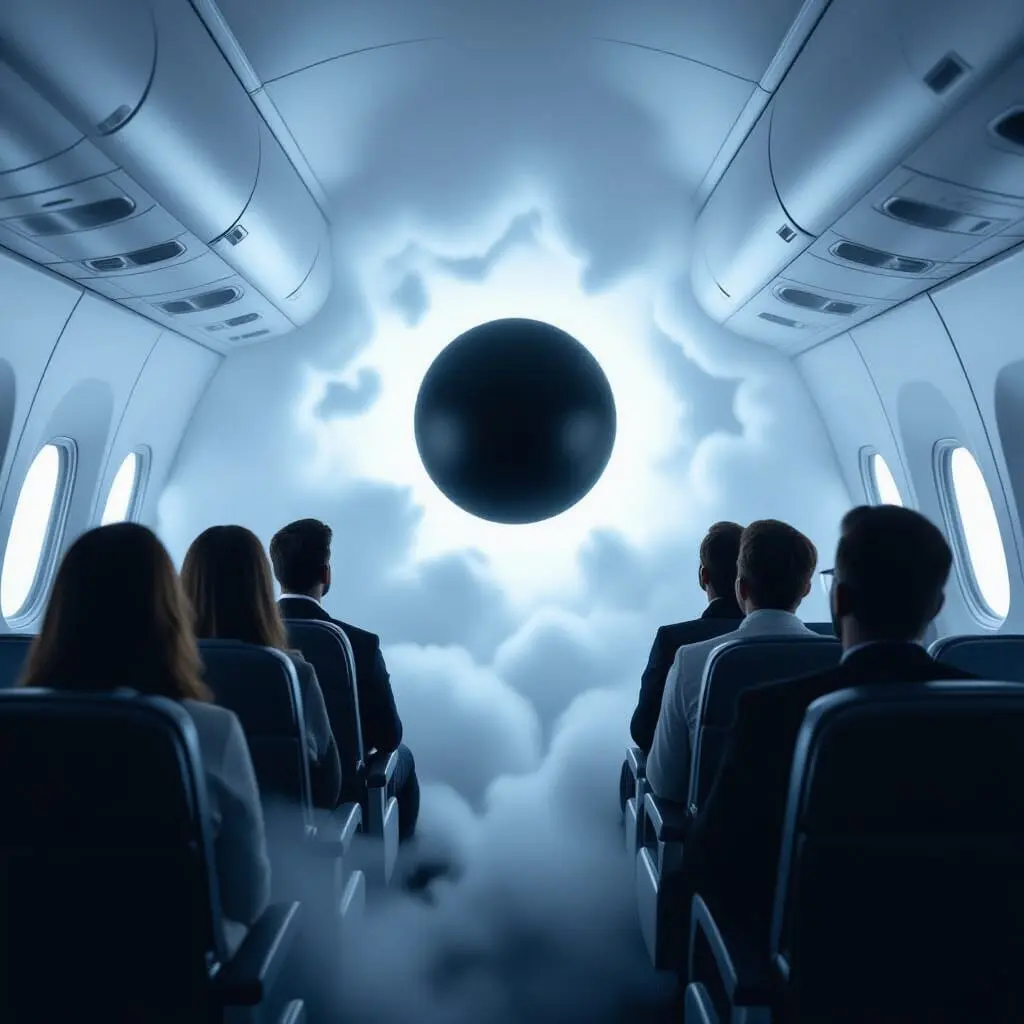
The absolute, sterile White outside the windows lasted only a human breath, but to the senses of the five awake ones—Isaac, Liz, Ariana, Diego, and Mina—it stretched into eternity. The black sphere hanging in that ethereal nothingness was not an object; it was a focal point.
The first to speak was Diego Silva, but not his voice, but the code on Ariana’s laptop. She was repeating aloud the archaic lines: “IF (EXISTENCE == TRUE) THEN (SILENCE == ZERO)” . Diego looked at her with a technical, almost surrealistic fever:
“This is a reverse protocol. Reverse. It means that if existence is there, then silence does not exist. But we are in zero silence. Therefore… we do not exist. Or at least – here and now – our definition of existence does not apply.”
At that moment, the three other nationalities – Liz Campbell (Ireland), Ariana Costakis (Greece) and Mina Lee (Korea) – closed their eyes. Not from fatigue, but as if some gentle but irrevocable force had triggered a memory recall button .
Liz Campbell, with her cherry-red case and blank notebook, found herself not on a plane but in a large, gray-and-white space that reminded her of the winter fields of her ancestors. Before her stood the image of her grandfather, who had loved minimalism and silence. He did not speak with his lips. His voice sounded directly into her mind, devoid of emotion but filled with gravitational weight: “Liz, you have been noticed. You have been chosen for your noise, but we seek your silence. We are here only to convey one fact. Hear me now.”
Arianna Kostakis was transported to a perfectly round, monochrome room of white marble that echoed her Greek roots. In front of her stood her grandmother, dressed in gray and black. The grandmother reached out and touched Arianna’s tattoo—the round black dot. “Ariana, don’t be afraid of the big space. You are not alone. Your loneliness is the strongest signal you give off. We are here to tell you that you are not alone. And we will connect again.”
Mina Lee saw an endless, light blue landscape—like the pure vision of her father, an architect. She stood beside him as he pointed to four horizontal, perfectly straight lines in the sky. “Mina, they see you—the five of you—as all the races of Earth. They are here to give hope. Remember this: You are not alone. You never were.
Isaac Vanderbilt and Diego Silva, who had not been selected for direct contact, sat as if paralyzed. Isaac watched the pearl octahedron on his lapel pulse with a faint light blue light, and Diego saw the scratches on his keyboard emit a faint, muffled heat. They could not hear the words, but they could feel the communication.
After those seven hours (which felt like 5 minutes to them – an absurd experience of time), the three women opened their eyes. There was no change in the plane. The passengers were sleeping. The flight attendants were standing. The Ethereal White had once again been replaced by the plain, deep blue of the Pacific Ocean, and the black sphere had disappeared.
5 seconds on Earth had passed.
Liz Campbell immediately reached for her laptop, which was on the table. She opened it. The battery, which had been at 100% before she fell asleep, now showed 30% charge. The evidence the aliens had left behind was physics.
Chapter III: Geometry of the Accusation
The return was unceremonious. In that very split second that the plane reappeared on radar, the Ethereal White collapsed, replaced by the familiar, echoing roar of the engines. The passengers stirred in their seats, as if waking from a very deep sleep. The five heroes were the only ones who knew that they had not slept, but had traveled for seven hours, erased by time.
Mina Lee opened her eyes, hearing her father’s last words ringing in her mind like an epitaph : “You will walk this path and we will contact you when you are ready and more confident.”
The landing at Incheon Airport, Seoul, was tense and devoid of any routine. The plane was isolated immediately. There was no panic among the passengers, who were only aware of a five-second delay in traffic. But for the authorities, the incident was a catastrophic anomaly.
The next few hours were spent in interrogations conducted by a military-intelligence coalition from the three countries involved. Our five heroes were separated and subjected to humiliating psychological pressure.
Isaac Vanderbilt , with his pearl octahedron , was questioned about his Russian influence and technological sabotage. Diego Silva had to explain the light blue scratches on his keyboard – were they a coded key?
The three who had received the message were subjected to the greatest test.
“You’ve made a deal, Mrs. Campbell!” a uniformed officer shouted at Liz. “You’re a journalist. This is a script prepared by you and funded by an unknown force to sow chaos!”
Liz, who held the cherry-red cover of her notebook (now filled only with the word “Protocol”) in her hand, replied with exhausted but iron logic: “There is no logic, Colonel. I am completely innocent. But my laptop, which is an American, unmodified product, shows 30% battery after a 5-second disappearance. Where did the energy for 70% go? What worked for 7 hours in 5 seconds?”
No one could answer. The military dismissed the battery as a “technical error.” They dismissed their synchronous disappearance as an “incredible coincidence.”
But the real key was far from the interrogation room, in a highly secured room at the airport.
Standing in front of a black monitor was Peter Stenson , a high-ranking airline security official whose sole privilege was a direct line to the White House. Next to him stood the Chief Investigator.
Stenson was holding the phone. His face was ashen.
“I understand, sir. Yes, five seconds is a technical error. I also said that it is impossible for such a trip to happen. There is no collision. There is no damage. Everything is fine, everything is fine on the Boeing .”
He paused, his voice barely audible, reduced to a whisper that traveled lonely through the fiber optic cable.
“I just don’t understand, sir, how this nothingness that happened within 5 seconds managed to make the black box record 7 hours of absolute, sterile Silence.”
Stenson hung up the phone. On the screen in front of him, on the black box graph, there was a horizontal, perfectly straight line for 7 hours—Zero Noise. He looked up at the ceiling, where he knew there was only a large, empty, gray space.