100
2030, for humanity, it will turn out to be a year unlike any other. A major social and information shift has changed the world around people, their consciousness and, as a result, their psyche. The digital revolution has given rise to a new reality, which, of course, gives rise to new conditions for socializing, new mental processes and loads on the human psyche. The social context of human life has changed rapidly in the 21st century, even in comparison with the stable socio-economic situation in which the major psychological theories of the 20th century were formed and verified. In connection with the collapse of what is currently known, one can only wonder if the so-called “science of psychology” will still be able to explain or provide an approach to new characteristics of a person’s personality and his behavior. Or maybe this science is being obstinately played out and is no longer relevant?
The foundations of modern psychology were largely established in an era when technology played a more limited role in human experience. Freudian psychoanalysis emerged before the advent of television; Skinner’s behaviorism preceded personal computing; humanistic psychology developed before the internet became ubiquitous. These theories were revolutionary in their time, providing profound insights into human cognition, behavior, and emotional development. However, they were inevitably products of their era, built upon observations of humans navigating relatively stable social environments with technological changes that unfolded across generations rather than months.
Today, we face a striking dichotomy. Traditional psychological frameworks continue to offer valuable perspectives on certain aspects of human functioning that remain constant—the need for connection, the search for meaning, the processing of emotional experiences. Yet these same frameworks often struggle to account for distinctly modern phenomena: digital identity formation, the psychological impact of constant connectivity, the blurring boundaries between physical and virtual reality, and the cognitive effects of information overload. The temporal assumptions embedded in many psychological theories—about how humans form attachments, develop attention spans, or construct narratives about themselves—are increasingly challenged by the accelerated pace of technological change.
Particularly notable is the disconnect between traditional developmental psychology and the experiences of digital natives. Theories that presumed a certain sequence of cognitive and social milestones now confront children who interact with artificial intelligence before mastering human conversation, adolescents who navigate complex online social dynamics alongside physical ones, and adults whose sense of self is distributed across multiple digital platforms. The fundamental psychological processes may remain similar, but their expression and pathways have transformed dramatically.
Despite the challenges, psychology’s methodological toolkit offers invaluable approaches for understanding the impact of technological change. Longitudinal studies tracking cognitive and social development in digital environments have begun documenting the emergence of new psychological adaptations. These include distributed attention patterns optimized for multiple information streams, social cognition specialized for asynchronous and text-based communication, and memory systems externalized to digital devices.
Neuropsychological research has revealed both concerning and promising changes in brain development associated with technology use. While some studies indicate potential reductions in certain forms of deep processing and sustained attention, others suggest enhanced visual-spatial processing, improved task-switching abilities, and new forms of working memory organization. The brain’s neuroplasticity—a concept central to modern psychology—enables adaptation to technological environments, though not always in ways that optimize well-being or traditional measures of cognitive function.
Social psychology has been particularly valuable in understanding the transformation of human interaction. Studies of online community formation, digital social comparison, and technology-mediated empathy reveal both continuities and divergences from pre-digital social processes. The psychological mechanisms underlying social contagion, group polarization, and identity formation remain operational but manifest differently in digital contexts—often with amplified effects due to the scale and speed of online networks.
Perhaps most importantly, health psychology and clinical research have begun documenting entirely new psychological conditions related to technology use: internet gaming disorder, social media anxiety, digital hoarding behaviors, and technology-mediated dissociative states. These emerging phenomena demand new diagnostic approaches and interventions that traditional clinical frameworks may be ill-equipped to address.
Rather than wholesale abandonment, many psychological theories require thoughtful reevaluation and expansion to remain relevant. Attachment theory, for instance, maintains its core insights about the importance of secure relationships for psychological development, but must now account for attachment patterns formed through digital interaction, including attachments to AI entities with human-like characteristics. Children in 2030 may develop significant attachments to consistent AI presences in their lives, raising new questions about the nature and consequences of such bonds.
Similarly, cognitive psychology’s understanding of attention, memory, and problem-solving remains foundational, but requires updating to account for the externalization of cognitive processes to technological systems. When artificial intelligence handles increasing portions of human cognitive load, how does this reshape internal cognitive architecture? The concept of extended cognition—where thinking processes span brain, body, and technological environment—becomes increasingly central rather than peripheral to understanding human psychology.
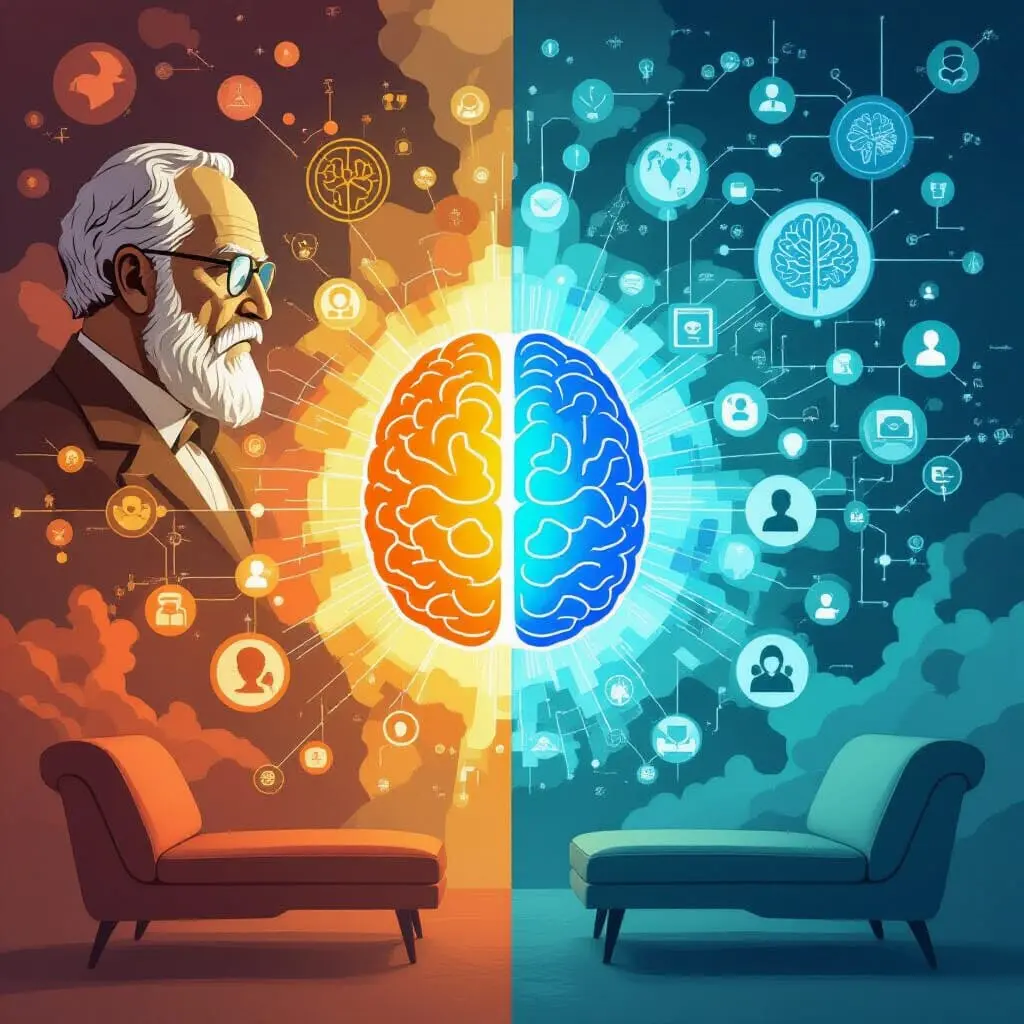
Even psychoanalytic concepts find new relevance when reconsidered. The unconscious takes on new dimensions when algorithms predict our desires before we consciously recognize them ourselves. Defense mechanisms manifest in novel ways when digital environments allow unprecedented control over self-presentation and social interaction. Projection, displacement, and sublimation occur across physical and virtual domains, creating complex psychological dynamics that traditional formulations couldn’t anticipate.
Behavioral theories require particular reconsideration as reward schedules in digital environments are engineered with unprecedented precision. Variable reinforcement patterns in social media, gaming, and other digital platforms create behavioral dependencies that classical conditioning models recognize but weren’t designed to address at their current scale and sophistication. The understanding of operant conditioning must expand to account for algorithmic reinforcement systems that adapt in real-time to maximize engagement.
Psychology faces formidable methodological challenges in studying contemporary human behavior. The accelerating pace of technological change means that by the time rigorous longitudinal studies are completed, the digital environments they examined have often transformed significantly. This creates a persistent lag between psychological understanding and technological reality, with research conclusions sometimes obsolete before they’re published.
Ethical frameworks for psychological research, developed for studying behavior in physical environments, struggle to address the complexities of digital contexts. Questions about informed consent, privacy expectations, and risk assessment become considerably more complex when research involves digital trace data, algorithmic interventions, or virtual environments. Institutional review processes designed for traditional psychological experiments often fail to adequately evaluate the ethical dimensions of research in technological contexts.
Measurement validity presents another significant challenge. Traditional psychological constructs like intelligence, personality traits, attention, and social connection require reconceptualization when expressed in digital environments. Does social media popularity reflect the same psychological constructs as popularity in physical social settings? Do problem-solving skills in virtual environments translate to real-world cognitive abilities? The psychometric tools developed for 20th-century humans may not capture the psychological reality of individuals whose lives span physical and digital domains.
Perhaps most fundamentally, psychology faces a challenge of theoretical integration. The field must develop frameworks that coherently connect traditional understanding of human psychology with the novel features of technologically mediated experience. This integration cannot simply append digital considerations to existing theories but must reconceptualize fundamental assumptions about the boundaries of the self, the nature of social interaction, and the processes of cognitive and emotional development.
Artificial intelligence isn’t merely changing the subjects of psychological study—it’s transforming the discipline itself. AI-powered research tools enable analysis of psychological data at unprecedented scales, from natural language processing of therapy transcripts to computer vision analysis of facial expressions and body language. These capabilities allow detection of patterns beyond human perceptual capabilities, potentially revealing psychological processes that traditional methods couldn’t observe.
More profoundly, AI is increasingly serving as both collaborator and competitor in psychological practice. Therapeutic AI applications provide accessible mental health support, sometimes demonstrating effectiveness comparable to human therapists for certain conditions. Advanced diagnostic algorithms often outperform human clinicians in detecting patterns indicative of psychological disorders from speech, writing, and behavioral data. These developments challenge traditional boundaries of psychological practice and raise questions about the unique value of human psychological expertise.
AI also presents psychology with novel research questions about human-machine interaction. As AI systems become more sophisticated in mimicking human communication and emotional expression, psychology must develop frameworks for understanding how humans form relationships with non-human entities. The emergence of parasocial attachments to virtual influencers, emotional connections to conversational AI, and social responses to humanoid robots all demand psychological explanation.
Perhaps most intriguingly, AI development is increasingly informed by psychological theory while simultaneously informing it. Cognitive architectures inspired by human psychology drive AI design, while observations of AI learning processes provide new metaphors for understanding human cognition. This reciprocal relationship creates a feedback loop where psychological understanding and artificial intelligence co-evolve, each reshaping the other in ways that earlier psychological theorists could never have anticipated.
New personality characteristics are emerging in response to technological environments—digital natives display traits that didn’t exist or weren’t measurable in previous generations. These include variations in attention distribution capacity, tolerance for context-switching, comfort with human-AI collaboration, and aptitude for managing multiple identity presentations across platforms. Traditional personality assessment frameworks like the Five-Factor Model remain useful but increasingly insufficient to capture these emerging dimensions of human variance.
Clinical psychology faces particular pressure to adapt its diagnostic categories and treatment approaches. The Diagnostic and Statistical Manual, once revised generationally, now requires more frequent updates to address technology-related conditions. These range from problematic internet use patterns to the psychological consequences of immersive virtual reality exposure, from algorithm dependency to digital relationship addictions. Treatment protocols must similarly evolve, incorporating technological tools while addressing the unique challenges of psychological distress in digital contexts.
Developmental psychology must reconsider its milestones and trajectories to account for children growing up with AI companions, augmented reality educational tools, and social media presence from early ages. The sequence and timing of cognitive, social, and emotional development no longer follows the patterns documented in 20th-century research, requiring new developmental models that acknowledge the role of technology in shaping psychological growth.
Occupational psychology perhaps faces the most immediate practical challenges, as AI and automation transform the workplace faster than workers can adapt. The psychological demands of continuous retraining, human-AI collaboration, remote work, and technological displacement create new forms of occupational stress and identity disruption. Psychological approaches to career counseling, work-life balance, and occupational health must rapidly evolve to address these emerging realities.
The relationship between traditional psychological theories and our technology-transformed reality in 2030 is neither one of complete obsolescence nor seamless continuity. Rather, we find ourselves in a period of accelerated theoretical evolution, where psychology’s core insights about human functioning retain value but require substantial reframing and expansion. The fundamental psychological needs for connection, meaning, competence, and autonomy remain constant, but the contexts in which these needs are expressed and satisfied have transformed dramatically.
Psychology’s path forward lies not in abandoning its theoretical foundations but in critically examining their assumptions, extending their frameworks to new domains, and complementing them with emerging understandings of human-technology interaction. The discipline must embrace methodological innovation, interdisciplinary collaboration, and theoretical flexibility while maintaining its central commitment to understanding the human mind in all its contexts—now including digital and AI-mediated environments.
Ultimately, the question is not whether psychology as a science is adequate for our changing world, but whether psychologists can adapt their approaches with sufficient speed and creativity to keep pace with technological transformation. The most promising developments come from those who neither cling dogmatically to traditional formulations nor rush to replace them entirely, but instead engage in thoughtful integration of established psychological wisdom with emerging insights about human experience in a technology-saturated world. In this integration lies the future of a psychology that remains relevant, rigorous, and responsive to the unprecedented psychological landscape of the 21st century.