100
The Quest to Touch the Depths of the Earth
In the twilight of the 21st century, humanity has long gazed at the stars, dreaming of extraterrestrial life. Yet, in 2090, a team of scientists, engineers, and volunteers set their sights – and their submarines – down to Earth’s most uncharted frontier: the Challenger. Deep , the abyss of the Mariana Trench. For more than a century, this trench has remained a mystery, its depths absorbing light, sound, and hope. But with advances in quantum-proof materials, AI-driven navigation, and bio-sustainable energy, the impossible has become possible.
On a crisp autumn morning, ” Abyssal Voyager , a titanium and graphene submarine the size of a school bus, launched from the Nereus research vessel Prime . On board were five people, each carrying a life filled with ambition, sorrow, and wonder. What they discovered 36,000 feet below the surface would rewrite humanity’s understanding of life, intelligence, and its place in the cosmos.
The Descent
” Abyssal” Voyager was a marvel of 21st-century engineering. Its dome-shaped observation deck, protected by a transparent nanoceramic alloy, glowed dimly in the submersible’s artificial light as it began its descent. Lead marine biologist Dr. Elena Maris, a woman whose career had been defined by the study of extremophiles , watched the external cameras with bated breath. Next to her, Captain Jackson Reed, a former astronaut turned deep-sea pilot, adjusted the engines to maintain balance against the crushing pressure.
“Seven kilometers down,” Jackson announced in an even voice. “Pressure 700 atmospheres. Systems are nominal.”
The crew also included Ayana Okoro , a bioengineer specializing in deep-sea robotics; Luca Moro, a volunteer whose brother had died in a failed expedition in 2075; and Dr. Raj Patel, an astrobiologist who believed the ocean could hold the key to extraterrestrial life.
As the sunlight faded, the sub’s LED spotlights cut through the black void, revealing familiar sights: bioluminescent jellyfish pulsing like living lanterns, anglerfish with dagger-like teeth, and fields of hydrothermal vents spewing mineral-rich plumes. Yet as they descended beyond the satellites’ reach, the world became increasingly strange.
“Are these… lines ?” Ayana muttered , pointing at the sonar. “It’s not geological. It’s… structured.”
Dr. Patel leaned closer. “It could be a natural formation, but I’ve never seen anything like it.”
Hours later, when ” Abyssal Voyager ” approached the bottom of Challenger” Deep , the submarine shook violently. “Seismic activity?” Jackson asked.
“No,” Dr. Maris whispered. ” It’s something else . Like… a buzzing.”
The crew’s headphones filled with a low, resonant frequency, neither sound nor vibration, but a feeling – a deep, primal call . The submarine’s artificial intelligence, AEGIS, fell silent for three seconds before restarting.
“Unidentified energy signature,” AEGIS recited. “Origin: Directly below.”
The Discovery
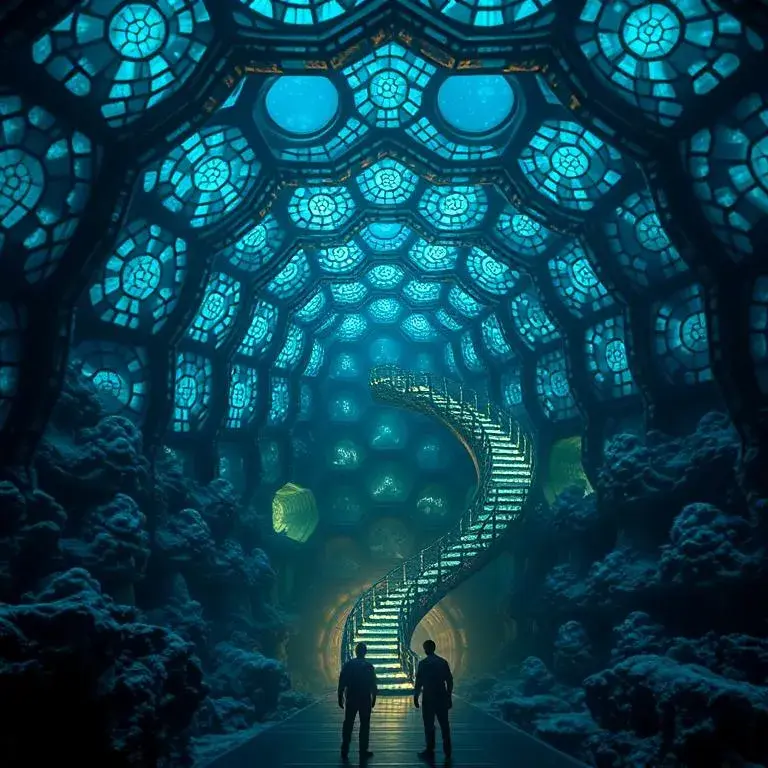
As the sub touched the ocean floor, the crew saw something that defied logic. Ahead of them stretched a colossal, spiraling structure, its surface a moving mosaic of iridescent blues and greens. It looked like a coral reef, but its symmetry was undeniable: hexagonal chambers, spiral staircases of bioluminescent tentacles, and arches that seemed to ripple like water.
“It’s… alive,” Ayana sighed .
Dr. Patel’s instruments revealed that the structure was made of a hybrid material—part organic, part crystalline. Tiny organisms, no bigger than a grain of sand, swarmed across its surface, feeding the whole with energy, much like neurons working in the brain.
“This is a living network ,” Dr. Maris said. “A neural network. This is not just a structure. This is a body .”
As if in response, the structure glowed brightly. The humming grew louder and the submarine’s systems flickered. Suddenly, the lights went out, and the crew was plunged into darkness—except for the structure, which now glowed in intricate fractal patterns resembling a tongue.
Ayana gasped. “It answers us.”
First Contact
The patterns on the structure began to change, forming images in the crew’s visors—a kind of projection. They saw visions: a planet covered in ocean, ancient civilizations rising and setting, and a great migration of life forms to the stars. But the central theme was Earth. The “voice” of the ocean showed them time-lapse footage of warming waters, coral bleaching, and plastic-choked currents. Yet, interwoven with these tragedies were moments of hope: wind farms, reforestation, and a child planting a mangrove sapling.
Dr. Patel turned to the others. “This is not just observation. It remembers . This consciousness has been here since before humanity.”
The creature—dubbed Leviathan by the crew—was not a god, but a guardian. A collective intelligence born from the fusion of microbial life, ancient alien spores, and the Earth’s magnetic field. It had lain dormant for millennia, awakening only when human technology was able to reach its depths.
“They are testing us ,” Luka whispered, his voice trembling. “They want to know whether we will destroy or protect.”
The Dilemma
The crew faced an impossible choice. Sharing their findings could spark a global scientific revolution, but risked being exploited by corporations or the military. Yet silence meant keeping a cosmic secret from a world already on the brink of ecological collapse.
“We have to tell them,” Dr. Maris argued. “The ocean is dying. If people know the Leviathan exists, they will fight to save it.”
“But if we can’t defend this place, it will be taken over by dredgers and warships,” Jackson objected.
Ayana had a third idea. Using the submarine’s bioengineered drones , she proposed creating a synthetic “echo” of the Leviathan signal—a version of consciousness that could be shared with humanity without revealing its physical location.
This was risky. If the drones could replicate the fractal patterns, the world could learn about Leviathan’s wisdom without putting it in danger. Otherwise, the submarine’s systems could collapse, leaving them stranded in the dark.
They did it.
The Ascent
As Abyssal Voyager began its return journey, Leviathan’s light faded, but not before imprinting one final vision: Earth as it could be—waters teeming with life, skies free of smog, cities in harmony with nature .
Back on Nereus Prime , the crew fell silent. The world would know soon enough; the drone data was already being decoded by scientists on the surface.
Years later, Leviathan’s echoes became the basis for Project Gaia , a global initiative to heal the oceans. Its fractal patterns inspired sustainable architecture, while its language of balance and interdependence changed humanity’s approach to technology and ethics.
But for Dr. Maris and her team, the biggest mystery remained. During their final moments aboard Challenger Deep , the Leviathan showed them a final, fleeting image: a second structure, even deeper – in a place where light had never reached.
Conclusion: A New Dawn
The year 2090 marked more than a technological triumph. It was a moment of reckoning, a reminder that Earth’s ultimate limits lie not just in space, but in the depths of our own planet. Leviathan’s gift was not dominance, but humility. To coexist with an intelligence that predates humanity is to accept a sacred responsibility: to protect the fragile, luminous thread of life that connects us all.
As Dr. Maris later wrote in his memoirs: “We did not bridge the chasm. We listened – and in return it gave us a future.”
Author’s Note: This story combines speculative science with a call for environmental conservation. While Leviathan is a fictional creature, the real challenges facing ocean conservation are urgent. May the echo of the abyss inspire us to protect the wonders still hidden beneath the waves.