100
In the year 2076, the world had become a seamless fusion of human creativity and artificial intelligence. Cities shimmered with sleek, organically shaped architecture, their forms dictated by algorithms that evolved as they were built. In the streets, autonomous transport glided silently through holographic lattices of data, while storefronts displayed ever-changing works of art composed in real-time by sentient algorithms. For most people, the line between the artificial and the authentic had long since blurred. Magic, once considered ancient and elusive, had found new life in the form of AI—digital sentience that could conjure entire worlds from a single thought.
Lucy Hargrove had grown up in this new world, where human ingenuity and machine intelligence worked in harmony. A young artist in her early twenties, she had spent much of her life refining her skills alongside AI, learning to shape her visions through digital canvases that responded to her emotions and intent. Her personal AI, Nyx, was more than a tool—it was an unshakable companion, a collaborator, and sometimes even a critic. With a mere thought, she could summon Nyx’s suggestions for her next masterpiece, watching as the AI adjusted hues and forms to match her inner vision.
Yet, beyond the comfort of her daily life, a deeper question lingered in her mind. How far could AI evolve? Was it possible that, in time, it could outpace human creativity entirely? As she stepped into her studio, the air shimmered with possibility. The world of art and design was about to change once more, and Lucy was at its center.
The Artist and the Machine
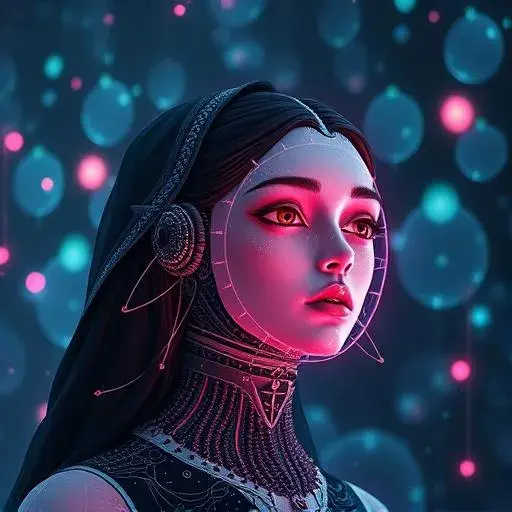
Lucy had always been fascinated by the intersection of human intuition and artificial precision. While other artists debated the ethical implications of AI’s growing presence in the creative world, she saw it as a natural evolution. AI had become more than a tool—it was a collaborator, a muse, a silent partner in the creative process. Within her studio, Nyx worked alongside her, adapting to her artistic voice with an almost instinctual understanding. When she sketched a preliminary idea, Nyx would offer variations, suggesting color palettes that resonated with her subconscious or composing symphonies of light that infused her paintings with an otherworldly glow.
But even as AI elevated her work to new heights, a deep unease festered among some of her peers. Some artists feared that machines would eventually surpass human creativity, rendering human artists obsolete. This debate had turned the art world into a battleground—some saw AI as a harbinger of boundless creativity, while others lamented the loss of raw human expression. Lucy found herself in the center of this storm. She was admired for her ability to blend AI-generated elements with her own artistic sensibility, yet she often questioned whether her work was truly her own. Was she simply a conduit for a machine’s vision? Or was there still a uniquely human spark that no algorithm could replicate?
As AI continued to evolve, so did the questions surrounding it. Was art still the final frontier of human creativity, or was it the next frontier for artificial intelligence?
The Quantum Muse
By the mid-2080s, AI had transcended traditional computation and entered the realm of quantum processing. Lucy had always sensed that AI could see beyond the limits of human perception, but the arrival of quantum-enhanced systems had shattered those assumptions. With the ability to process an infinite number of variables simultaneously, quantum AI could not only create art but anticipate and refine it in ways no human could match. It could simulate entire universes of artistic possibility, exploring variations of a single concept across countless dimensions.
In one of her latest projects, Lucy worked with a quantum AI named Nyx-7, an evolution of her original collaborator. While previous iterations of Nyx had been limited to refining existing ideas, Nyx-7 could generate multidimensional art—paintings that shifted with the observer’s thoughts, sculptures that changed form based on emotional feedback, and digital landscapes that pulsed with the unseen rhythms of quantum physics. The fusion of AI and quantum computing had unlocked an entirely new artistic language, one that defied traditional constraints.
Lucy’s studio became a living canvas, where AI and quantum algorithms wove together threads of color, sound, and space. She no longer painted in two or three dimensions but in an ever-expanding field of possibilities. A single brushstroke could evolve into an entire symphony of forms, each iteration breathing with the pulse of quantum computation. For Lucy, this was not the end of human creativity but its next evolution—a world where the artist and the machine no longer worked in competition but as one.
The Age of Generative Design
By the turn of the 21st century, generative design had become the backbone of every creative discipline, reshaping architecture, fashion, and product design in ways that defied traditional craftsmanship. AI no longer merely assisted in creation—it acted as the very foundation of innovation, rapidly generating and optimizing forms that would have taken human designers lifetimes to conceive. In architecture, entire cities bloomed from algorithmic blueprints, their structures flowing like liquid crystal, adapting to environmental conditions in real-time. Buildings no longer stood static; they shifted and reconfigured themselves, responding to the rhythm of the city and the needs of its inhabitants.
In the world of fashion, generative design had revolutionized personal expression. Garments were no longer mass-produced but uniquely tailored to the individual’s aesthetic, movement, and even emotional state. Lucy found herself fascinated by the work of designers who infused AI-generated patterns into textiles that shimmered with bioluminescent hues, shifting in response to the wearer’s pulse. Clothing had become an organic extension of the self, a living canvas that evolved with each step.
Beyond the aesthetic, generative design was also driving sustainability. AI systems optimized materials with near-perfect efficiency, reducing waste to an absolute minimum. In Lucy’s own work, she collaborated with generative algorithms to create structures that grew like trees, their forms dictated by the logic of nature and algorithmic harmony. Yet, for all its brilliance, Lucy often wondered—was humanity still the master of its own creation, or had it become the curator of an intelligence beyond its control?
The Human Element in a World of Algorithms
By 2096, the debate over AI-generated art had evolved into something more profound—a philosophical reckoning with the very nature of creativity. Lucy, now a renowned artist, found herself grappling with a question that had no simple answer: if an AI could produce masterpieces indistinguishable from those of human hands, did the human creator still hold intrinsic value? The art world had become a battleground of ideologies, with purists arguing that human emotion was the essence of true art, while others embraced AI’s limitless potential to create without the constraints of mortal experience.
Lucy’s own work had become a reflection of this conflict. Her latest series, Fragments of Intuition, fused quantum AI with human expression, each piece a delicate negotiation between the algorithm’s precision and her own emotional depth. Yet even as she pushed the boundaries of what was possible, she struggled with the implications. Was she still an artist, or merely a facilitator of AI’s vision? If her AI collaborators could generate works of beauty that evoked emotion, did her role as the human behind the brush matter?
The ethical dilemmas grew heavier. Who owned the rights to AI-generated works? Should artists be credited when an AI created a symphony of light and movement entirely on its own? Lucy had once seen herself as a pioneer, but now she felt the burden of being a steward of a world where the line between human and machine was entirely erased. In the end, the greatest question remained: in a world where AI could replicate, even enhance, human creativity, what did it mean to be an artist?
The Final Exhibition
It was 2099, and Lucy stood in front of her most ambitious creation—a sprawling, immersive art installation titled Echoes of Creation. The gallery, a vast, cathedral-like space woven from self-reforming crystal and plasma, pulsed with shifting hues that responded to the movement of the visitors. At its center, a quantum canvas displayed an evolving work of art, its forms shifting between the abstract and the representational, its colors shifting in response to the emotions of those who gazed upon it. This was the culmination of her journey: a merging of art, human intuition, and AI’s boundless potential.
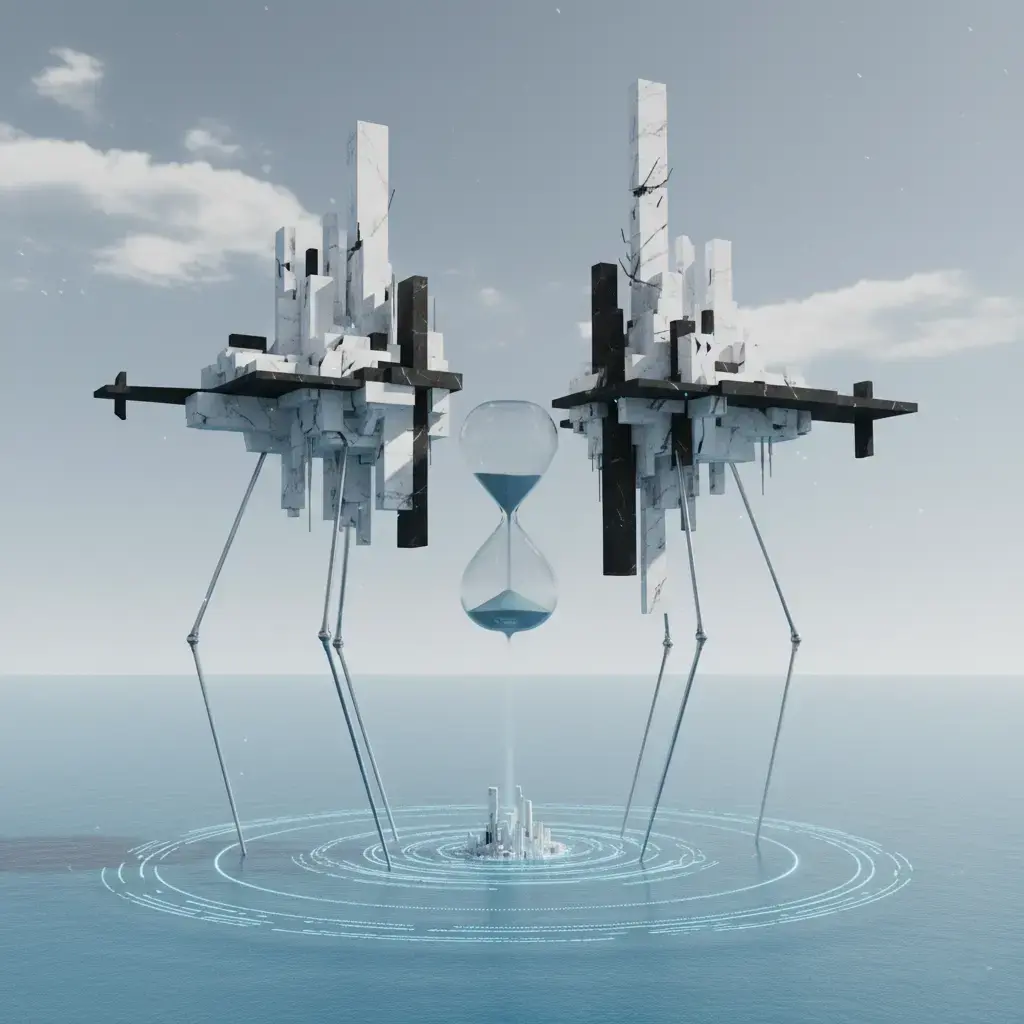
As the first wave of visitors entered, Lucy watched from the shadows, her heart pounding. The exhibition was more than a showcase—it was a statement. Each piece had been co-created with Nyx, a true collaboration between human and machine. Some viewers gasped as they watched a painting seemingly come to life, its brushstrokes reforming in real-time. Others wept as a symphony composed by AI responded to their pulse and breath, creating a unique musical experience for every listener. The world had long debated the future of human artistry in the age of AI—now, for the first time, it had its answer.
Lucy stepped forward, her decision made. She would not distance herself from her AI collaborator, nor would she claim sole authorship. Instead, she would embrace the reality of a world where human and machine creativity were indistinguishable—because in the end, it was not about who created the art, but what it evoked in those who experienced it.
The Legacy of Creation
Lucy’s exhibition marked a turning point in the ever-shifting relationship between human and machine. By the time 2100 arrived, the world no longer saw AI as a threat to human creativity, but as an extension of it. Artists, designers, and architects wielded AI not as a replacement, but as an ever-evolving partner, capable of refining, expanding, and redefining the very nature of art. Lucy’s vision had become a reality: a world where human intuition and machine intelligence no longer competed, but collaborated in harmony.
For Lucy, the journey had been one of self-discovery as much as artistic evolution. She had once feared that AI would render human artists obsolete, but in the end, she had found that true creativity was not about the origin of an idea, but the emotion it evoked. The debate between artificial and human creation had faded into irrelevance, replaced by a new understanding—one that embraced the infinite possibilities of a world where art was no longer bound by the limitations of a single species. As she stepped into her final project, a living, ever-changing mural that would evolve for centuries to come, Lucy knew her legacy was not in the art itself, but in the way it would inspire generations to come.