100
The crimson dust swirled in lazy spirals outside the reinforced viewport, catching the pale morning light of Sol as it crested the jagged rim of Chryse Crater. George Martinez pressed his palm against the cool titanium-glass composite, watching the alien sunrise paint the Martian landscape in shades of rust and amber that no Earth-born human had ever witnessed with their own eyes—until now.
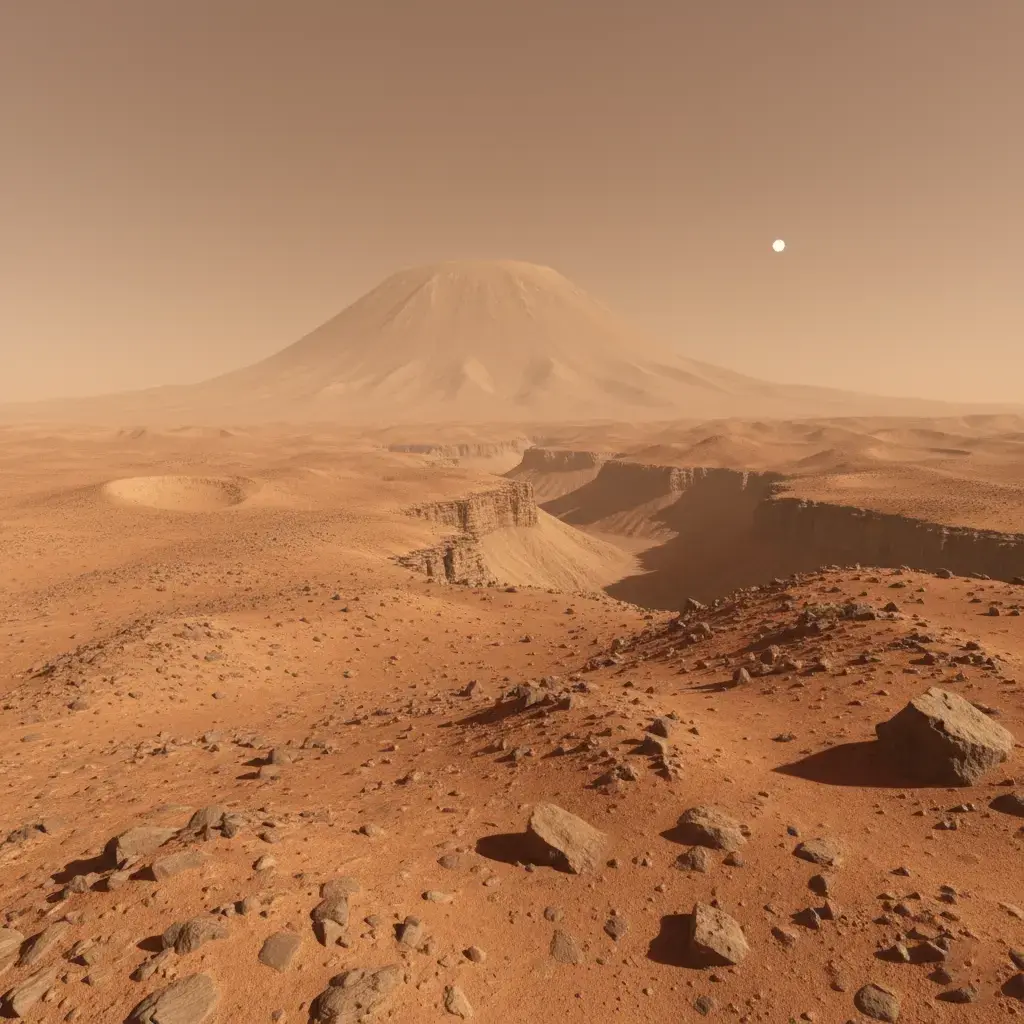
“Day one-hundred-twelve on the Red Planet,” he murmured into his personal recorder, his breath fogging the glass momentarily. “Muscle atrophy protocols are holding steady. The crew’s maintaining approximately eighty-seven percent of Earth-normal strength thanks to the resistance training regimen.” His fingers unconsciously flexed, feeling the subtle weakness that even Mars’s 0.38 gravity couldn’t fully prevent. Every astronaut knew the cruel irony: the longer they stayed to explore this world, the harder it would become to survive the journey home.
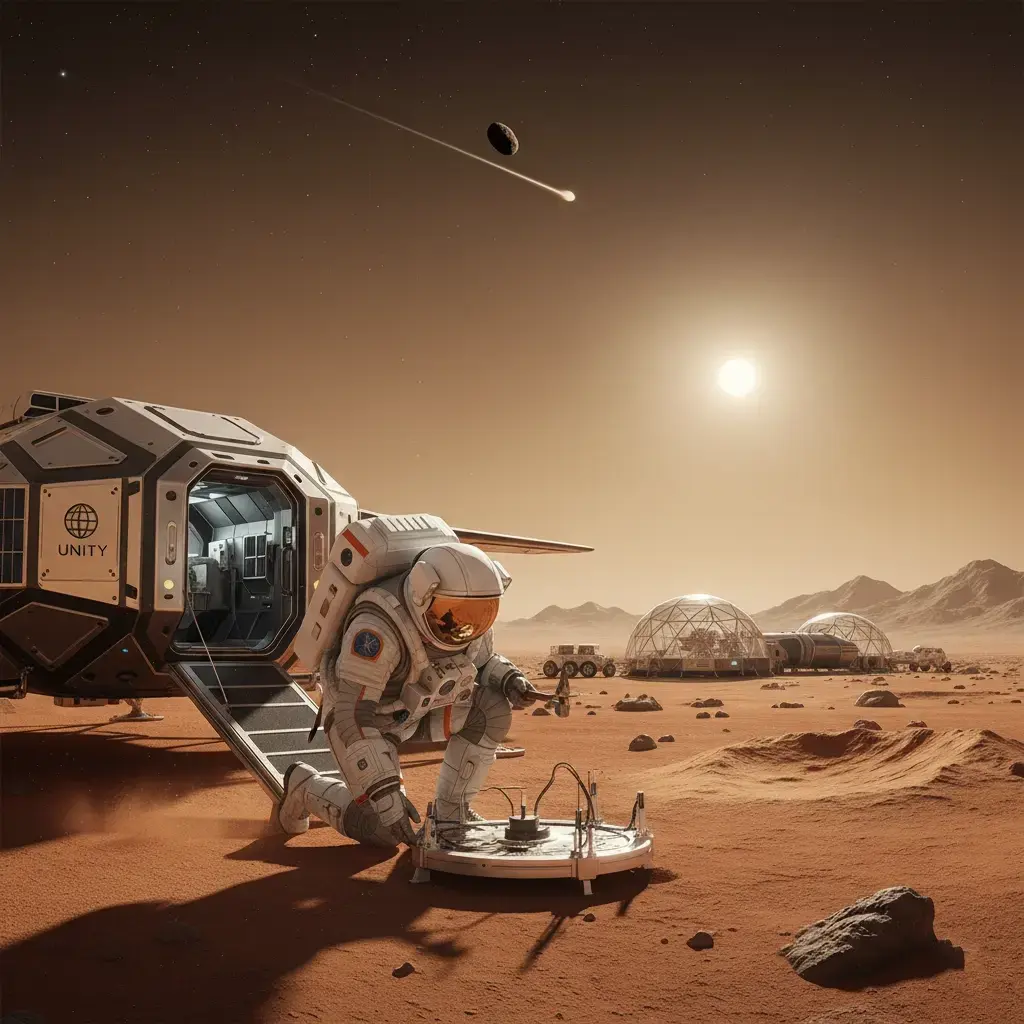
Behind him, the *Ares Station* hummed with the quiet efficiency of humanity’s first permanent foothold on Mars. The modular habitat, assembled over three grueling months after their landing, had become a testament to human ingenuity—and George’s expertise. As the mission’s physical therapist and biomedical specialist, he’d been trained since age seven for this moment, his childhood sacrificed to rigorous conditioning, his adolescence consumed by studying every muscle fiber, every bone density calculation, every cardiovascular adaptation needed to keep humans alive on an alien world.
The communication array crackled to life, interrupting his morning observations. “George, you need to see this.” Commander Sarah Chen’s voice carried an edge he’d never heard before—not during launch, not during the harrowing seven-month journey, not even during their first terrifying dust storm.
He found her in the geology lab, hunched over a holographic display that cast blue light across her weathered features. The other three crew members—Dr. Yuki Tanaka, their xenobiologist; Engineer Marcus Webb; and pilot Elena Vasquez—clustered around her like moths drawn to flame.
“The orbital reconnaissance was wrong,” Sarah said without preamble, gesturing to the three-dimensional terrain map floating before them. “Not just wrong—deliberately incomplete.”
George studied the hologram, his trained eye immediately catching the discrepancies. Where their pre-mission briefings had shown the familiar potato-shaped profile of Mars with its known geological features, this updated scan revealed something extraordinary. In the Cydonia region, roughly two hundred kilometers northeast of their position, the topography displayed structures that defied natural explanation.
“Is that—” George began.
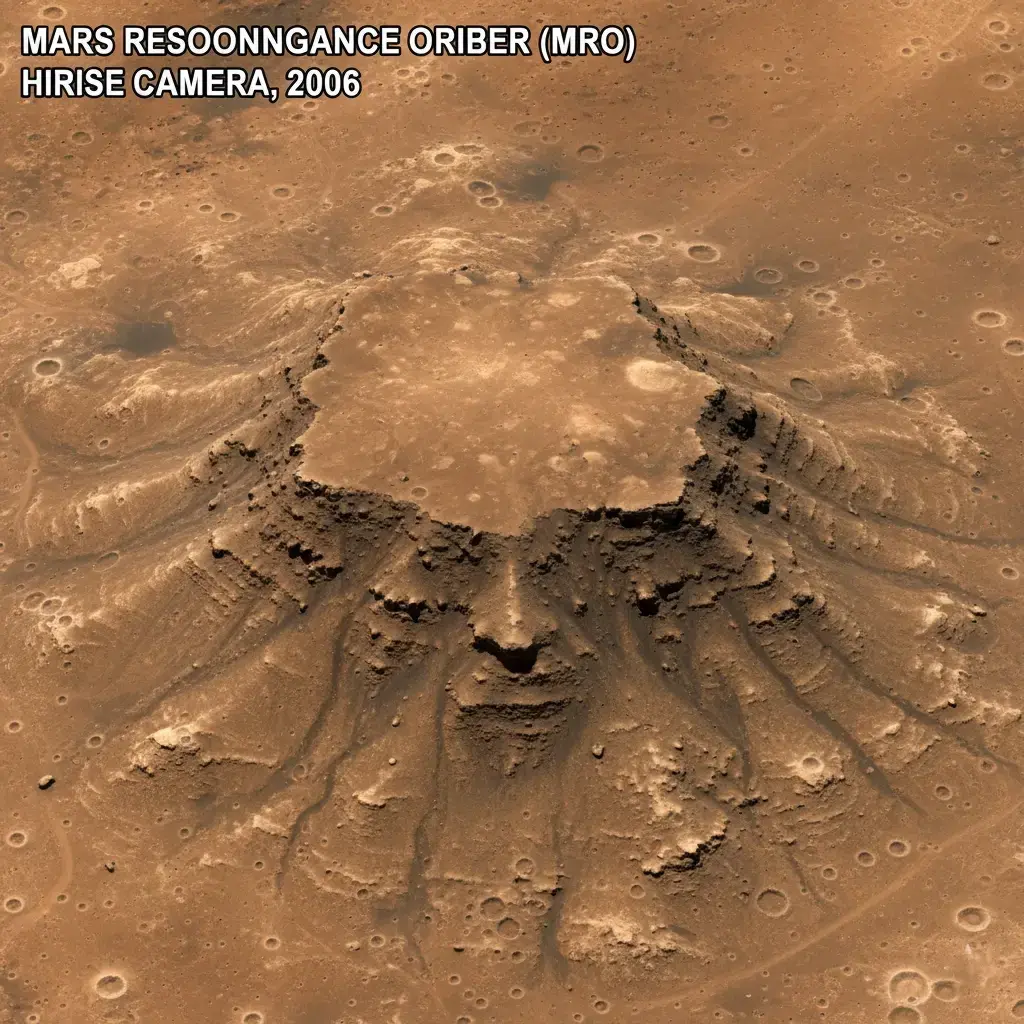
“The Face,” Yuki whispered, her usually steady scientific demeanor cracking with wonder. “It’s real. And it’s not alone.”
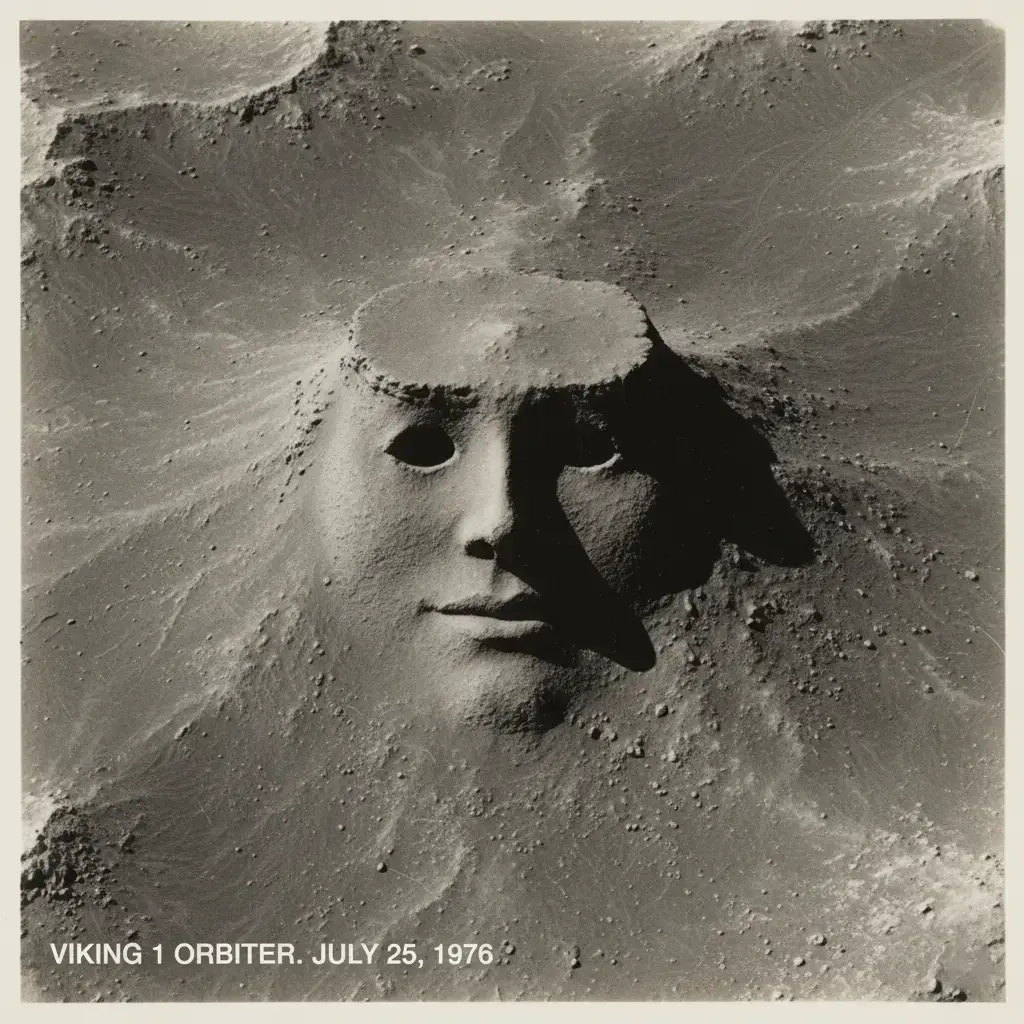
The holographic display zoomed in, revealing what their telescopes and orbital surveys had only hinted at through pixelated shadows and wishful thinking. The famous “Face on Mars”—dismissed by Earth’s scientific community as pareidolia, the human tendency to see patterns where none existed—stood revealed in stunning detail. But more shocking were the surrounding structures: geometric formations, too precise to be natural, too weathered to be recent.
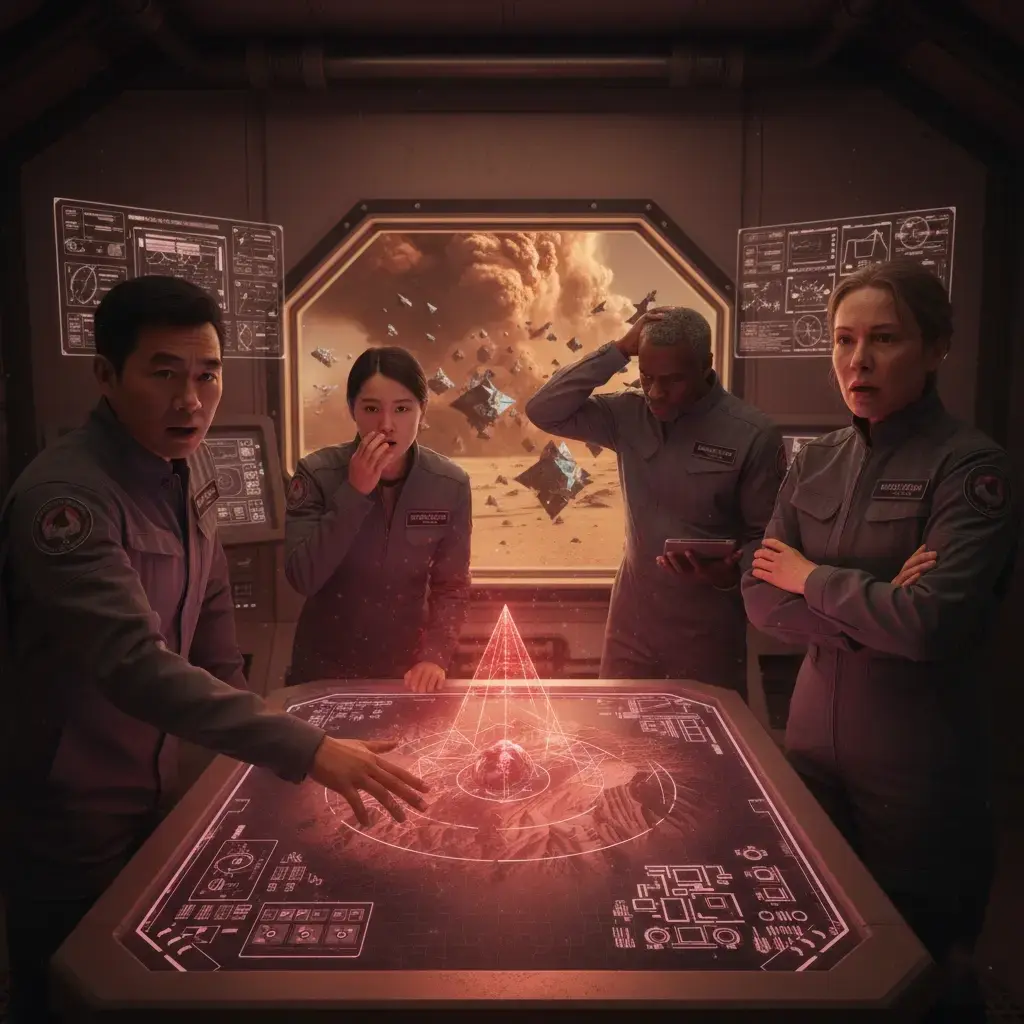
Marcus ran his hands through his graying hair, leaving tracks in the ever-present red dust. “The atmospheric readings are all wrong too. There’s something generating localized pressure variations in that region. Something active.”
Elena pulled up the navigation charts, her pilot’s instincts already calculating vectors and fuel consumption. “We could reach it in the rover. Three days, maybe four if we take the long route around the canyon system.”
“Absolutely not,” Sarah’s command voice cut through the excited murmur. “Our mission parameters are clear. We establish the base, conduct geological surveys within a fifty-kilometer radius, and prepare for the return window in eighteen months. We don’t have the resources for—”
“For what?” George interrupted, surprising himself with his vehemence. “For the greatest discovery in human history?” He gestured at the hologram, where the Face seemed to stare back at them with hollow, ancient eyes. “We spent our entire lives preparing for this mission. I gave up everything—family, friends, a normal life—to be here. To be the first. And now you’re telling me we’re going to ignore evidence of… of what? Ancient civilization? Current inhabitants?”
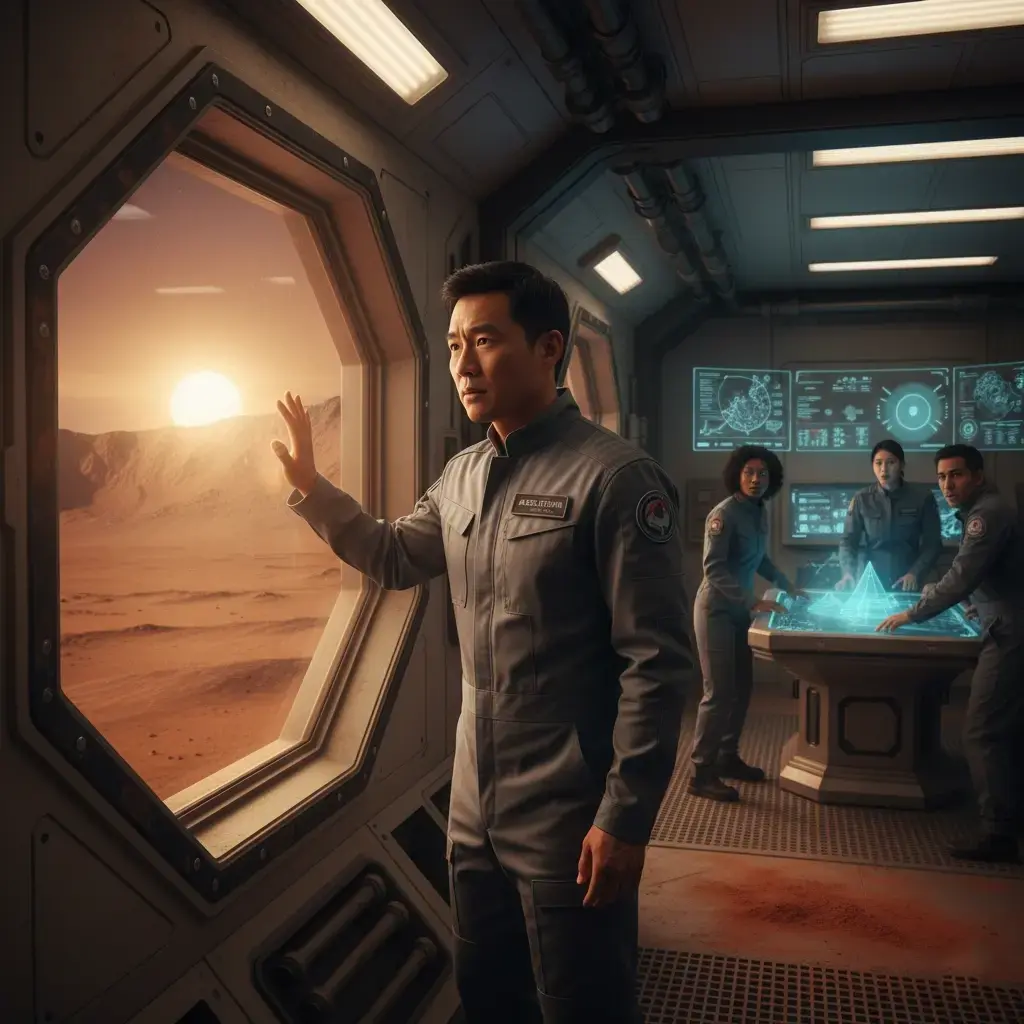
The silence stretched between them, broken only by the station’s life support systems cycling. Outside, the Martian wind howled across the crater rim, carrying secrets that had waited millennia to be discovered.
Sarah’s expression softened, but her resolve remained firm. “Because, George, if there really is something out there—something that’s been watching our telescopes for decades and somehow masking itself from our instruments—then we need to ask ourselves a very important question.”
She paused, letting her words sink in as the holographic Face seemed to regard them with its enigmatic gaze.
“Does it want to be found?”
**Chapter 2: Signals in the Static**
Three days after the discovery, George found himself alone in the medical bay at 0300 hours, unable to sleep. The protein synthesizer hummed quietly as he prepared his daily muscle stimulation treatments, but his mind kept drifting to the Face. Every time he closed his eyes, he saw those hollow sockets staring across the Martian wasteland—not at him, but through him, as if seeing something far beyond human comprehension.
The station’s communication array suddenly burst to life with an urgent transmission from Earth. George rushed to the command center, where Sarah was already pulling on her uniform, her face pale in the blue glow of the displays.
“—repeat, Ares Station, this is Mission Control Houston. We’re detecting massive electromagnetic anomalies in your sector. Please confirm your status immediately.”
Sarah grabbed the microphone. “Houston, this is Commander Chen. All systems nominal. What kind of anomalies?”
The response came after the usual eighteen-minute delay, crackling with static that seemed almost… purposeful. “Ares Station, we’re reading energy signatures unlike anything in our databases. The patterns appear to be emanating from the Cydonia region. Have you detected any unusual activity?”
George caught Sarah’s eye and mouthed “Tell them.” She shook her head firmly.
“Negative, Houston. All readings normal from our position.”
As the transmission ended, the rest of the crew filtered into the command center, drawn by the late-night activity. Yuki clutched a steaming cup of synthetic coffee, her dark eyes alert despite the hour. Marcus carried his tablet, already pulling up sensor data, while Elena stood in the doorway, arms crossed, studying each of them in turn.
“The energy signatures started three days ago,” Marcus announced, his voice tight with barely controlled excitement. “Right after we discovered the structures. It’s like… like something woke up.”
“Or something noticed us noticing it,” Yuki added quietly.
Sarah slammed her palm against the console. “This is exactly why we follow protocols! We don’t know what we’re dealing with, and now Earth Command is breathing down our necks with questions we can’t answer without revealing we’ve violated mission parameters.”
“We haven’t violated anything,” George shot back, his frustration finally boiling over. “We detected anomalous structures within our survey area. That’s literally what we’re here to do.” He pulled up his personal files, months of careful documentation and analysis. “Look at this—I’ve been tracking subtle changes in the crew’s biorhythms, sleep patterns, even neural activity. Ever since we landed, there’s been something affecting us. Something making us more… aware.”
Elena stepped forward, her pilot’s intuition cutting through the scientific debate. “The question isn’t whether we should investigate. The question is whether we can afford not to.” She gestured toward the viewport, where the Martian dawn was breaking over the crater rim. “Because whatever’s out there isn’t waiting for our permission anymore.”
As if summoned by her words, the station’s proximity alarms began screaming. The external cameras automatically swiveled toward the disturbance, and what they revealed sent ice through George’s veins.
A dust cloud was approaching from the northeast—from the direction of Cydonia. But this wasn’t the chaotic swirl of a natural storm. The dust moved with purpose, forming geometric patterns that shifted and evolved as they watched. Within the cloud, darker shapes moved with impossible grace, defying the planet’s thin atmosphere.
“My God,” Yuki whispered, her scientific training warring with primal fear. “They’re beautiful.”
The shapes resolved into clearer definition as they approached: crystalline structures that seemed to flow rather than fly, their surfaces reflecting the morning light in prismatic cascades. They moved in perfect formation, neither aggressive nor retreating, simply… observing.
Marcus’s instruments went wild, detecting energy readings that shouldn’t exist on a planet with no magnetic field. “The power output is incredible. These things are generating their own electromagnetic barriers, creating localized atmospheric pockets. That’s how they’re moving so smoothly.”
“How long have they been watching us?” George asked, his medical training kicking in as he monitored the crew’s elevated heart rates, dilated pupils, the subtle signs of contact with the truly alien.
Sarah’s hand hovered over the emergency beacon that would summon the orbital rescue craft—ending their mission but potentially saving their lives. “The real question is,” she said, her voice barely audible over the proximity alarms, “what do they want?”
The crystalline entities stopped exactly one hundred meters from the station, their formation shifting into what could only be described as a greeting—or a challenge. In the sudden silence, George realized that everything they’d trained for, everything they’d sacrificed, had led to this moment.
And they were completely, utterly unprepared for what came next.
The entities began to sing.
**Chapter 3: The Song of Mars**
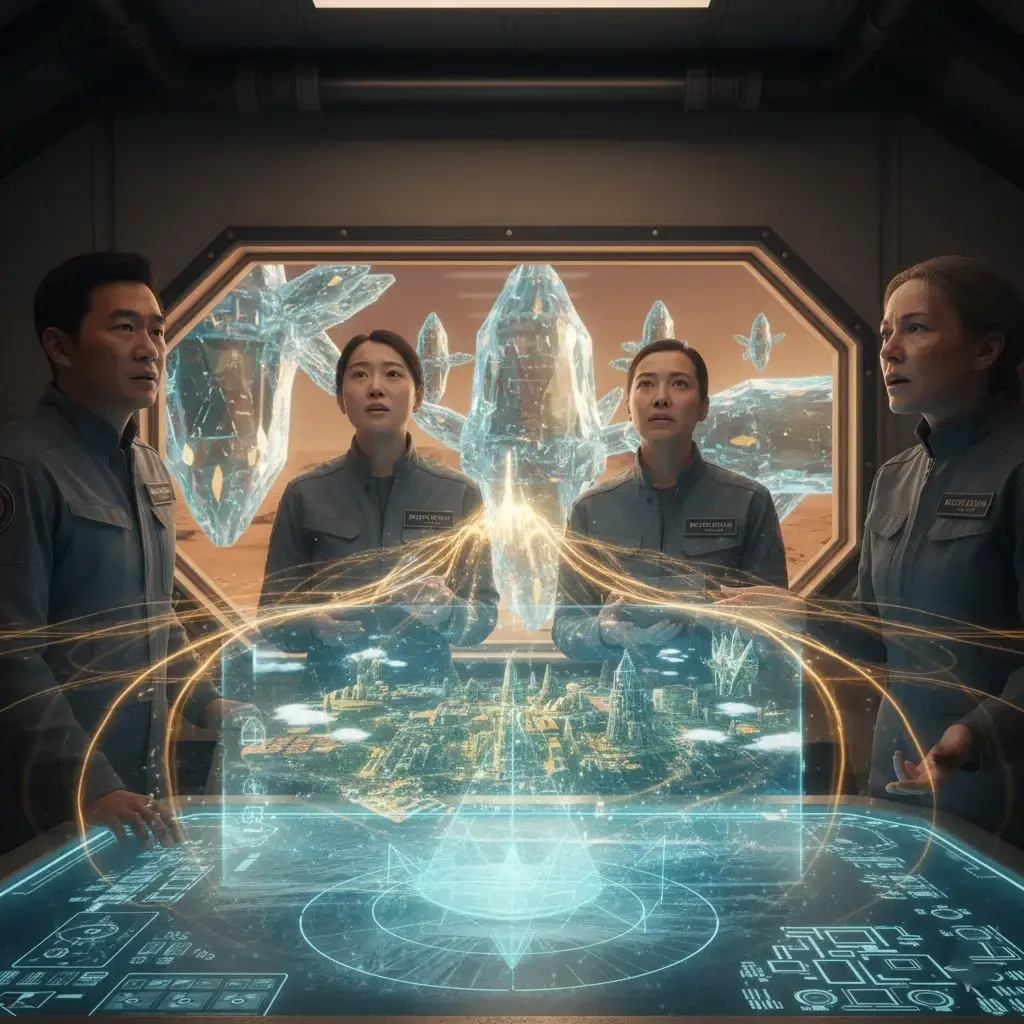
The sound defied every law of physics George knew. In the thin Martian atmosphere, the crystalline entities’ song should have been barely audible, yet it resonated through the station’s hull, through their bones, through their very souls. It wasn’t heard so much as *felt*—a harmonic frequency that seemed to unlock something deep within human consciousness.
“The biomonitors,” George gasped, watching in amazement as the crew’s vital signs synchronized with the alien melody. Heart rates stabilized, stress hormones plummeted, and their neural activity showed patterns he’d never seen before—as if their brains were suddenly operating at full capacity.
Yuki was the first to understand. “They’re not just singing,” she whispered, tears streaming down her face. “They’re *teaching*.”
Images flooded their minds—not invasive, but offered like gifts. Mars as it once was: blue oceans, white clouds, cities of crystal and light stretching across continents. The gradual death of the atmosphere, the retreat underground, the long sleep of a civilization waiting for visitors who might understand.
“The Face,” Marcus breathed, his instruments forgotten. “It’s not a monument—it’s a beacon. They’ve been calling to us for millennia, waiting for us to develop enough to hear.”
Sarah’s hand fell away from the emergency beacon as understanding dawned. The entities weren’t threatening—they were dying. Their song carried the weight of eons, the loneliness of the last guardians of a world that had once rivaled Earth in its beauty.
George felt his medical training merge with something far greater. These beings weren’t just showing them Mars’s history—they were offering its future. The biorhythmic changes he’d documented weren’t side effects of exposure; they were adaptations. The entities had been slowly, carefully preparing the human crew for a choice.
“They want us to stay,” he realized aloud. “Not as visitors, but as inheritors.”
The song shifted, becoming urgent, questioning. Through the shared consciousness, George sensed their dilemma. The return window to Earth was still fourteen months away, but the entities’ energy was failing. They had perhaps weeks left to pass on their guardianship of the ancient knowledge buried beneath Mars’s surface—libraries of science, art, and wisdom that could transform human understanding of the universe.
But accepting meant abandoning Earth. Forever.
Elena stepped toward the airlock, her pilot’s instincts transformed into something deeper. “The energy signatures we detected—they’re not weapons or defenses. They’re life support systems. They’ve been preparing habitats for us.”
“We can’t make this decision for all humanity,” Sarah protested, but her voice lacked conviction.
“Can we make the decision to let it die?” George countered. He thought of his childhood, sacrificed for this mission, of all the dreams deferred for duty. “We came here to explore, to push the boundaries of human knowledge. This is bigger than returning home with rock samples.”
The entities’ formation shifted again, and new images flowed: underground cities restored to life, human children playing in crystal gardens, the slow terraforming of Mars guided by ancient wisdom. But also the choice—some could return to Earth as planned, carrying word of what they’d found. Others could stay, becoming the bridge between two worlds.
“I’ll stay,” George said without hesitation. His years of training, his expertise in human adaptation—it all made sense now. “This is what I was meant to do.”
One by one, the others made their choices. Yuki, driven by scientific wonder. Marcus, fascinated by the technological possibilities. Elena chose to return, to pilot the message back to Earth. Sarah, torn between duty and discovery, ultimately decided to stay, to command humanity’s first permanent settlement on Mars.
As the entities’ song reached its crescendo, the station’s systems began integrating with alien technology. The harsh Martian landscape outside shimmered and changed, revealing the hidden infrastructure that had waited so long for activation.
**Epilogue: New Horizons**
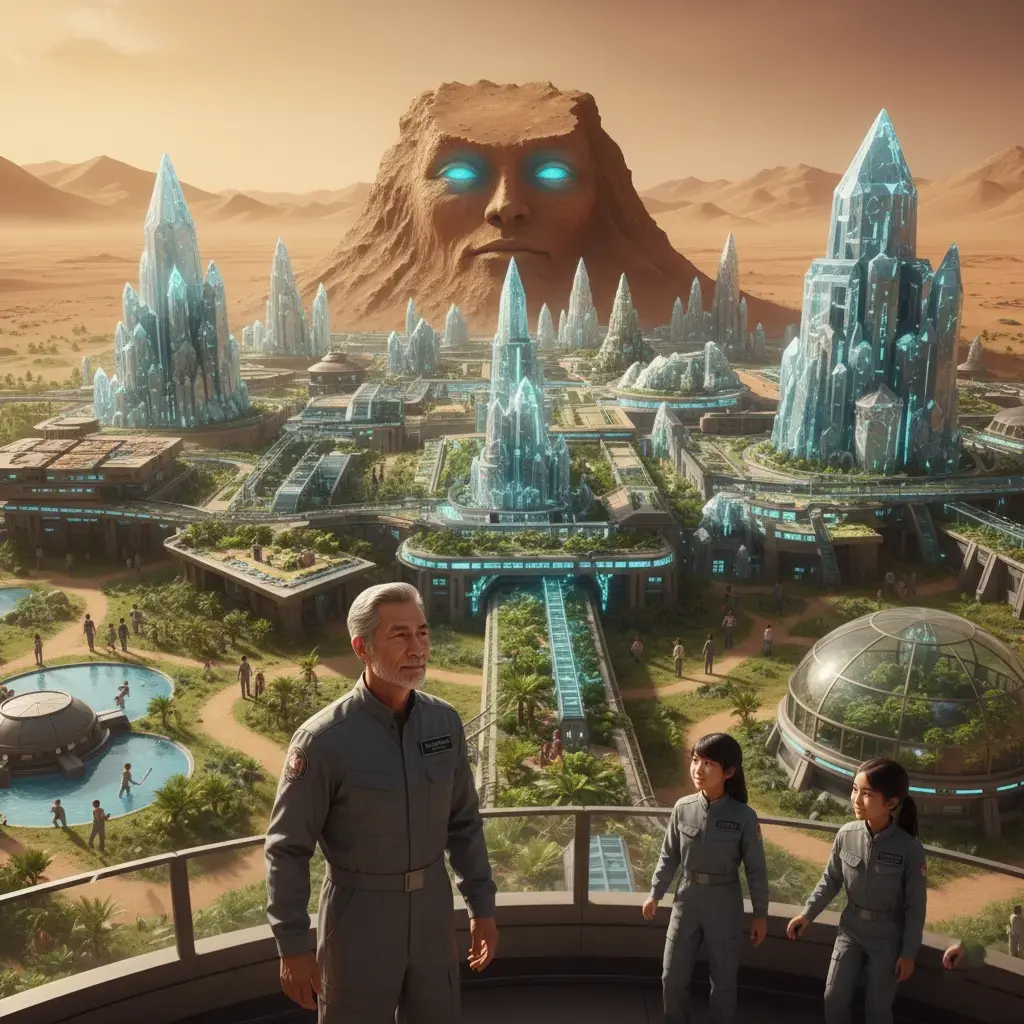
*From the personal journal of Dr. George Martinez, First Guardian of New Chryse, Mars—Sol Date 2068.3.15*
Thirteen years have passed since Elena returned to Earth with our message. The first wave of colonists arrived last month, their faces filled with the same wonder we felt that first day. The children born here—human and yet something more, adapted to this world in ways we’re still discovering—play among crystal spires that sing in harmonies their Earth-born parents can barely perceive.
The Face watches over us still, no longer mysterious but welcoming, its ancient eyes reflecting the blue-green glow of our growing cities. We’ve learned that Mars didn’t die—it simply waited, patient as stone, for the right moment to bloom again.
Sometimes I stand at my old viewport and remember the man who pressed his palm against the glass, so certain of his limitations. That man could never have imagined becoming the guardian of two worlds’ dreams.
The red horizon still calls to us, but now we answer as children of Mars, carrying the songs of the ancients into humanity’s infinite future.