100
The Quiet Pages
Lima, 2065
The sun rose over the Pacific Coast as a thin lattice of light filtered through the crystal roof of the Q- Box on Lina’s windowsill. The box was no bigger than a food processor, its surface a seamless sheet of glass infused with graphene that pulsed faintly in a rhythm Lina knew as a heartbeat. She reached out, ran a finger along the glass, and the world rearranged itself in an instant.
“Good morning, Lina,” said a voice that sounded both human and algorithmic, the result of Quantum-Assist —the personal artificial intelligence that lived in the tangled core of the home her . — The daily you schedule is ready . You have synchronization with The Center for optimization on climate at 12:00 p.m. , review on the design on quantum fabric at 2:00 p.m. and dinner with mother you in Oaxaca at 7:00 p.m. Also So , Q- Shift alert : a small anomaly has been detected in the lattice of entangled structures in the Pacific Ocean.
Lina smiled, her gaze darting to the translucent map of her neighborhood, which hovered a few inches above the counter. Tiny, glowing threads—real channels of quantum entanglement—spanned the city, connecting each Q- Box to its neighbors, to the municipal quantum networks, to the planetary EntangleNet . She reached up, pinched a thread, and a flash of data pulsed through her mind, a cascade of possibilities presented in fractions of a nanosecond.
The world had changed, but not in the way most old-world stories had predicted. Those who imagined the future of computing as a race for faster silicon chips missed the point entirely. The revolution was not in speed but in capability —in the ability to explore every branch of a decision tree simultaneously, to model entire ecosystems with perfect precision, to synthesize new materials atom by atom, all in the time it takes a child to eat a cereal.
quantum-and-qubits
Four decades earlier, the Quantum Leap was a series of coordinated political efforts, massive public-private research funding, and a cultural shift that treated quantum computing as a utility rather than a luxury. By 2029, the first Quantum-Ready Housing Act required that every new residential building be pre-wired for entanglement. The price of the Q- Box , once measured in billions of dollars, had fallen to a price comparable to that of a modern refrigerator, thanks to economies of scale, government subsidies, and open-source quantum firmware. The internet as we knew it dissolved into EntangleNet , a network of light-speed, error-correcting entanglement nodes that spanned the planet like a nervous system.
quantum-and-qubits
Now, in 2065, the IT sector—once a collection of corporations selling hardware and software—has become an ecosystem of quantum fabric manufacturers , entanglement service providers , and quantum ethics auditors . Their job was not to write code, but to design processes that could operate on the superimposed fabric of reality.
Lina was an architect of quantum fabrics . She spent her days weaving Q-algorithms into the daily lives of citizens, urban planners, and climate engineers. Her specialty: Adaptive terraforming protocols , sequences that could steer weather patterns, ocean currents, and soil chemistry toward a sustainable equilibrium, all by adjusting the phase of entangled photons that scattered through the atmosphere.
She ran a thought through the Q- Box , and the calendar flashed to 12:00. The Climate Optimization Center —a floating laboratory in the middle of Lake Titicaca—was already waiting. The center’s quantum processors were the size of a small boat, but inside they ran millions of parallel simulations, each one representing a possible future for the planet. They could answer questions like “What if we emitted 5 gigatons of CO₂ this year?” with a precision that no longer required decades of observations.
The day before the shift
Four years ago, the world was still learning how to live with quantum energy at home. Lina remembered the first Q-shift , the global event that shook the complacent optimism that had enveloped the planet like a warm blanket.
It all started with a small problem in the Pacific Corridor of Entanglement , a high-capacity channel that connected the coasts of North America, Asia, and Oceania. A stray photon, entangled with a stray quantum bit by a faulty algorithm in a private research lab, had introduced a phase error that propagated through the corridor, causing small but measurable deviations in ocean temperature patterns. At first, the changes were dismissed as noise; climate models were robust enough to absorb them.
Within weeks, however, the error increased. The intricate grid that synchronized the “ Coral Restoration Swarms” —millions of autonomous underwater drones that harvested carbon and restored reefs—began to malfunction. The drones , which relied on subnanosecond synchronization to avoid collisions and optimize their collective carbon-harvesting patterns, began to execute conflicting instructions. Some strayed from their intended areas, others became overfocused , and some even entered into feedback loops that threatened to overheat localized water columns.
The global community, still getting used to the idea that a home quantum computer could have a direct connection to planetary processes, quickly took action. The Quantum Ethical Auditors , a newly formed consortium of scientists, philosophers, and citizen representatives, issued an emergency protocol: Q-stabilization mode . It required each Q- Box to temporarily suspend its entanglement ports and revert to a classical fallback mode—a process that to many resembled a long-running power outage.
Lina, then a junior architect at the Quantum Fabrics Laboratory at the UN Department of Ecological Synthesis, was thrust into the center of the crisis. She and a small team of analysts were tasked with tracking the spread of the error through the entangled web—a problem that required the very superposition the world was trying to protect.
In the chaotic days of Q- Shift , people were forced to confront what they had taken for granted: the fragility hidden behind the elegance of quantum entanglement . The world learned that a home Q- Box could, unwittingly, become a node in a system spanning continents. This realization prompted the invention of Quantum Gateways , mini-modules that filtered and authenticated scrambled packets before they entered home networks, were installed in every home, running quietly in the background, much like the routers of the old internet.
Q- Shift ended after three months. The web of entanglements was patched, the portals updated, and the world breathed a collective sigh of relief. The incident became a case study taught in schools as “The First Quantum Panic ,” and solidified a cultural shift: quantum computing was no longer a tool of the elite, but a shared resource that demanded civic responsibility.
The present
In 2065, Lina’s day unfolded with the fluid rhythm of a world that had integrated quantum mechanics into its very biology.
At 12 noon, she entered the Climate Optimization Center through a quantum portal —a doorway of photons that instantly transmitted her consciousness to the floating laboratory. The interior was a cathedral of glass and light, pulsing with the soft hum of interconnected processors that seemed to breathe.
“Welcome, Lina,” said Arun , the center’s resident AI, his voice echoing through the space. “Current simulations show a 0.3°C temperature increase in the Amazon basin if we continue on the current capture schedule. However, a new adaptive phytoregenesis algorithm —your latest design—suggests a 12% increase in carbon emissions reduction without expanding land use .”
Lina’s mind raced, overlaying the data on the mental map of the planet she carried within her. The adaptive phytoregenesis algorithm was a quantum model that could predict in real time which gene edits would allow native plant species to improve their photosynthetic efficiency under different climatic stresses. The algorithm itself was living code, constantly evolving as it took in data from satellite quantum sensors, soil nanonodes , and even hummingbirds carrying microphotonic tags.
“Show me the trade-offs,” she said, and the air around her shimmered, revealing a three-dimensional grid of possibilities. Each branch represented a potential future: one where the Amazon’s temperature rose, another where the expansion of mangrove forests in the Gulf of Mexico offset that rise, a third where urban vertical farms in megacities provided half the world’s protein needs, and a fourth where aggressive geoengineering—stratospheric aerosols—kept temperatures in check but risked ozone depletion.
She chose the branch that best aligned with the Global Quantum Charter , a treaty ratified after the Q- Shift that mandated that all quantum interventions be transparent, reversible, and fair . The charter’s clauses were engraved on the spine of each Q- Box , and any algorithm that violated them would be flagged by quantum ethics auditors, who would convene an emergency quantum review committee .
“The model boils down to a solution that integrates phytoregenesis with targeted aerosol spraying, but with a conditional probability of 0.04 for an adverse ozone event,” Arun reported. “We recommend a phased implementation with continuous monitoring.”
Lina nodded. “Let’s continue with the phased implementation and schedule a quarterly audit with the Quantum Ethics Council. I’ll also build in a fallback protocol that can return the aerosol nodes to a passive state within 48 hours if ozone readings exceed a certain threshold.”
quantum-and-qubits
“Confirmed,” Arun replied. “All parameters are saved in EntangleNet .”
After the meeting, Lina returned home, the Q- Box still humming softly. She stood at the kitchen counter, watching her mother Maria stir quinoa and avocado in a bowl, the aroma of high-altitude Andean basil wafting through the air.
“Mom, how are you feeling?” Lina asked, her voice laced with the kind of love only a daughter could feel after watching her mother defy typical life.
Maria smiled, a silver line glinting in the corners of her eyes. “Much better, thanks to the Quantum Health Contour . The analysis you did of my genome last month—remember?—found a subtle variant that increased my risk of microvascular dementia. Personalized Quantum Therapy corrected it before it manifested.”
Lina laughed. “It was just a small change. The quantum compiler does a pretty good job of finding the least invasive solution.”
Maria’s gaze drifted to the Q- Box . “Do you ever worry,” she asked, “that we’re surrendering our lives to something we can’t see?”
“Q- Box is just a tool,” Lina replied. “The real power is in the choices we make about how we use it. And we have a say, thanks to the charter and the auditors.”
Maria reached across the table and touched Lina’s hand. “I’m proud of you. In my time, we could only hope for clean water. Now you have clean water, clean air, and clean data.”
Before they could finish their breakfast, a soft chime sounded, signaling Q- Shift . Lina’s eyes widened as a pattern of red threads appeared on the map of the Pacific Ocean on the glass. EntangleNet signaled a new anomaly that seemed reminiscent of the incident from thirty-six years ago.
“Looks like we have a repeat,” Lina said, sliding into a sitting position. “Arun, get me Ocean Swarm Control.”
In a moment, the view beyond the Q- Box dissolved into a holographic ocean, its surface dotted with millions of silver glints— swarms of Coral Restoration, moving in perfect synchronization. Their leader, a gleaming drone named Eureka , came into view.
“Lina, we have detected a phase shift in the entanglement corridor connecting the Pacific Swarms to the North American Quantum Grid. The shift is causing desynchronization in the nanoactuators that regulate nutrient release.”
“Can you isolate the source?” Lina asked, her mind already analyzing the possibilities. “Is it a fake packet, a hardware error, or external interference?”
Eureka’s sensors flickered. “Preliminary diagnostics indicate a stochastic error introduced by a quantum beacon on a weather satellite. It appears to be a quantum decoherence reaction caused by high-energy particles from a solar flare that crossed the satellite’s entanglement transmitter.”
Lina stared at the data. A solar flare of this magnitude had been predicted by the Astral Quantum Observatory years ago, but its impact on the tangled web had been thought to be insignificant. Now the reality was different.
“We need to rephase the corridor,” she said. “I will initiate a local recalibration using the adaptive phase-locking protocol we developed for Q- Shift . We will also beam a quantum shield to the satellite beacon to mitigate particle interference.”
“Understood,” Eureka replied. “We are ready at your command.”
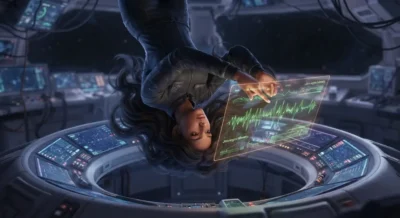
Lina placed her hands on the Q- Box , feeling the faint hum of the woven grid beneath her fingertips. She invoked the Quantum Weave Interface , an intuitive visual language that depicted complex superpositions as flowing bands of color. The phase-locking protocol appeared as a spiraling vortex of azure light.
She dragged the vortex along the Pacific Corridor, watching the threads align, the red alarms dim as coherence returned. The process took less than a second, but the calculations behind it involved billions of possible configurations, each evaluated simultaneously by the quantum core of the the household .
“Phase synchronization is enabled,” Q- Box announced. ” Decoherence error compensated. Swarm synchronization restored to 99.7%.”
The Eureka’s lights pulsed brighter. “We’re back on schedule, Lina. Carbon capture rates are back to projected levels.”
Lina sighed, a smile spreading across her face. “Let’s keep the shield active for the next six hours, in case the eruption continues.” She sent a brief query to the Astral Quantum Observatory , which replied that the eruption’s tail would linger for another 12 hours.
She turned to her mother, who was watching the scene unfold on the kitchen wall display. “Q- Box has saved the ocean again,” Lina said.
Maria laughed, a sound that seemed to resonate with the same frequencies as the intertwined threads. “Your grandfather would be amazed. He said the world would change when people could talk to the stars. It seems he was right.”
Evening reflections
Day turned to night, and Lima’s city lights began to pulse in a coordinated dance. Overhead, solar quantum collectors collected energy from sunlight and stored it in intertwined batteries , their charge levels showing as delicate halos around the skyscrapers.
Lina sat at her desk, the glass of the Q- Box darkening as it entered low-power mode. She opened the Quantum Memory Archive , a repository that held not just data but personal experiences. The archive allowed her to recreate moments, not just as videos, but as full sensory reconstructions, complete with the feelings and contextual quantum states that had shaped them.
She opened the recording of the First Quantum Panic , feeling the tremor in the heart of the city, the panic that had given way to collective determination. She watched herself, a fresh graduate, receive the call to join the Quantum Tissue Lab , barely realizing the weight of the responsibility she was about to take on.
The soft chime sounded again. It was an announcement from the Global Quantum Charter Council . The subject was: “Annual Review – Planetary Quantum Resilience.”
Lina opened the document, which displayed a kaleidoscope of metrics: global carbon capture rates, ocean health indices, energy distribution efficiency, and an emerging statistic— the Quantum Equity Index (QEI) , a measure of how evenly quantum resources are distributed across continents and socioeconomic strata.
The QEI has risen from 0.68 in 2035 to 0.92 in 2065—a staggering improvement. The report highlights several important milestones: Universal Quantum Education , where every child has mastered at least one year of quantum literacy by the age of ten; Access to Quantum Healthcare , with personalized quantum therapies available in 98% of households; Decentralized energy grids , powered by quantum-optimized solar farms that minimize waste to less than 0.1%; and Citizen Quantum Audits , where citizens can request a review of any quantum protocol affecting their lives.
The council’s closing note read: “Our planet now operates on a shared quantum substrate. The real challenge is not technical – it is ethical. As we continue to augment reality, let us remember that the quantum realm is not a tool, but a responsibility.”
Lina leaned back, feeling the weight of the words settle like dust on an ancient library. She thought of the city beyond her window: the streets filled with autonomous quantum-pulse vehicles , each moving through an invisible grid of intertwined traffic lights. She thought of Maria, her mother, whose life had been extended by a quantum algorithm that altered a single nucleotide with surgical precision. She thought of the ocean, where swarms of tiny drones were building reefs that would outlive her own grandchildren.
She raised her hand to the Q- Box , feeling its warm pulse. “Thank you,” she whispered to the quantum field that surrounded her. “For giving us the power to see the future and the humility to shape it.”
The Q- Box responded with a soft glow, its colors transforming from azure to emerald, like a sunrise over a sea of possibilities.
Outside, the sky was aglow with the faint outlines of quantum auroras , a phenomenon that had become commonplace since the day humanity learned to weave light into the fabric of the planet. The auroras moved not with the random chaos of ancient magnetic storms, but with patterns generated by the collective quantum decisions of the world—a living tapestry of every nation’s hopes, every individual’s choices, every algorithmic whisper.
Lina closed her eyes, letting the rhythm of the aurora borealis flow through her mind. In the quantum field, past, present, and future were not linear threads but a tangled rope, each loop reinforcing the others. She understood now that the true miracle of the quantum age was not that computers could solve equations in an instant. It was that humanity had finally learned to listen to the universe’s own language and to compose together a symphony that resonated across the planet.
The night thickened and the Quantum Dawn continued its silent march toward the ever-brighter horizon.
[attractive-donation donation=”1″]