100
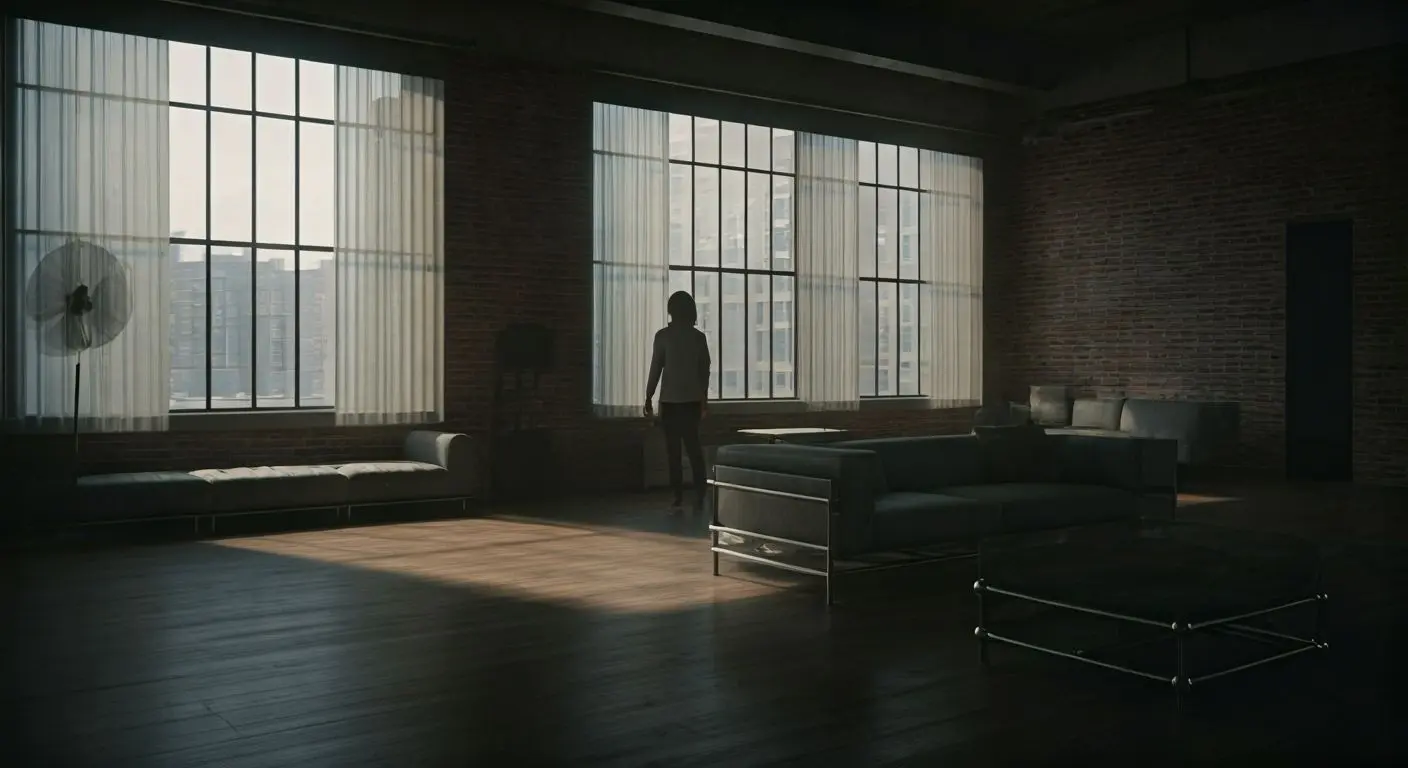
It was a cool April morning in 2030 when Elena Vogel’s alarm went off quietly at 6:15 a.m. Her small apartment in Chicago’s old brick neighborhood still seemed vast in the dim light: the high ceiling, the wide windows framing the pale sky, the gleaming lines of the modular furniture she had chosen for herself after her layoff. Everything about the space spoke of possibility—smart lights, temperature controllers that remembered her patterns, air purifiers that purred when they detected pollutants. Yet, in this grand openness, Elena felt confined, a prisoner of her own insecurities.
For the past six years, Elena had devoted herself entirely to her job as a senior editor at Spectrum magazine, one of the world’s most respected print and online periodicals. She prided herself on shaping narratives, guiding writers through editorials, and guiding long-form articles from proposal to design and layout. She had never wondered if she would ever need another job. Then, late last month, Spectrum announced that it would transition entirely to an AI-driven editorial process. In a corporate video—sleek, ultramodern—her face and the faces of thirty other editors flashed across the screen. A digital voice informed them that a new system called “Veritas” would replace human oversight.
Elena lay in bed a little longer, listening to the distant din of traffic and the soft mechanical click of her coffee maker starting its cycle in the kitchen. She imagined Veritas: a sleek black oval perched on a painfully white countertop, analyzing sentence structure in milliseconds, correcting tone, and fact-checking, scanning every corner of the internet. There would be no need for a human editor. Not for grammar, not for style, not for fluency. And apparently for empathy.
She stood up, threw back her blanket, and paced her apartment with automatic movements: brushing her teeth, turning on the oatmeal stove, pulling on an old wool sweater that still hung loosely around her shoulders. On her counter, next to a half-dozen battered glasses she had collected over the years, sat a small holographic frame, displaying a rotating gallery of memories: candid staff photos, product launch parties, layout sketches drawn in marker. These images had once been a testament to her pride. Now they felt like artifacts from someone else’s life.
After breakfast, Elena returned to her desk, which rose with pneumatic lifters at the touch of a panel. She had set it to “lunchtime sitting height” in the hopes of tricking her brain back into productivity. But her laptop remained closed. In its place, she had set up a tablet displaying the job postings she had reviewed since the announcement. AI writing labs, content creation firms, even a few ghostwriting agencies. No one answered.
She opened her calendar app. Empty. She used to plan her week by the minute: calls from collaborators, photo edits, internal reviews. Now she saw empty spaces stretching forward like a yawning abyss. The only thing filling them was a single, repeating reminder at 3 p.m.: “Meditate.”
For a moment she considered calling one of her former colleagues—Marilyn or Chen, perhaps—to express her condolences. But she didn’t. She tapped the reminder to snooze it. She would deal with it later.
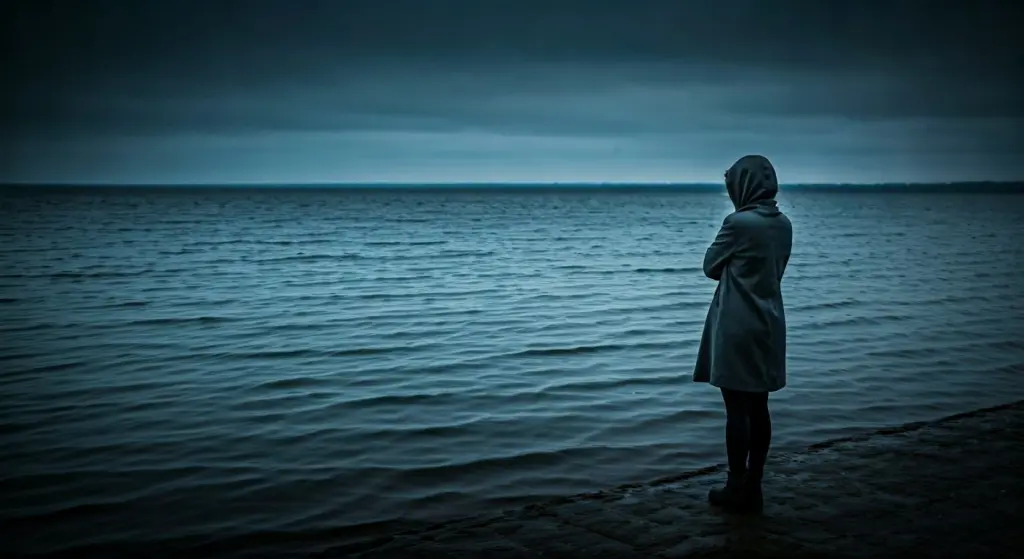
By midmorning, the apartment felt stuffy. Elena grabbed her light, elegant jacket, put on her sneakers, and stepped outside. The city hadn’t changed its rhythm for her. Drones buzzed overhead, delivering coffee to the balconies of tall buildings. Autonomous deliveries hummed along the sidewalks. Electric buses glided by almost silently. She walked two blocks to Lakeshore Park, where the wind off the lake was colder than she had expected. She hugged her arms and stared out at the dark water, stirred by small ripples.
Ahead of her, a group of gloved children chased a robotic dog that hopped and spun like a four-legged drone. Further away, a family perched on a bench while augmented reality glasses projected information about migrating birds. Everything around her pulsed with novelty, with technology made small and friendly. And Elena felt like an analog relic.
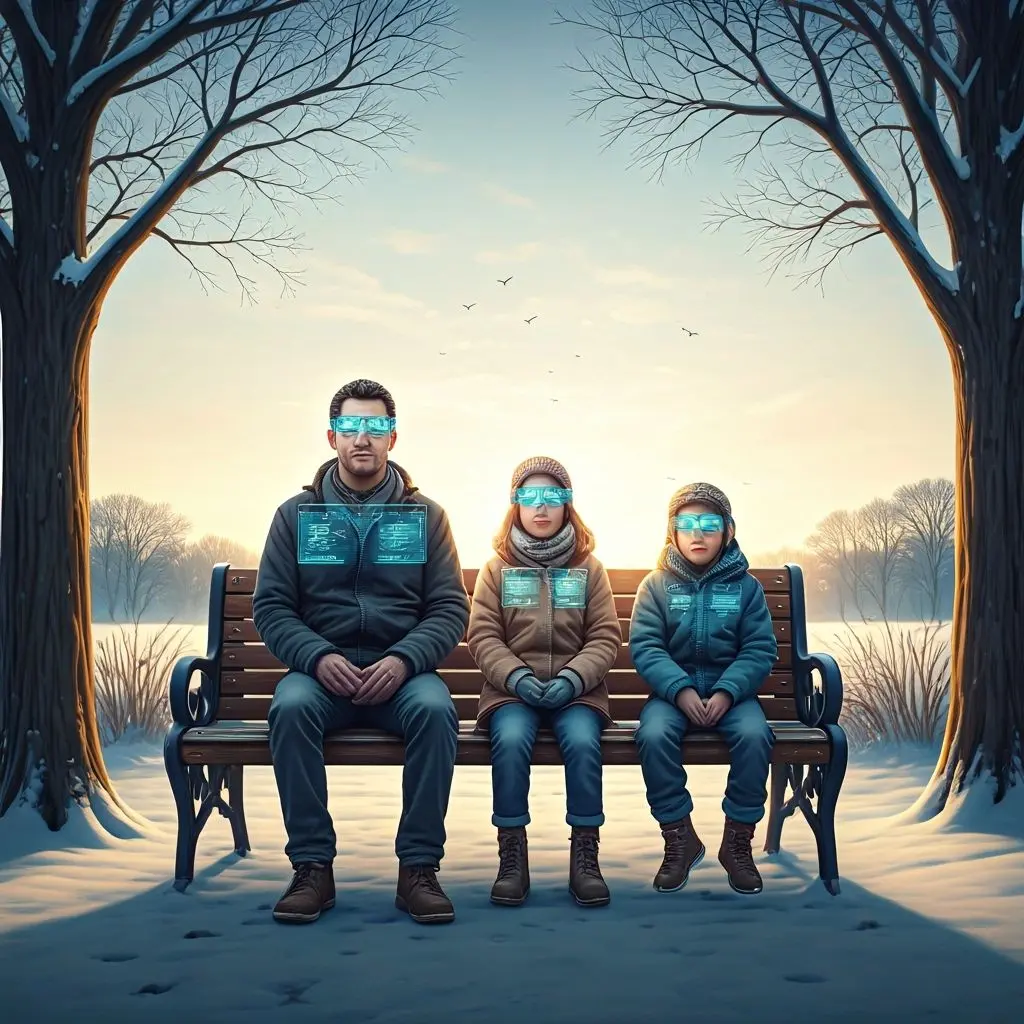
She found a bench. She inhaled, her shoulders relaxing. She closed her eyes and listened: the singing of seagulls, the creak of a floating buoy, the faint echo of a hovercar along the shoreline. It was soothing, but also terrifying. In that silence, she realized how much of her identity had been tied to proofreading, to debating the power of headlines, to finding the perfect phrase. What was she if not an editor?
Her phone rang. A text from her brother, Julian: “Brunch tomorrow? I’ve been thinking about you.” She wrote, “Sure,” and sat back on the bench, staring at the clouds that looked like cotton whales drifting across the pale sky. She touched her ring finger, where there was still a faint scar from a childhood wound. There was no ring. There were no plans for a wedding. There were no children. At thirty, she had devoted herself to her career. Now that career was gone.
As she walked home, the city felt different, sharper—constant with possibilities. She passed a storefront advertising the “Neurolink Creativity Trainingcamp,” which promised to rewire your brain patterns for content creation using noninvasive electromagnetic pulses. Next door, a coworking space offered hourly VR immersive pods. A sign in the window read, “Create Your Next Story in MetaSpace.” She paused. If she couldn’t edit stories in the real world, maybe she could help create them in virtual spaces, where human insight still mattered.
In her apartment, she threw her jacket on a chair and plugged her tablet into the USB port on the kitchen counter. She had saved up a little severance pay—enough for a few months of living expenses, plus whatever she could invest in retraining. She opened her browser and scanned the descriptions of these new programs. Neurolink’s program looked advanced but disturbingly experimental. MetaSpace’s boot camp promised hands-on experience but cost twice as much. She scrolled until her vision blurred.
When she woke from her daze, the screen showed an email confirmation: “Your application to the MetaSpace Creativity Traincamp has been received. Orientation begins next Monday.” She had done it on autopilot. She had signed up. Her furnace of anxiety was heating up—What if it didn’t work? What if she was wasting her money? But it was still something. A step. She leaned back and exhaled. For the first time this week, she felt a glimmer of momentum.
That weekend, she wandered through digital forums, where professionals who were out of control shared advice on how to adapt. Someone suggested a weekly online group called “Editors Reimagined,” a virtual reality peer support group. On Sunday afternoon, Elena put on her headset, entered the virtual café, and found herself sitting at a round table with five other people, their avatars sipping hot cups of pixelated tea.
A man with a decent beard named Ari introduced himself: “Former fact-checker. Now runs an AI calibration consultancy.” A woman named Soma said she was a proofreader who had retrained to become a data journalist. Each person had a story of sudden displacement, of forced reinvention. When it was Elena’s turn, she felt her throat tighten. “I was a luxury travel editor,” she said. “Long-form culture, tech profiles… I don’t know where to go next.” They nodded. They shared suggestions: look into UX writing, content strategy, voice design for conversational AI. They recommended classrooms and mentors, virtual meetups and hackathons.
Elena left the café with a sense of camaraderie she hadn’t felt in weeks. She spent Sunday night sketching out a new resume that emphasized transferable skills: narrative architecture, stakeholder management, clarity in meeting deadlines. She highlighted her experience managing cross-functional teams and her award for Spectrum’s “Most Engaging Special Issue.”
On Monday morning, early and bright, she joined MetaSpace’s orientation via a holographic channel in her living room. She listened to the instructor—a cheeky chatbot named Cora—explain that creativity in mixed realities requires “empathetic interface design, engaging sensory choreography, and adaptive storylines.” She was skeptical but eager. Over the next two weeks, Elena learned to program branching narratives that responded to the user’s gaze, to create scenarios for ambient soundscapes that evoke moods in virtual reality. She discovered that she loved working in 3D space, placing digital artifacts that evoke memories or surprise. She collaborated with classmates halfway around the world, editing their code and providing feedback on dialogue choices for simulated characters.
At night, exhausted, she dreamed of sentences that bent and transformed into shapes that she had to remove. But beneath the fatigue, she felt alive again.
By the fourth week, the boot camp required each participant to create a final project. Elena proposed an idea: a virtual memoir of the city, seen through the eyes of its disappearing old bookstores and print kiosks. Users would walk through a recreation of a 1920s Chicago block, pick up newspapers, scan headlines, listen to interviews with real former journalists. She imagined it as a meditation on change, on the human impulse to document time. Cora approved.
Over the next few weeks, Elena interviewed former magazine colleagues through carefully orchestrated video calls, recording their voices and facial expressions. She commissioned a local artist to digitize sketches of brick storefronts. She wrote dialogue for an elderly owner who had sold print magazines for forty years. She wove in news clippings, the sounds of steaming coffee, the whispers of conversations about last week’s article on sustainable textiles. She felt her old skills—interviewing, fact-checking, narrative flow—come to life in new forms.
Finally, the day of the demo arrived. In the MetaSpace auditorium, a dozen VR modules were lined up on the floor. Investors, potential customers, even representatives from Spectrum’s innovation lab were lining up inside. Elena sat in her seat, her heart pounding. When it was her turn, she led three visitors through her virtual street, watching them stop in front of a flickering newsstand, watching a hologram of an editor reading text aloud. They asked questions: Where did you get your audio? How did you ensure authenticity? How could a project like this be monetized? She answered confidently, pointing out opportunities for sponsorship from local publishers, for museum licensing, for educational modules in schools teaching media literacy.
By the end of the day, she had two offers. A small VR studio wanted to hire her as a “narrative architect.” A grant committee at the city’s cultural foundation offered funding to expand the project to other neighborhoods. Elena accepted both. She would join the studio on a contract basis, but keep her project as an independent commission.
When she sent the email with her approval, she felt a surge of relief and pride she hadn’t felt since her first signature. She had stepped out of her comfort zone, reimagined her talents, and found a new purpose. She realized that the work she had lost wasn’t gone forever—it had been transformed. Machines could replace mechanical editing, yes, but they had no memory, no pleasure in nuance, no ethical compass calibrated by years of human judgment. They were still needed.
That evening, Elena sat by her window, the city lights flickering one by one like fireflies. She made herself a cup of jasmine tea and opened a digital sketchbook. She scribbled down ideas for the next phase: incorporating AI-driven character responses that adapt to users’ reading history, overlaying archival audio from old radio shows. She outlined blog posts to share with her new network, guiding other editors who had been displaced through similar changes.
Her phone rang again. This time it was a message from Marilyn: “I heard the great news—congratulations!” Elena smiled and typed back: “Thanks. It’s good to be building something again.” She closed her eyes for a moment, listening to the faint hum of drones overhead and the soft whir of a passing hovercar. Then she returned to her sketchbook, her mind already racing through the possibilities at her fingertips.
In 2030, when a life’s work could be wiped out with the click of a corporate command, it was easy to feel obsolete. But Elena had learned that human creativity was not so easily erased. It simply changed form, emerging wherever empathy, curiosity, and the art of storytelling found new terrain. Her days at magazines had given her the tools; high technology had opened doors. Now she stood in a sprawling virtual city of her own making, ready to shape the next chapter—one conscious syllable at a time.