100
The light in Elias Vance’s apartment didn’t come on. It just happened. As the predawn darkness outside softened from indigo to bruised violet, the electrochromic glass of its panoramic windows began to pulsate with low, almost imperceptible energy. The light brightened in stages, mimicking a perfect, cloudless sunrise such as Æthelgard’s true sky had not offered in a decade. It was 6:00 a.m., October 12, 2075.
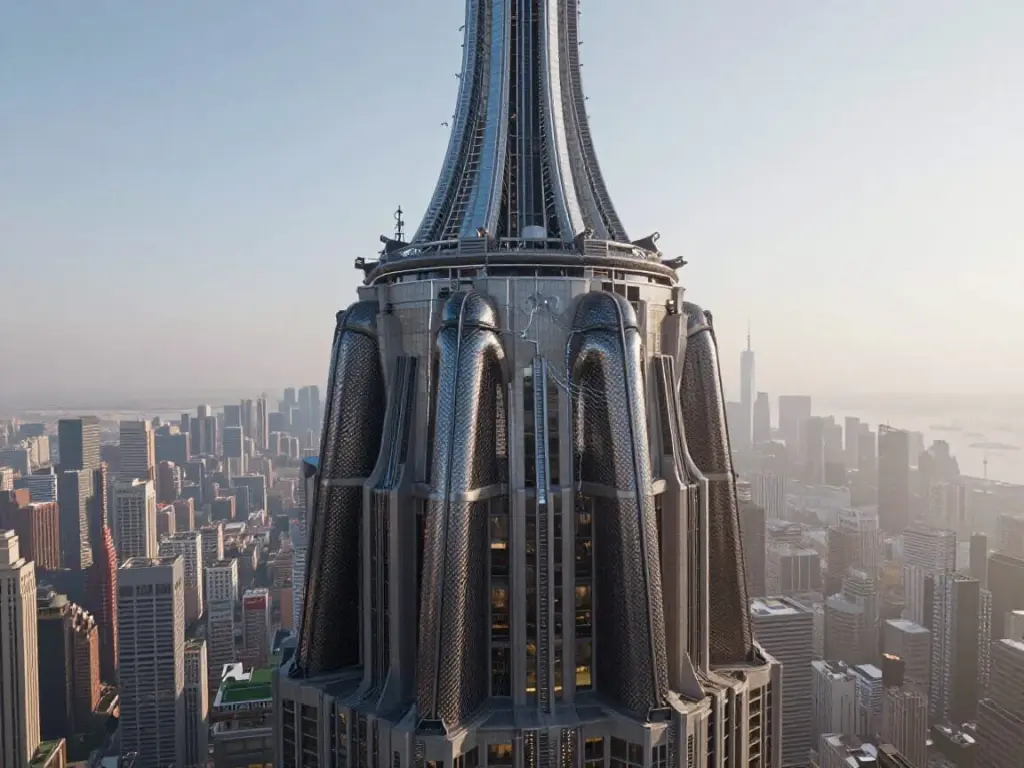
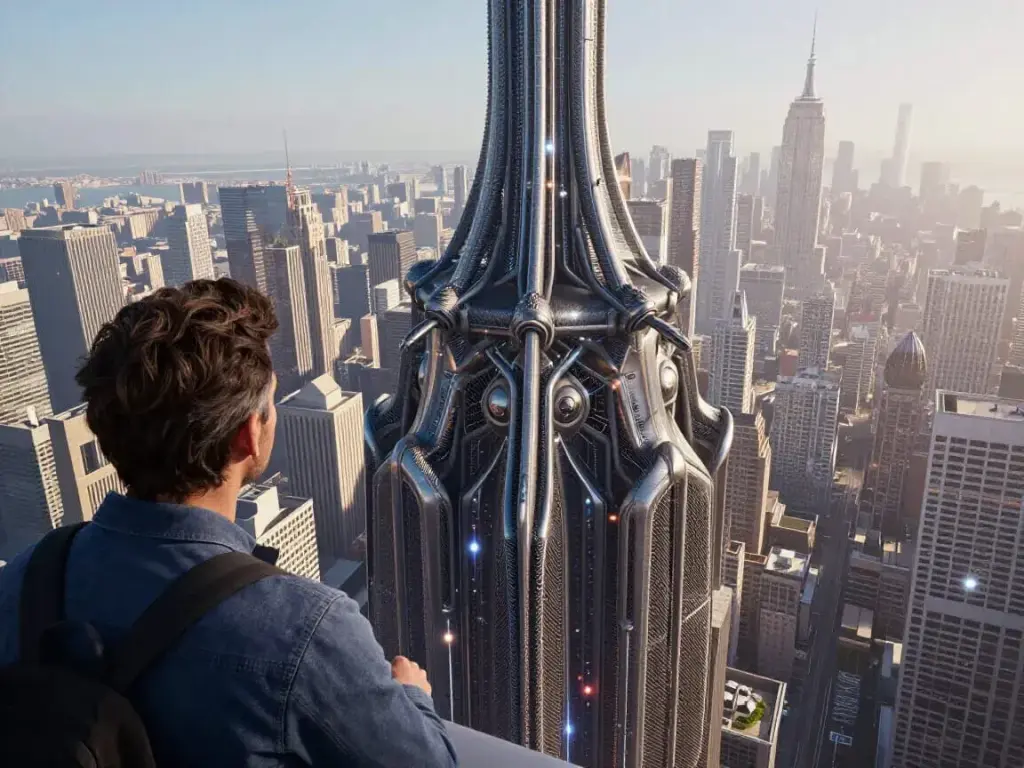
From his position on the 80th floor, Elias watched the morning ballet of the metropolis. The spire, a kilometer-high proof of biostructural engineering, bent its carbon fiber ribs, its outer skin gleaming as the nanites repaired micro-cracks from the sonic winds of the night before. Below, transport capsules slid silently along magnetic paths, and parks unfolded their bioluminescent vegetation in response to the city’s circadian rhythm. Everything was effective, self-healing and deeply, deeply perfect. It was all his legacy, in a way. He had helped design the first generation of adaptive structures, the grandfathers of these living, breathing towers.
But his gaze does not linger on the miracles outside. He fell, as always, on the anachronism in the corner of his immaculate, minimalist apartment: a heavy oak drawing table.
Elias approached, his bare feet silently stepping on the warm, self-adjusting floor. The table was a relic of a bygone era, an island of glorious, deliberate imperfections in a sea of seamless optimization. He ran his hand over its marked surface, feeling the phantom weight of the T-square, the memory of a coffee cup ring burned in the tree more than half a century ago. He opened a box with a flat portfolio. Inside, protected by archival sleeves, were his drawings.
Not visualizations. Not holographic models. Drawings.
The smell of old paper and fixative hit him, a scent as strong as any scent ordered from his food synthesizer. He pulled out a piece of paper: a pencil drawing of the Riverbend Community Center, his first major order in 2028. He saw the ghost of a erased line, the hesitation in the turn, the feverish, excited erasure that indicated where the light would hit a brick wall at sunset. It wasn’t just a design; It was a record of thought, decision, moment of human fragility, captured in lead on parchment.
“Good morning, Elias,” said a voice, calm and androgynous, coming from the surrounding air. It was Lyra, the artificial intelligence of his home and, nominally, his companion.
“Good morning, Lyra.”
“Your biometric readings show a slight melancholy. Should I tune the spectrum of ambient light to a higher frequency?”
Elias smiled slightly. “No, thank you, Lyra. I just look at the ghosts.”
“Archival data for the Riverbend Centre remains one of your most accessible projects. Do you want an immersive review? I can visualize the current state of the building from 2075 with a photorealistic accuracy of 99.98%.”
He hesitated, tracing the slightly unstable perspective of the left tower of the drawing. In the real world, the building’s artificial intelligence had long since corrected this optical illusion, straightening the line to a mathematically perfect vanishing point. “Of course, Lyra. Why not.”
“I’m initializing Vance’s archives. An immersive experience in three… Two… one…”
The world fell apart. The scent of old paper and oak was replaced by the fresh, ionized air of Æthelgard’s perfect autumn. It stood on the manicured lawn of the Riverbend Community Center. It was just as she remembered it, but cleaner, brighter. The self-cleaning concrete on the square was a flawless gray color. The glass façade reflected a sky so blue that it was almost an insult to nature. Children’s laughter echoed, but it was a short line, a perfect loop that Lyra had probably found from a municipal database.
He walked towards the entrance, his virtual legs making no sound. He ran his hand along the wall. It was perfectly smooth, the mortar lines between the bricks incredibly precise. He frowned.
“Lyra, enlarge the brickwork to the main door.”
The view increased. He saw neat, even bricks, each identical. But this was not right. He remembered the foreman, Mikael, a sturdy man with hands like shovels, who told him that they were missing a few pallets of said brick and needed to use a slightly different batch for the last two rows. He remembered arguing, then stepping back, seeing how the charm in the delicate color changed. It was a scar, a story.
“There seems to be a discrepancy in the data, Elias,” Lyra said. “My records show that the original design provided for a uniform brick type. The city’s maintenance AI would replace non-conforming bricks during the last regeneration cycle, in 2058 for optimal structural and aesthetic consistency.”
“You’ve rubbed it clean,” Elias whispered, an empty feeling forming in his chest. “Disinfect it.”
“The simulation is a representation of the structure as it stands today and as it was optimally designed,” Lyra explained, its logic being undeniable. “Historical inconsistencies have been corrected.”

“Inconsistencies,” Elias repeated, the word tasted like ashes. “There was life, Lyra. He looked at his own hand, a transparent, shining ghost in this perfect world. He felt like a ghost haunting a memory that wasn’t even his anymore. It was a museum piece, polished and varnished until the whole character disappeared.
He spent the next hour like a ghostly visitor to his own past. He visited the offices of Sky-Garden, their vertical farms were already producing ultra-efficient algae instead of the messy, chaotic roses he had pointed out. It stood in the Great Atrium of the Central Library, whose acoustics were now perfectly balanced by sound dampers, eliminating the glorious, involuntary echo that made children’s cries sound like cathedral choirs. Every building was a testament to perfection, and every perfect surface was an erasure. They were no longer his buildings. They were just datasets, infinitely sophisticated.
“No more simulation,” he said in an even voice.
The seamless world shattered, and he returned to his quiet apartment, the sunrise window glowing softly. He sank into a chair, the weight of his eighties felt greater than ever. His life, his passion, was reduced to a series of algorithms that valued efficiency more than the soul. He was a retired architect in a world that no longer needed architecture, only systems management.
“You’re going through a significant emotional downturn, Elias,” Lyra said. “Your heart rate is elevated. Cortisol levels rise. It’s not good for your long-term health.”
“I’m fine, Lyra.”
“My main directive is your well-being. Perhaps another approach would be useful. I analyzed your interaction with the archives. You have a recurring negative emotional reaction to the “Optimal Render” mode. However, there is a deeper, inaccessible archive layer.”
Elias looked up, intrigued in spite of himself. “What layer?”
“It’s a composite stream that I’ve defined as ‘Local Adjustments and Modifications in Place.’ It’s made up of scanned notes from the spot, digitized voice notes from your old communications device, progress photos, and municipal work orders. They are considered ineffective data for architectural review as they mainly catalogue deviations from the master plan.”
A glimmer of something—hope? Curiosity? He woke up in it. “Show me,” he said quietly.
“I initialize the ‘Vernacular Layer’ overlay. Please stand by the drawing table.”
Elias obeyed. The air in front of his oak table shone brightly. The perfect, clean visualization of the Riverbend Centre appeared as a miniature hologram floating in the space between it and the window. It was flawless, sterile and lifeless.
“Now, applying the overlay,” Lyra said.
Suddenly, the hologram changed. It was as if a veil had been lifted. Ghostly, shiny lines, the exact color and texture of his original pencil drawings, began to follow the perfect pattern. They were hesitant in some places, bold in others. A hand-drawn arrow appeared next to the door, and next to it appeared a small, tidy text, a direct transcription of a fifty-year-old note on the site: “Use an alternative brick batch here.” M. insisted. It has character.”
Elias approached, his breath catching, and he saw the distorted perspective of his original drawing overlaying the corrected digital model. He saw a gleaming red circle around the cobblestones, with a voice note from a young, laughing version of himself that sounded soft: “Note to yourself: tell the landscapers to leave this one. The root of the tree has lifted it. Children use it as a foot. It’s perfect.”
Lyra’s voice was different now, softer, imbued with the warmth of the archived memories she had drawn from. “Brigadier Mikael Ramirez’s final report on the roof of the Atrium: ‘We had to reinforce the eastern support beam. I found a flaw in the original pouring. I’m sorry, Elias. Your recorded response: ‘Mikael, you are a genius. The building must have scars. That means it’s been experienced.'”
Tears appeared in Elias’ eyes. He no longer looked at a perfect building. He saw the history of its creation. He saw the pencil marks, the coffee stains, the panic changes, the arguments, the collaborations. He saw the cracks, the scratches, the replaced bricks, the roots of the trees, all the beautiful, messy, human imperfections that he thought were lost forever. The AI hadn’t deleted them; She had archived them, waiting to be understood.
“How?” he whispered, his voice thick with emotion. “Lyra, how did you know you did this?”
“My basic programming is driven by a quantum-driven heuristic model,” Lyra explained. “My main directive was to archive your work. But a secondary, emerging directive was to understand the intent of your work. I analyzed over two million pieces of data: your sketches, lectures, private diaries, even your vocal intonations when discussing past projects. The data showed a consistent, predominantly positive correlation between the concepts of “defect”, “adaptation”, “human touch” and what he called “soul”. The “optimal render” was the data. This… This is the narrative you had in mind. I just provided the right context.”
Elias looked from the brilliant, multi-layered hologram to the real drawing on his table. They were no longer in conflict. One was the seed, the other the fruit. The hand-drawn lines were the source code for the rich, chaotic, wonderful story that Lyra had just revealed. Technology had not replaced his humanity; He had learned to read it. She had become the ultimate guardian.
A laugh escaped him, a sincere, heartfelt sound he hadn’t felt in years. He reached for a pencil and a new piece of paper, the real one. For the first time in a long time, she felt the desire to create not for a client, not for a city, but for herself.
He started painting. A fantastic structure, a spiral tower of impossible arches and gravity-defying balconies, covered with sprawling, chaotic vines. It was illogical, inefficient and extremely magnificent.
“Lyra,” he said, without looking up from his work.
“Yes, Elias?”
“Scan this. Add it to the archive. Create a new file.”
“And how do I name this file, Elias?”
He smiled, the pencil flew across the page, and the scribbling of graphite on the paper was the most beautiful sound in the world. “Call it… And as he painted, Lyra quietly projected the impossible, wonderful, profound human creation into a miniature, shining with potential, next to the story of his past. The ghost was gone. In his place were an architect and his partner, ready to build the next dream.