100
The year is 2083. The air in Stockholm tastes of ozone and recycled oxygen, a sterile tang that Mina had grown accustomed to since moving to the city from the quieter, greener outskirts. She sits in the velvet-cushioned front row of the Grand Hall, her hands clasped so tightly in her lap that her knuckles are white. The weight of the moment presses down on her, heavier than the gravity that holds them all to this spinning rock.
On stage, bathed in the soft, holographic glow of the Nobel insignia, stands her uncle, Dr. Aris Thorne. He is a man who looks perpetually surprised by his own existence—thin-framed, with hair the color of a storm cloud and eyes that seem to see past the visible spectrum. For a century, physics had slept. Since the late 20th century, the Standard Model had been a comfortable, if cramped, house. We knew the particles, the forces, the math. We knew that quantum mechanics allowed for five to seven dimensions, curled up tight like strings in a ball of yarn, inaccessible and theoretical. We knew that entanglement—two particles communicating instantly across light-years—was real, a “spooky action” that defied logic but existed nonetheless. We accepted it, like we accept the weather, without truly understanding the sky.
But we had stopped looking up. We had stopped inventing.
Until Aris.
Mina watches as the King presents the gold medal. The applause is a thunderous wave, but Aris doesn’t seem to hear it. He is staring at the ceiling, or perhaps through it. He accepts the prize not with a speech of gratitude, but with a silence that stretches uncomfortably long. The world watches via neural-link streams, billions of minds waiting for the man who solved the riddle of the universe.
When Aris finally leans into the microphone, his voice is a dry whisper amplified to fill the hall.
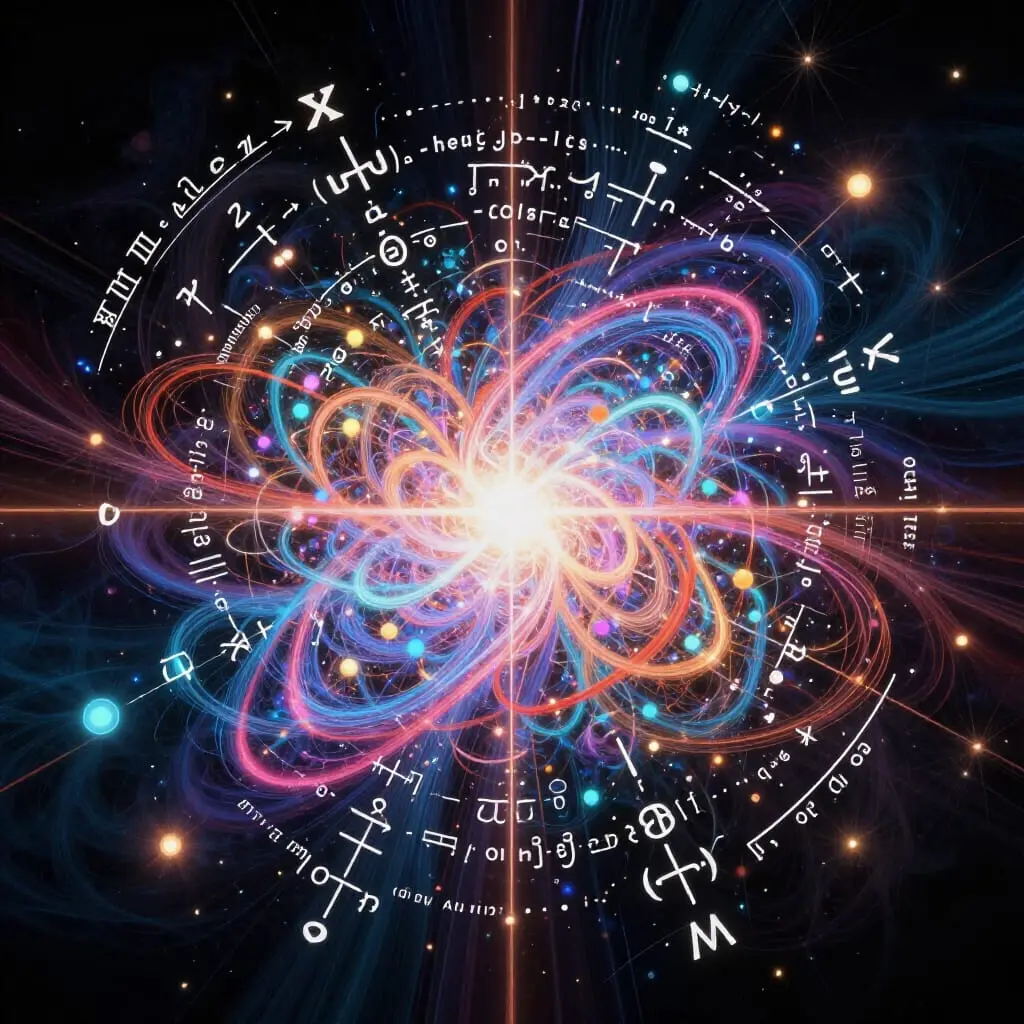
“For a hundred years,” he begins, his eyes scanning the crowd but landing on no one, “we have treated the universe like a locked room. We mapped the walls, counted the floorboards, and memorized the dust. We accepted entanglement as a ghost in the machine—a paradox we could not explain but had to agree with. Two particles, separated by galaxies, acting as one. We called it ‘spooky.’ We called it ‘non-local.’ We called it everything but what it truly is.”
He pauses. The silence is absolute.
“I am here to tell you that the room has a door. And it has been open all along.”
Mina feels a chill crawl up her spine. She knows this tone. It is the sound of Aris on the precipice of a breakthrough, that fragile moment before the glass shatters.
“We believed the extra dimensions—string theory’s five, six, or seven—were mathematical abstractions, curled up so small they were irrelevant,” Aris continues. “We believed movement between them was impossible, a violation of causality. We were wrong. We were looking for a tunnel, a bridge, a physical passage. We should have been looking for a reflection.”
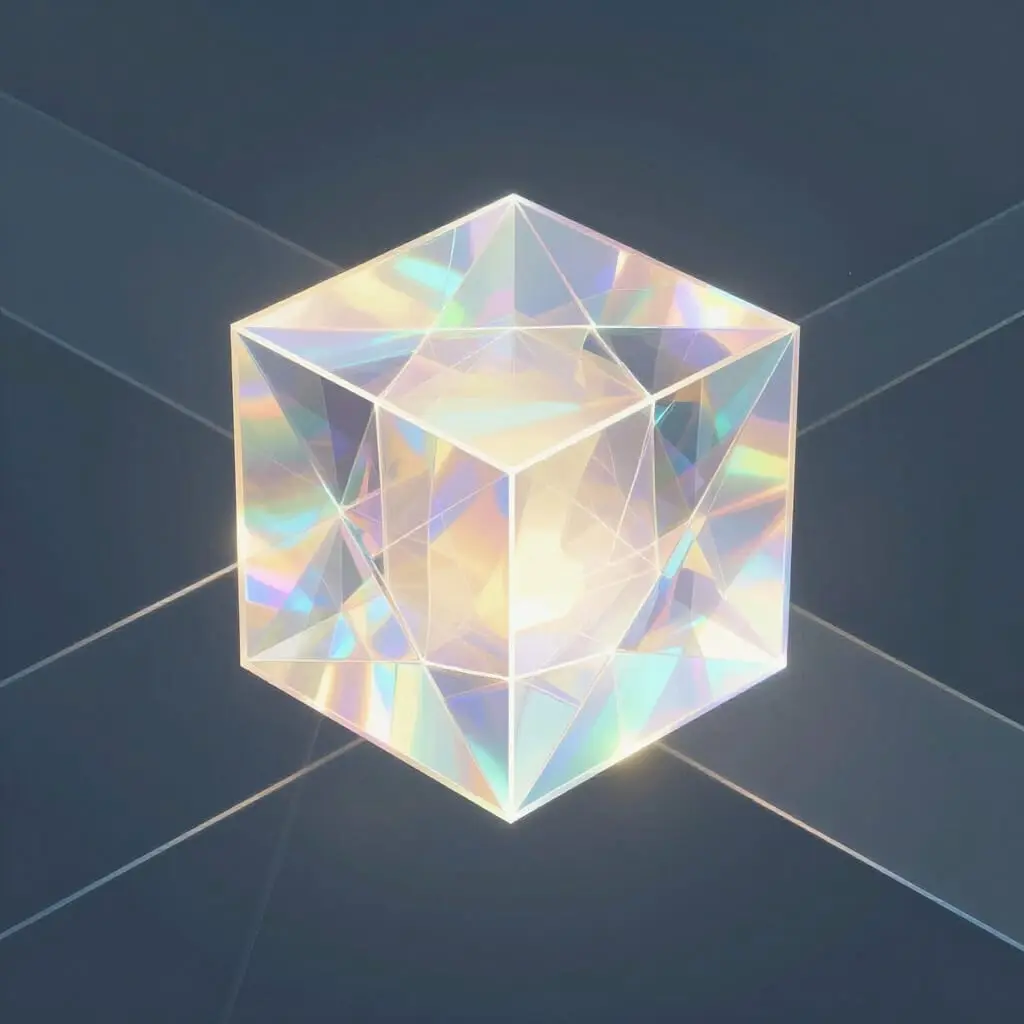
He gestures to the massive screen behind him. It displays a complex equation, one that had baffled quantum computers for months. “The ‘Thorne Constant’ isn’t a new law. It is a translation key. The dimensions aren’t stacked like layers of a cake. They are superimposed. Like sheets of glass. And the ‘spooky action’ of entangled particles? It isn’t communication across space. It is the shadow of a single object existing in multiple dimensions simultaneously.”
The room erupts. Not in applause, but in a cacophony of voices. Mina watches the faces of the other physicists in the front row. They look pale. Terrified.
Aris leans in again, his voice dropping to a conspiratorial hush. “I have proven that we can open the door. We can step through the glass. We can walk into the parallel worlds that exist inches from our own.”
He looks directly at Mina then. A strange, sorrowful smile touches his lips. “But we must ask ourselves… if we step through the glass, does the reflection step out?”
The aftermath of the Nobel ceremony was a blur of flashbulbs and screaming reporters. Now, weeks later, Mina sits in the silence of Aris’s laboratory, a converted observatory atop a high-rise in the Neo-Gothic district of Stockholm. The city glitters below, a web of bioluminescent transport lines and holographic advertisements selling synthetic dreams.
Aris is not celebrating. He sits hunched over a workbench, surrounded by prisms and quantum processors. The air hums with the low thrum of cooling fans.
“You didn’t tell them everything,” Mina says softly, pouring two cups of tea. The steam curls upward, vanishing into the dim light.
Aris doesn’t look up. “You can’t tell a child how to build a fire without teaching them the danger of the burn first. The world… the world is a child right now.”
“You said the dimensions are like sheets of glass,” Mina presses, sitting beside him. “You said entanglement is a shadow. What did you mean?”
Aris finally turns to her. He looks exhausted. “Think of a coin, Mina. A coin has two sides. Heads and tails. You can look at the heads side, or you can look at the tails side. You can never see both at once. But the coin is one object.”
“Okay…”
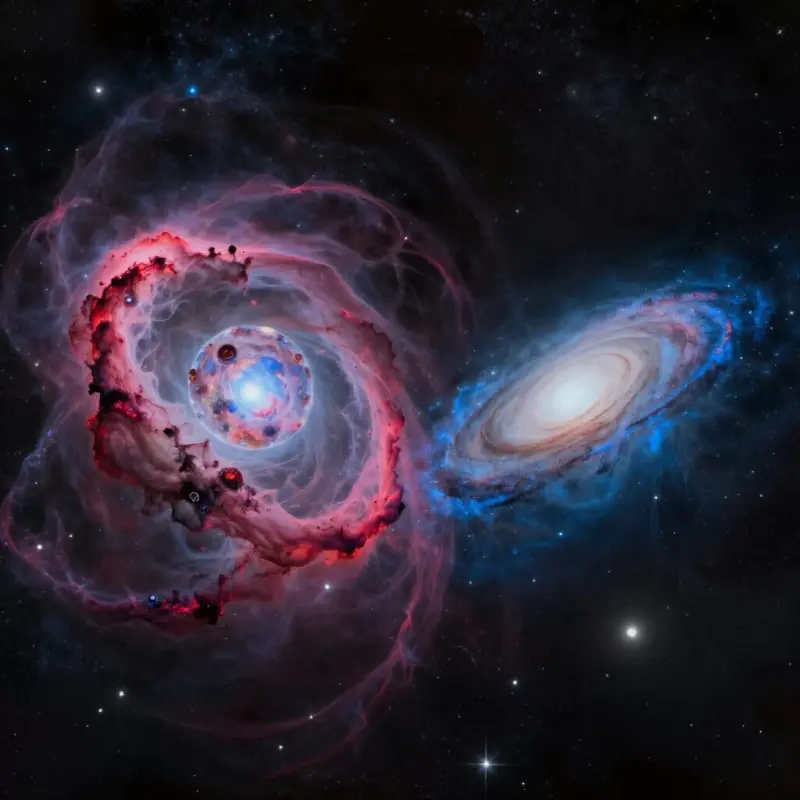
“Now imagine the coin is the universe,” Aris whispers. “We live on the ‘heads’ side. We call it the Third Dimension, the physical world. But there is a ‘tails’ side. And a rim. And an edge. Dimensions five, six, seven… they are other sides of the same coin. We thought they were separate. They aren’t. They are the same moment, viewed from a different angle.”
Mina frowns. “And the particles?”
“Entanglement,” Aris says, tapping a complex diagram on his tablet. “When two particles are entangled, they aren’t sending signals across space. They are the same particle. One exists here, in our dimension. The other exists there, in another. When we measure one, we aren’t receiving a message; we are simply observing the other side of the coin. It’s not communication. It’s identity.”
The realization hits Mina with the force of a physical blow. “So… if we can open the door…”
“We can walk to the other side of the coin,” Aris finishes. “We can step into a world that is identical to ours, yet different. A world where history took a left turn instead of a right. A world where you are not my niece, but perhaps a stranger.”
“Is that dangerous?” Mina asks, her voice trembling slightly.
Aris stands up and walks to the large bay window. The city lights reflect in his glasses. “Balance, Mina. Nature seeks balance. If we cross over, we disrupt the superposition. We introduce a variable that shouldn’t be there. Imagine two identical clocks, ticking perfectly in sync. Now, imagine reaching out and stopping one. The other… the other might not stop. It might shatter.”
He turns back to her, his face shadowed. “I have spent months running simulations. If we open the door, even a crack, the pressure between the dimensions will equalize. It’s not a physical pressure, but a causal one. Information will bleed through. Memories that don’t belong to us. Ghosts of people who never died in our world. And eventually… the walls will collapse. The sheets of glass will break.”
“Then you can’t publish the method,” Mina says urgently. “You have to destroy it.”
Aris laughs, a dry, brittle sound. “It’s too late. The equation is out there. The world knows that the door exists. They are already building machines, Mina. They think it’s the next frontier. They think it’s a new land to conquer.”
He walks to a heavy safe in the corner of the room and inputs a code. The door swings open, revealing not a stack of papers, but a single, small device. It looks like a stylus, glowing with a soft, violet light.
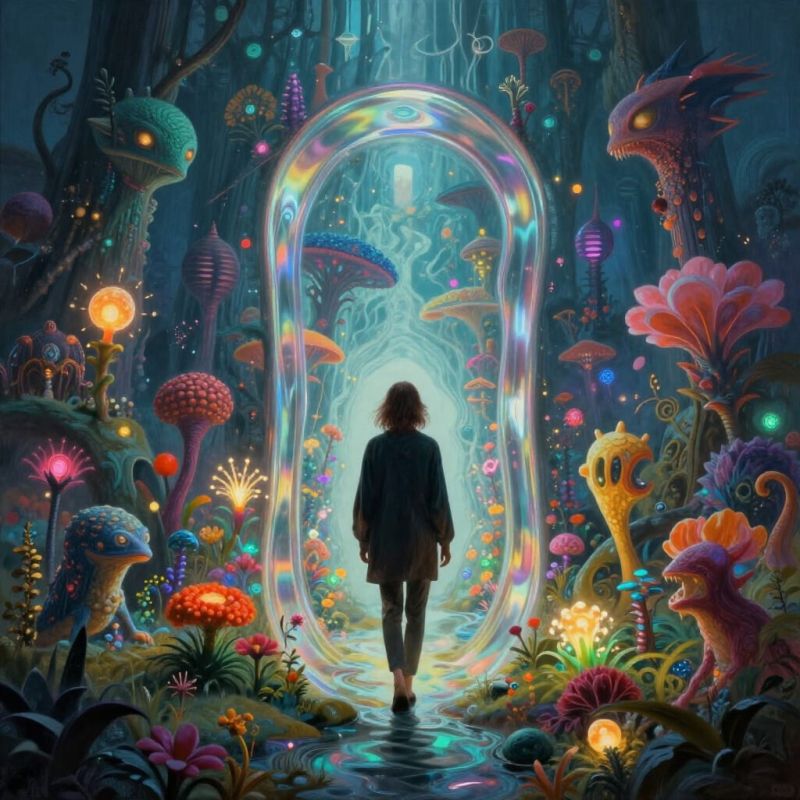
“This is the Key,” Aris says. “It doesn’t just open the door. It locks it.”
Two months later, the world is on the brink of madness.
Mina walks through the streets of Stockholm, her coat pulled tight against a wind that feels wrong. It’s not the cold; it’s the texture of the air. Since Aris’s announcement, reports have flooded the global net. People claiming to see doppelgängers in mirrors. Architects finding blueprints for buildings that were never built. Children speaking languages that don’t exist.
The “Thorne Effect” is leaking. The glass is cracking.
The scientific community is in an uproar. A consortium of global powers, led by the enigmatic CEO of Chronos Corp, has built a massive collider in the Pacific Ocean, designed to force the dimensions apart. They call it “The Expansion.” They promise a world of infinite resources, of energy drawn from parallel realities.
Mina knows better. She knows it’s a suicide machine.
She arrives at the Chronos Corp tower, a needle of black steel piercing the smoggy sky. She isn’t here as a scientist. She is here as a thief. Aris is gone. Three days ago, he vanished. The official story is that he is in seclusion, refining his theories. The truth, Mina knows, is darker. He tried to sabotage the collider’s precursor experiments. He was taken.
Security is tight, biometric scanners and laser grids. But Aris taught Mina everything. He taught her that security systems are just patterns, and patterns are just equations. She slips through the service tunnels, her heart hammering a rhythm that syncs with the hum of the building’s massive servers.
She reaches the central control room just as the countdown begins.
On the main screen, a view of the Pacific facility. The collider is active. A sphere of blinding light forms in the center of the ring.
“Initiate Phase One,” a voice commands over the intercom. It’s the CEO of Chronos Corp.
Mina bursts into the room. The technicians spin around, startled. She holds up the small, violet device Aris left for her—the Key.
“Stop!” she screams. “You don’t know what you’re doing!”
The CEO steps out from the shadows. He is a tall man, handsome in a synthetic, polished way. “Dr. Thorne’s niece. We expected you. Your uncle is… unwell. He doesn’t understand the potential.”
“He understands the balance!” Mina shouts, stepping toward the console. “You’re not opening a door. You’re shattering the mirror!”
“Let it shatter,” the CEO smiles. “We’ll build a new one.”
He nods to security. Two guards grab Mina, but she is faster than they expect. She slams the Key onto the console. It doesn’t look like a weapon, but the moment it touches the interface, the room plunges into darkness.
The emergency lights flicker on, casting the room in a blood-red glow. On the main screen, the sphere of light in the Pacific doesn’t expand. It implodes.
But it doesn’t vanish.
A crack appears in the air of the control room. Not a crack in the wall, but a crack in reality. Through it, Mina sees a world that is a negative image of their own. The colors are inverted. The people in that room—ghostly, translucent versions of the CEO and the guards—are screaming, though no sound comes through.
The barrier is breaking.
“Look!” Mina cries out, pointing at the rift. “That is the other side! If we force our way in, we destroy both worlds!”
The CEO stares, mesmerized and horrified. The rift widens. The air pressure drops, sucking the breath from their lungs. Through the crack, Mina sees a figure stepping forward. It is Aris. But not the Aris of this world. This Aris is older, his eyes burned out, his skin gray like ash. He reaches a hand through the rift, not to help, but to pull.
The Key on the console begins to pulse violently. Mina realizes the truth too late. The Key doesn’t just lock the door. It transcends it.
Aris—their Aris—didn’t just vanish. He used the Key to merge with the dimensions, to become the bridge itself. He is the equilibrium.
“Uncle!” Mina whispers.
The ash-gray Aris grabs the CEO’s arm. The CEO screams as his flesh begins to turn translucent, merging with the negative world. The room is dissolving. The laws of physics are unraveling.
Mina grabs the Key. She understands the final equation. To save the balance, one side must be sacrificed. Not destroyed, but integrated.
She doesn’t run. She steps toward the rift, toward the gray version of her uncle.
“Close your eyes,” she says, though she isn’t sure who she is speaking to.
She jams the Key into her own chest.
There is no pain. Only a sudden, deafening silence.
The Epilogue
The year is 2084. The world has changed, though few remember how.
Mina sits on a park bench in Stockholm. The sky is a brilliant, impossible shade of violet. The trees whisper in a language that sounds like wind chimes. The people walk by, their forms shimmering slightly, like heat haze on asphalt.
The collider didn’t destroy the world. It didn’t open the door to infinite resources.
The Key, activated by Mina, did something far more profound. It didn’t let them step through the glass. It melted it.
The dimensions didn’t collapse; they fused. The “heads” and “tails” of the coin were stamped together. The barrier between parallel worlds dissolved completely.
Now, there is only one world. But it is a composite. A mosaic of every possibility.
Mina looks at her hand. For a second, it is young and smooth. For a second, it is aged and spotted. She is all versions of herself at once. The “spooky action” is no longer a mystery; it is the fabric of existence. Everyone is entangled with everyone else. You can feel the emotions of the stranger sitting next to you because, in some dimension, they are you.
The danger Aris feared—the collapse of the walls—has happened. But the universe adapted. It didn’t die; it evolved into something incomprehensible.
A man sits down next to her. He is wearing a Nobel Prize medal around his neck, but it is made of light. It is Aris. Or a version of him. He is translucent, a ghost woven into the fabric of the city, a guardian of the new equilibrium.
“Did we win?” Mina asks, her voice echoing with a thousand other voices.
Aris looks at the violet sky. “We didn’t conquer the dimensions, Mina. We became them.”
He reaches out, and for a moment, his hand passes through hers, merging into a single, solid form. There is no separation anymore. No distance. No light-years between particles. Only the infinite, terrifying, beautiful now.
The world is safe. The balance is restored. But humanity is no longer alone in its own skin. They are the universe, finally awake to itself. And it is a silence louder than any scream.