100
Chapter 1: The Deep
The Pacific Ocean, 150 nautical miles southwest of Hawaii
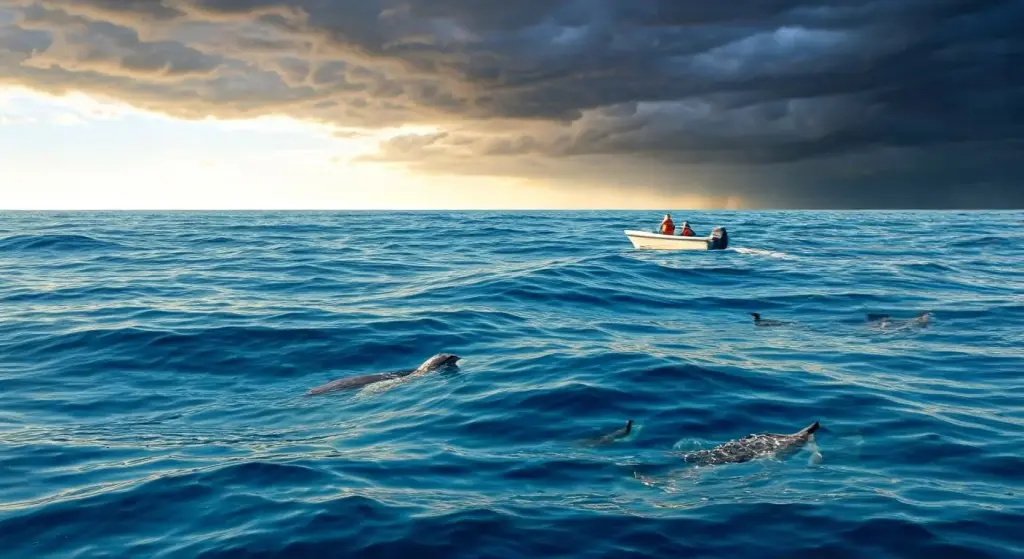
Captain Maria Santos wiped the salt spray from her weathered face as the Kanaloa’s Dream cut through the moderate swells of the North Pacific. The year was 2060, and fishing had changed dramatically since her grandfather’s days, but the ocean remained as unforgiving as ever. Her co-captain and longtime friend, James “J.J.” Chen, studied the holographic display floating above the control panel, his fingers dancing through the air as he adjusted their course.
“The sonar’s picking up something interesting two hundred meters down,” J.J. called out, his voice cutting through the hum of the boat’s quantum engines. “Could be a school of Pacific bluefin, maybe even some of those genetically-enhanced salmon the aquafarms are breeding.”
Maria nodded, her dark eyes scanning the horizon. At fifty-two, she had spent more than half her life on these waters. The Pacific had been good to her family for three generations, ever since her grandfather had arrived from the Philippines with nothing but a wooden skiff and dreams of abundance. But lately, the fishing had been different. Climate change had altered currents and migration patterns, forcing captains like her to venture further from shore.
“Let’s drop the nets,” she decided. “But keep them shallow. I don’t like the look of those clouds building to the west.”
Chapter 2: The Storm
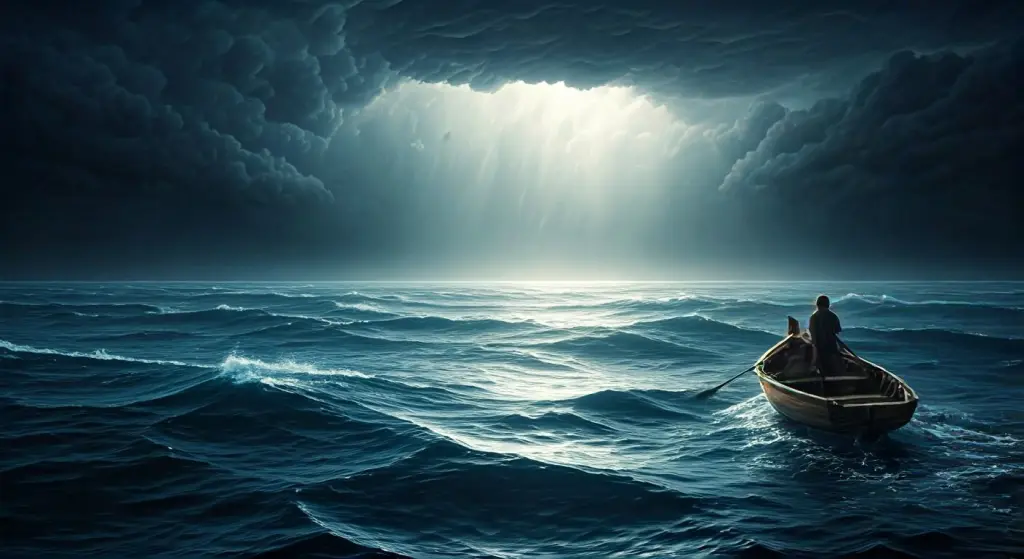
Three hours later, the weather turned vicious with a speed that only the Pacific could muster. What had started as a pleasant sailing day transformed into a tempest that seemed to rise from the ocean’s very depths. The Kanaloa’s Dream, though modern and well-equipped, suddenly seemed like a fragile nutshell in the vastness of angry water.
“I’m reading winds at sixty knots and climbing!” J.J. shouted over the howling wind, his hands frantically working the boat’s stabilization systems. “The storm’s got some kind of electromagnetic component – our navigation systems are going haywire!”
Maria gripped the wheel with white knuckles, fighting to keep the boat steady as twenty-foot waves crashed over the bow. The narrow vessel—only eighteen feet in beam—was designed for agility and speed, not for riding out major storms. Every wave threatened to roll them, and she could feel the boat groaning under the stress.
“We need to jettison some weight!” Maria called out. “Dump the fuel tanks and the extra equipment!”
But as J.J. moved to comply with her orders, a massive wave, taller than the mast, loomed ahead. The boat climbed the wave’s face like a roller coaster, hung suspended for an eternity, then plummeted into the trough with a crash that shook every bolt on the vessel.
When the spray cleared and Maria’s vision cleared, she realized the terrible truth. The storm had torn the Kanaloa’s Dream in half. They were floating in the narrow stern section, barely six feet wide and twelve feet long, with the bow section already sinking into the churning depths. Their emergency beacon was gone, their radio was dead, and they were alone in the vast Pacific, hundreds of miles from the nearest landmass.
Chapter 3: The Reckoning
As the storm finally began to exhaust its fury, Maria and J.J. found themselves clinging to a makeshift raft constructed from the boat’s remaining debris. The narrow section of the Kanaloa’s Dream had partially flooded, but thanks to its modern composite construction, it remained afloat. They had managed to salvage a few essential items: a water purification tablet worth a week of drinking water, a small solar-powered beacon, emergency rations designed to last three days, and J.J.’s waterproof fishing tackle box.
“Well,” J.J. said with grim humor, “remember when we complained about the charter fishing regulations being too strict?”
Maria almost smiled, but the reality of their situation was too dire. They were professional fishermen, yes, but they were used to working with modern equipment, GPS systems, and the knowledge that rescue was always just a radio call away. Now they had to rely on skills that their grandfathers had known but that their generation had largely forgotten.
“First priority is water,” Maria said, adopting the same tone she used when teaching new crew members. “Second is food. Third is signaling for rescue. We need to prioritize, and we need to work together.”
They had been floating for six hours when the sun broke through the dissipating clouds, revealing the vast expanse of blue that surrounded them. No land was visible in any direction, just an endless horizon that seemed to mock their helplessness.
“According to my calculations,” J.J. said, consulting the compass in his tackle box, “the nearest land is probably the Hawaiian Islands, but that’s still over a hundred miles due east. And that’s if we’re navigating correctly in this current.”
Chapter 4: Skills Reborn
On the second day, as their emergency rations dwindled and the reality of their situation settled in, Maria remembered something her grandfather had taught her during the rare moments when he would share stories of his early fishing days. “In the old days,” he had said, “we didn’t have all this fancy electronics. We had to read the water, read the sky, read the behavior of the fish themselves.”
“J.J.,” she said, “do you remember anything about traditional fishing methods? I’m talking about the basics – hand lines, spear fishing, anything that doesn’t require a motor.”
J.J. scratched his head, thinking. His family had been in the fishing business for generations too, but more recently focused on commercial operations. “I remember my uncle teaching me to make a hand line from fishing line and a weight. But beyond that…” He shrugged helplessly.
Maria stood carefully on their unstable raft, using J.J.’s shoulders for balance. The Pacific around them showed signs of life – schools of small fish darting just below the surface, and she could see the occasional dorsal fin of larger predators. The key, she realized, was to think like their ancestors had thought.
“We need to make tools,” she decided. “Real tools, not just rely on what we salvaged. Can you work with your tackle box?”
J.J. opened the waterproof container, revealing an assortment of hooks, line, weights, and lures. “I can work with this, but we’re going to need more line, more hooks, and some way to catch something bigger than a sardine.”
As the day wore on, they began to improvise. Maria used her knife – one of the few tools they had salvaged – to carve a spear point from a piece of the boat’s hull that had broken off in the storm. J.J. untangled various lengths of fishing line from his tackle box and began constructing improvised nets using knots his grandfather had shown him.
By sunset of their third day, they had managed to catch three small fish using improvised hand lines. It wasn’t much, but it was protein, and more importantly, it was proof that they could survive if they could adapt their modern knowledge to primitive methods.
Chapter 5: The Long Game
By the fourth day, the initial adrenaline had worn off, and the true psychological challenge of their situation began to set in. Floating in the middle of the Pacific Ocean, with only each other for company and the vast emptiness of water stretching to every horizon, would test even the strongest minds.
“We need to establish a routine,” Maria said, her voice steady despite the fear she felt creeping into her chest. “We’ve got water from the purification tablets, and we’ve proven we can catch small fish. But we need to think long-term.”
J.J. had been working on improving their fishing gear, using pieces of their salvaged equipment to create more sophisticated traps. “I’ve been thinking,” he said, “about the currents. If we can predict them, maybe we can use them to our advantage. The Pacific currents could carry us toward land if we time it right.”
They had also activated their solar beacon, which pulsed a weak signal every few minutes. It wasn’t powerful enough for long-range rescue, but it might help if any ships passed within fifty miles. They made a schedule: one person would keep watch while the other slept, always maintaining the beacon’s position facing upward.
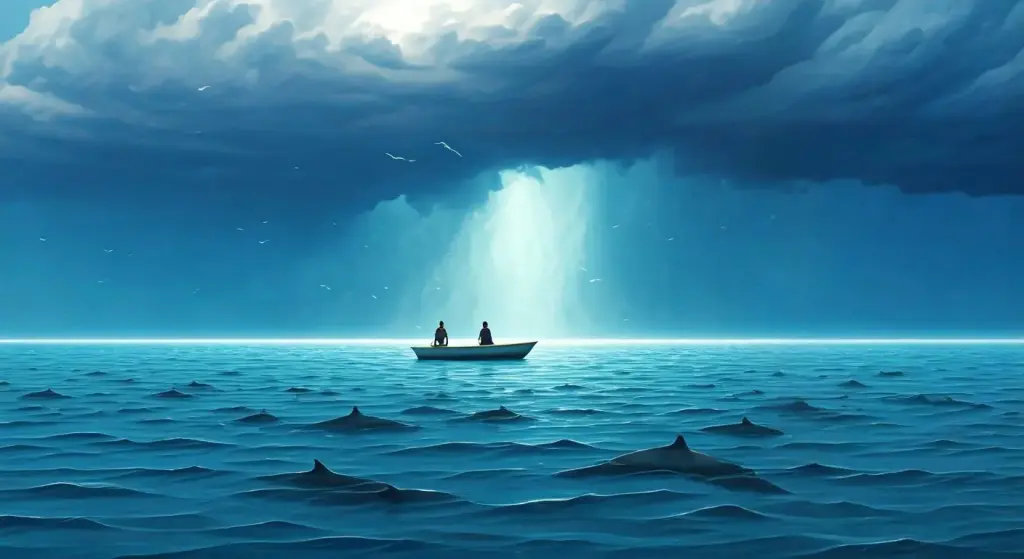
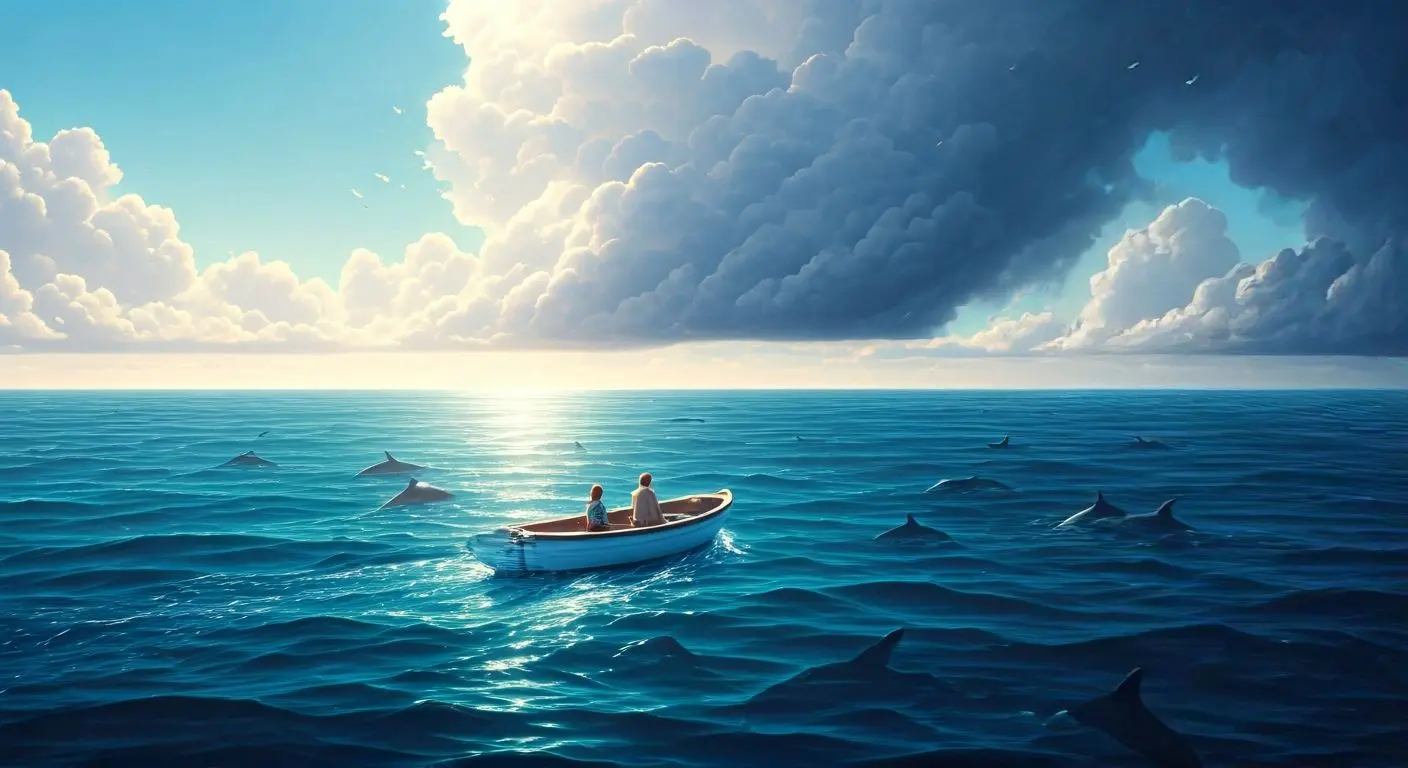
The fifth day brought a new challenge – a pod of dolphins appeared, swimming around their raft with curious intelligence. Maria had heard stories about dolphins helping lost fishermen, but she had always assumed they were just sailor tales. Now, watching these magnificent creatures circle their tiny vessel, she began to wonder.
“Do you think they know we’re lost?” J.J. whispered, afraid to speak too loudly and scare the dolphins away.
“I think they know we’re in trouble,” Maria replied. “The question is whether they can do anything about it.”
That night, as they took turns keeping watch, Maria noticed something remarkable. The dolphins weren’t just swimming randomly around their raft. They were creating a kind of barrier, driving smaller fish toward their improvised nets while warning them away from larger predators. It was as if the dolphins had adopted them.
Chapter 6: Unexpected Allies
The dolphins’ presence changed everything. Not only were they helping to concentrate fish near the raft, but their behavior seemed to indicate a deeper understanding of the fishermen’s situation. On the sixth day, when Maria was attempting to spear a larger fish that had been harassing their nets, one of the dolphins actually guided the fish toward her blade.
“I can’t believe it,” J.J. breathed, watching in amazement as another dolphin helped corral a school of mackerel close enough to their raft that they could catch them with their bare hands. “They’re actually helping us hunt.”
Maria nodded, her hands working automatically to clean the fish they had caught. “My grandfather always said that the ocean has its own logic, its own intelligence. Maybe the dolphins understand that we’re part of that system, even if we got here by accident.”
Their food situation improved dramatically with the dolphins’ help. They were catching enough fish not just to survive, but to build up their strength. More importantly, the dolphins seemed to be guiding them toward areas where the water was cleaner and the fishing was better.
But the most remarkable thing happened on the seventh day. J.J., while monitoring their improvised radio equipment, picked up a faint signal. At first, he thought it was just static, but as he adjusted the frequency, the signal became clearer.
“Maria!” he called out excitedly. “I’m getting a transmission. It’s weak, but it’s definitely artificial. Could be a ship, maybe even an aircraft.”
They managed to send a response using their solar beacon’s emergency signal, flashing it in patterns that matched standard maritime distress codes. But the transmission was intermittent, and they couldn’t tell if their message was being received.
That night, as they sat on their raft sharing a meal of fresh fish cooked over their small camping stove, Maria looked up at the stars and said something that surprised even herself: “You know, in a strange way, this might be the most connected I’ve felt to the ocean in years. All the technology, all the modern equipment – sometimes it feels like we’re not really part of the water we’re working on.”
Chapter 7: The Breakthrough
On the ninth day, their luck changed completely. J.J.’s constant monitoring of the radio frequencies finally paid off. A research vessel, the Oceanus Discovery, had been searching for them since the storm had been reported by weather satellites. The electromagnetic interference from the unusual storm had made their position difficult to determine, but their persistent beacon signal had finally allowed the rescue team to triangulate their location.
“We’re about twelve miles south of your position,” came the voice through J.J.’s makeshift antenna. “ETA approximately four hours. Can you maintain your position and keep that signal active?”
Maria grabbed the radio, her voice shaking with relief and exhaustion. “This is Captain Maria Santos of the Kanaloa’s Dream. We can maintain position, but our raft is getting pretty beat up from the swells. We’re alive and we’re well, but we need that pickup as soon as possible.”
As they waited for rescue, something remarkable happened. The dolphins, as if sensing that their human friends were about to be saved, performed what could only be described as a farewell ceremony. They jumped and played around the raft, diving and surfacing in patterns that seemed almost celebratory.
“Look at them,” J.J. said, his eyes misting. “They know we’re going home.”
When the Oceanus Discovery finally appeared on the horizon, Maria felt a复杂的 mix of emotions. Relief, certainly, but also a strange reluctance to leave their floating home. For nine days, they had lived in perfect harmony with the ocean, learning lessons that a lifetime of modern fishing had never taught them.
As the rescue ship’s inflatable boats approached their raft, the lead dolphin swam close to Maria one last time, seeming to look directly into her eyes. Then, with a graceful leap that sent spray across the raft, the entire pod disappeared beneath the surface, leaving behind only ripples and the memory of their extraordinary kindness.
Chapter 8: New Horizons
The rescue was swift and professional. The crew of the Oceanus Discovery had been following reports of the unusual storm system and had been monitoring maritime frequencies for anyone who might have been caught in its path. When they finally pulled Maria and J.J. aboard their vessel, they found two fishermen who had not only survived their ordeal but had thrived in ways that surprised even them.
“You two have quite a story to tell,” said Dr. Elena Vasquez, the ship’s chief scientist, as she examined their improvised fishing gear with professional interest. “The techniques you’ve developed, the relationship you established with the dolphin pod – this could have implications for sustainable fishing practices.”
Maria and J.J. spent the next three days aboard the research vessel, sharing their story and helping Dr. Vasquez understand how traditional fishing knowledge could be integrated with modern sustainability practices. What had started as a tale of survival became something much more significant – a blueprint for a new kind of fishing that honored both technological progress and ancient wisdom.
When they finally reached port in Honolulu, they found that their story had already spread throughout the maritime community. The film footage they had managed to record on J.J.’s waterproof camera – showing their interactions with the dolphins – had gone viral, sparking discussions about marine intelligence and conservation.
But more importantly, their experience had changed how they approached their own lives and work. Within six months, Maria and J.J. had formed a new company – Pacific Harmony Fishing – that specialized in sustainable fishing practices guided by both traditional knowledge and modern environmental science.
Their boats were equipped with the latest technology, but they also carried the simple hand tools and techniques they had developed during their nine-day ordeal. They worked closely with marine biologists to understand and protect the dolphin populations that had become their unexpected teachers.
“
Epilogue: The Last Tide
Two years after their rescue, Maria stood on the deck of her new boat, the Harmony’s Call, watching a pod of dolphins play in the distance. The Pacific waters around the Hawaiian Islands had become her second home, not just as a place to work, but as a community of which she felt she was truly a part.
J.J. approached from the other side of the deck, carrying a steaming cup of coffee and a tablet displaying their latest catch reports. “The sustainability committee is meeting next week,” he said. “They want to discuss expanding our dolphin-assisted fishing techniques to other regions.”
Maria smiled, accepting the coffee gratefully. The warmth spread through her hands and into her chest, reminding her of cold nights on the raft when they had shared body heat and stories to survive. “You know what the strangest part is?” she said. “Sometimes I miss it. Not the danger, not the fear, but that feeling of being completely present, completely dependent on the ocean and each other.”
J.J. nodded thoughtfully. “I know what you mean. All our lives, we’ve been trying to tame the ocean, to make it bend to our will with better technology and bigger boats. But what we learned out there was that the ocean doesn’t need taming – it needs partnership.”
As the Harmony’s Call prepared to head out for another day of fishing, Maria reflected on the journey that had brought them here. Their narrow boat had been destroyed, but from its wreckage, they had built something stronger – a new understanding of what it meant to work with the sea rather than simply on it.
The Pacific Ocean stretched endlessly to every horizon, as vast and mysterious as it had been since time immemorial. But now Maria saw it not as an adversary to be conquered, but as an ancient friend whose wisdom they were finally beginning to understand. The dolphins still visited their boats sometimes, playing in the bow waves and guiding them toward abundant fishing grounds.
As the boat’s engines hummed to life and they began to move away from port, Maria looked back at the coastline fading behind them. Somewhere out there, in the vastness of blue that covered most of the world, other fishermen were still trying to master the ocean through force and technology. But she and J.J. had learned a different way – a way of listening and adapting, of giving as much as they took, of recognizing that sometimes the greatest strength came from understanding your own limitations.
The last tide that had nearly killed them had also taught them how to truly live. And as the Harmony’s Call cut through the moderate swells of another Pacific morning, Captain Maria Santos smiled and thought about the strange turns that life could take. Sometimes the ocean gave you exactly what you needed, even when what you needed most was to learn how to receive its gifts gracefully.
In the distance, a pod of dolphins broke the surface of the water in a spectacular display of joy, their silhouettes catching the morning light like living jewels. Maria raised her hand in a gesture of greeting, and for a moment, she could swear that the lead dolphin waved a fin in response.
“In the end, we did not conquer the last tide. It conquered us, transformed us, and set us free to sail toward a future where man and ocean move as one.”