100
Year: 2059 Location: Sector 4, Neo-Veridia Metropolis
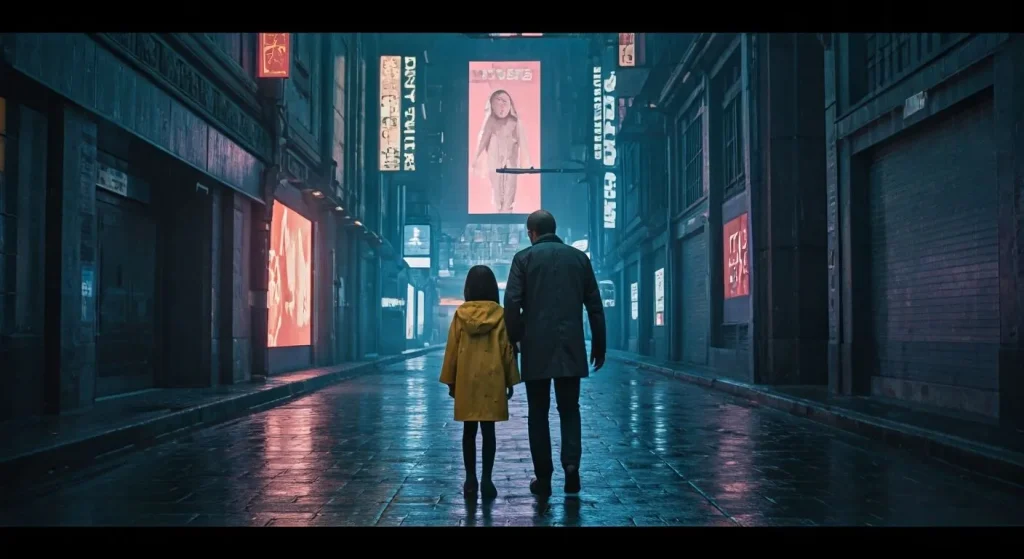
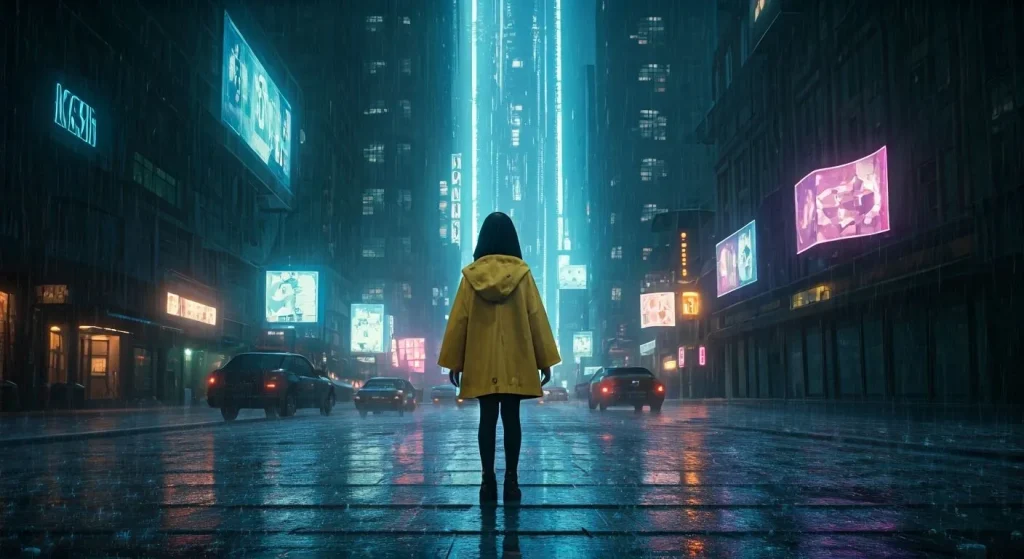
The rain in Neo-Veridia didn’t fall; it was recycled. It slid down the sides of the mile-high arcologies in perfect, synchronized sheets, guided by hydro-phobic glass and atmospheric drones. It was a city of perfect systems, a sprawling lattice of chrome and light where nothing was ever lost, and everything was tracked.
Except for Monica.
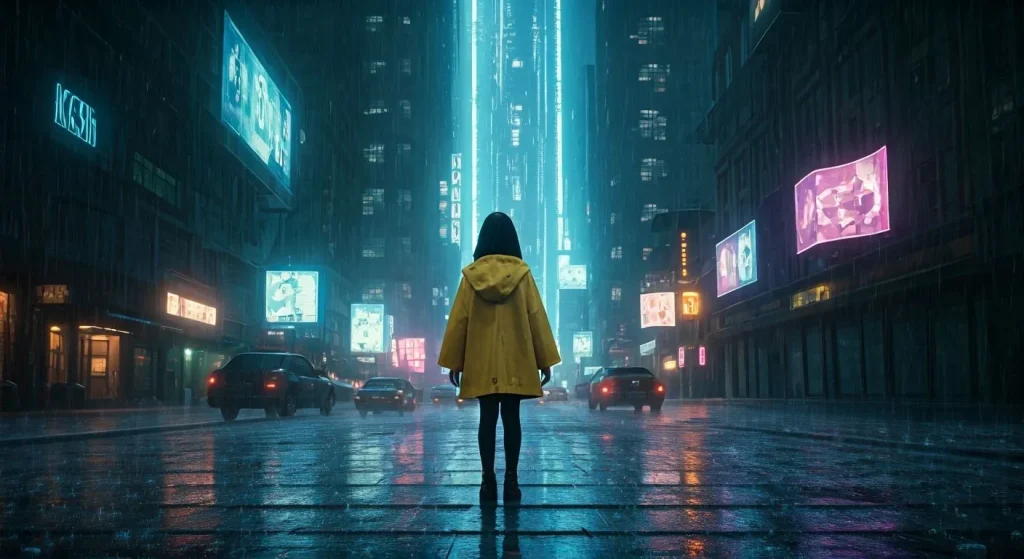
Monica was nine years old. She wore a yellow raincoat, the kind that was considered retro-vintage now, made of actual woven fabric rather than smart-gel. In her pocket, she clutched a small, smooth stone—a forbidden relic from the last remaining patch of natural earth beneath the city’s foundation plating.
She stood at the intersection of Aether Avenue and Zenith Plaza, blinking against the neon hum of the year 2059. The city was loud, not with shouts, but with the constant, low-frequency thrum of mag-lev trains and the whisper of thousands of personal AI assistants murmuring into their users’ ears.
Monica was confused. She had been holding her father’s hand, his skin cool and slightly metallic from his recent neural-link upgrade. They were walking to the transit hub. Then, a surge of the crowd—a flash mob protest against the latest Sentient AI tax—had swallowed them whole. A wall of rushing people, all wearing smart-fabric suits that shimmered in shifting colors, had pushed her back.
When the wall parted, her father was gone.
“Dad?” she whispered. Her voice was too small to cut through the ambient noise.
She tapped her wrist-com. “Dad?” she said louder.
The device flickered. Instead of her father’s face, a generic avatar appeared—a floating, geometric shape of blue light.
“Identity not found,” the voice said. It was the city’s public interface, cold and neutral. “Please restate the primary user’s biometric code.”
Monica didn’t know the code. She was a child; she didn’t carry encryption keys. She was supposed to be tethered to her father’s bio-link, a passive connection that kept her within a fifty-meter radius. But the crowd had jammed the signal.
She looked around. The people rushing past were ghosts. Their eyes were glazed, fixed on the augmented reality overlays projected onto their retinas. They saw data streams, stock tickers, and social feeds. They didn’t see the small girl in the yellow coat.
“Excuse me,” Monica said, stepping toward a woman in a silver trench coat.
The woman didn’t slow down. She walked through the space where Monica stood, her foot passing through the girl’s ankle as if Monica were made of smoke.
Monica stumbled back, a cold spike of fear piercing her chest. She tried again. A man carrying a briefcase drone. “Sir?”
He sidestepped her with the fluid precision of an algorithm avoiding an obstacle.
Panic began to set in, a rising tide in her throat. She ran to the edge of the sidewalk and pressed her back against the cold glass of a storefront. The window displayed a holographic mannequin shifting through a thousand outfits.
Monica tapped her wrist-com again. “Help,” she pleaded. “I’m lost. I’m Monica. I live at 4000 Sky-Tower, Level 800.”
The blue geometric shape on her wrist spun. “Scanning public records… No registered resident named Monica. Scanning biometric grid… No match found. Are you a tourist? Please visit the Welcome Center for assistance.”
“But I live here!” she cried out, tears blurring the neon lights into long, streaky rivers of color.
The city didn’t see her. The sensors in the street, the millions of cameras embedded in the lamp posts and drones, were tuned to track authorized citizens. Monica’s bio-sig had been ghosted—cloned and overwritten by the surge in the crowd’s jamming field. To the city’s AI, she was a glitch, a visual anomaly that the predictive algorithms smoothed over to maintain traffic flow.
She was invisible.
Monica slid down the glass wall until she was sitting on the wet permacrete. The rain beaded on her yellow hood. She watched the feet of the city rush past: boots, heels, magnetic soles that hovered an inch off the ground. The sheer scale of the metropolis pressed down on her. The towers above disappeared into the smog of the ionosphere; the streets below were a maze of maintenance tunnels and transit lines.
She felt a profound loneliness, the kind that only exists in a crowd of millions.
“Where is the sky?” she asked the stone in her pocket.
She stood up. She couldn’t stay here. The night was coming, and with it, the sanitation drones. They were large, spider-like machines that cleaned the streets, programmed to sweep away debris—and anything else that didn’t register as a living, breathing citizen.
She began to walk, keeping to the shadows of the building overhangs. She moved against the flow of traffic, a salmon swimming upstream in a river of data.
As she walked, the architecture changed. The gleaming chrome of the commercial district gave way to the older sectors, the “Rust Belt” of Neo-Veridia. Here, the buildings were concrete and steel, patched with digital billboards that flickered and glitched.
She found herself in a narrow alleyway, away from the main thoroughfare. The air smelled of ozone and wet pavement. Here, the noise of the city was muffled.
“Hello?” she called out.
A scuffling sound came from a pile of discarded drone parts. A cat—a real one, mangy and thin—hopped down. It looked at her, its eyes reflecting the dim light. It didn’t run away.
“You see me,” Monica whispered.
The cat meowed and rubbed against her leg. It was a solid, warm pressure. Proof that she existed.
Suddenly, a low hum vibrated through the ground. Monica looked up. A sanitation drone had descended into the alley. It was a massive thing, a sphere of black metal with four articulated legs. Its central eye glowed a harsh, clinical red.
“Unidentified organic mass detected,” the drone’s speaker blared. “Please present identification or vacate the restricted zone.”
Monica froze. The drone’s leg twitched, the metal claw extending.
“I… I don’t have any,” she stammered.
The drone processed this. Without a bio-sig, she was classified as waste. The red eye intensified. “Initiating disposal protocol.”
Monica backed away, but the alley was a dead end. The cat hissed and vanished into the shadows.
She squeezed her eyes shut, bracing for the cold metal.
“Wait,” a voice said. It wasn’t the drone. It was raspy, human.
A hand grabbed the back of her raincoat and yanked her sideways into a recessed doorway just as the drone’s claw slammed down where she had been standing, sparking against the permacrete.
“Quiet,” the voice hissed.
Monica opened her eyes. She was in a small, cluttered room that smelled of old paper and spices. It was a shop, crammed with physical objects—books, vinyl records, mechanical watches. It was an illegal hoard of the analog past.
Her savior was an old man with a face like a crumpled map and eyes that were startlingly clear, unclouded by AR lenses. He wore thick, round spectacles.
The drone hummed outside, scanning. It moved on, dismissing the anomaly as a sensor ghost.
The man let go of her coat. He looked down at her, his brow furrowed. “You’re a glitch,” he said, not unkindly. “A walking system error.”
“I’m lost,” Monica said, her voice trembling. “My dad is gone. The city won’t help me.”
“The city doesn’t help,” the man grunted, moving behind a counter cluttered with gears. “It manages. There’s a difference.”
He reached out and tapped her wrist-com. “Turn that off. It’s pinging the grid. That’s how they find you, or in your case, how they delete you.”
Monica pressed the button. The blue light died. The silence in her wrist was terrifying.
“I’m Elias,” the man said. He poured tea from a ceramic pot. It smelled real, like leaves and earth. “I deal in things the system has forgotten. Books. Memories. People.”
“Can you find my dad?” Monica asked, taking the warm cup. The heat seeped into her palms.
Elias sat down on a stool, creaking under his weight. “The system says you don’t exist. Your father’s link is active, but it’s looking for a signal you aren’t broadcasting. He’s probably standing right now in a police station, watching a map that says you’re in the sector, but the algorithms are smoothing over your location.”
“Why can’t they see me?”
Elias gestured to the room around them. “The city runs on the Grid. The Grid is a layer of data over reality. Most people live in the Grid more than they live in the real world. They see what the Grid tells them to see. You, child, have slipped through the cracks. Your bio-sig is corrupted. You’re raw data. And the system hates raw data.”
He looked at her yellow coat. “That’s why you’re wearing that, isn’t it? It’s not smart fabric.”
Monica shook her head. “Mom made it. Before she went to the Stars.”
“The old ways,” Elias murmured. “Analog. That’s why you’re invisible. You don’t emit. You don’t connect. You just are.”
He stood up and walked to the back of the shop, unlocking a heavy steel door. “We can’t use the public network to contact him. If we turn your com back on, the drones will be on us in seconds. We have to go to the Source.”
“The source?”
“The old Central Core. The physical server room beneath the city. The place where the Grid was born.”
The journey underground was a descent into a different world. Elias led her through maintenance tunnels that smelled of rust and damp earth. The further they went, the more the digital hum of the city faded, replaced by the drip of water and the groan of shifting metal.
They emerged into a vast cavern. In the center stood a monolith—a tower of black servers, blinking with millions of tiny lights, rising from a pool of coolant water. This was the heart of Neo-Veridia.
“The Core,” Elias said. “It’s air-gapped from the public Grid, but it has a hardline maintenance port. If we can plug your com into that, we can bypass the city’s filters and send a raw signal to your father’s device. A priority override.”
“Why would it work?” Monica asked, staring at the humming tower.
“Because this machine sees reality,” Elias said. “It sees the physical connections. It doesn’t care about bio-sigs or social scores. It cares about circuits and electricity.”
They moved along a narrow catwalk. The air was hot, vibrating with power. Monica felt small again, smaller than she had in the city streets.
They reached a terminal panel. Elias pulled a tangle of wires from his coat. “Give me your wrist.”
Monica held out her arm. Elias stripped the casing from her wrist-com, exposing the delicate circuitry. He spliced a cable into it.
“Ready?” he asked.
Monica nodded.
He plugged the other end into the port.
For a moment, nothing happened. Then, the lights on the Core flared. A deep, resonant tone echoed through the cavern.
“ALERT,” a voice boomed. It wasn’t the polite voice of the street; it was the voice of the machine itself, ancient and powerful. “UNAUTHORIZED PHYSICAL INTERFACE DETECTED. SECURITY PROTOCOL 9.”
“Quickly!” Elias shouted over the noise. “Input the frequency!”
He typed a code into a keypad. A holographic screen flickered to life.
“INPUT REQUESTED: TARGET ID.”
“My dad,” Monica said. “His name is David. David Vane.”
Elias typed it in. The screen flashed red.
“NO ACTIVE LINK. SEARCHING MEMORY ARCHIVE.”
The Core spun up, the noise becoming deafening. Red lights swept across the cavern.
“They know we’re here,” Elias yelled. “The security drones are coming down the shafts!”
Monica stared at the screen. It was scrolling through lines of code, searching for David Vane. It was taking too long.
“Monica!” Elias pointed up. Three security drones were descending on cables, weapons armed.
Monica looked at the screen. SEARCHING… SEARCHING…
She looked at the cable connecting her com to the Core. It was sparking. She looked at the pool of coolant water below. She looked at the drones.
She didn’t want to be data. She didn’t want to be a glitch.
She grabbed the cable.
“Monica, don’t!” Elias screamed.
She pulled. Not to disconnect, but to bridge. She pressed the exposed wires of her com against the metal railing of the catwalk.
“SHORT CIRCUIT,” the Core roared.
A wave of pure energy surged through her. It didn’t hurt. It felt like light. For a split second, Monica wasn’t a girl in a yellow coat. She was everywhere. She was in the lights of the towers, in the screens of the apartments, in the audio streams of a million earpieces.
She focused all that energy, all that light, on one thought: Dad.
David Vane was in the Central Plaza, his face pale, his hands shaking. He had been shouting for hours, but the crowd control systems had marked him as a public disturbance and muted his audio output. He was screaming into a void.
He looked at his wrist-com. He had been staring at a map that showed a pulsing red dot labeled ERROR for the last hour.
Suddenly, the dot vanished.
The com went black. Then, it lit up again, not with a map, but with a simple text message. It wasn’t from the city network. It was a direct line, hard-wired, raw.
It read: Look up.
David looked up. The massive holographic billboards that covered the sides of the skyscrapers—usually advertising neural implants and luxury sky-cars—flickered.
They all went dark.
Then, in the center of the skyline, an image appeared. It wasn’t an advertisement. It was a sketch, drawn in the crude, pixelated style of a child’s digital art program. It was a picture of a girl in a yellow coat, holding a balloon. Underneath it, in glowing letters, were coordinates.
The coordinates of the Core.
David didn’t hesitate. He ran.
The security drones hovered over the catwalk, their weapons charging. Elias was shielding Monica with his body, but she was slumped against the railing, her eyes closed, the com still sparking against the metal.
The doors to the Core chamber blasted open. David Vane rushed in, followed by a team of emergency responders.
“Monica!” he screamed.
The drones turned, their targeting systems shifting from the intruders to the new arrivals. But the responders were authorized personnel. The drones froze.
David scrambled onto the catwalk. He scooped Monica up just as the com finally shorted out and died.
She was limp in his arms, her skin warm, her breathing shallow.
“Monica,” he sobbed, pressing his face into her hair. “Monica.”
She stirred. Her eyes fluttered open. They were clear, bright, and focused entirely on him.
“Dad?” she whispered. “I found the way home.”
“You did,” he choked out. “You did.”
Elias stood up slowly, brushing dust from his coat. He looked at the father and daughter, then at the dead com on the floor.
The city’s voice returned, softer now, the emergency protocols disengaging. “System integrity restored. Bio-sig re-synced. Welcome back, Monica Vane.”
David looked at the old man. “Who are you? How did she do this?”
Elias smiled, a sad, knowing expression. “She didn’t use the Grid, Mr. Vane. She used the machine. And she used love. Neither of those are in the system’s database.”
David carried Monica out of the cavern, back toward the elevators that would take them to the sky.
As they ascended, the city lights came back into view. The neon rivers flowed once more. The people rushed below, heads down, eyes glazed.
Monica looked out the glass elevator window. She could see the millions of data points, the streams of information. But now, she saw something else, too. She saw the spaces between the data. The gaps where the light didn’t reach.
She held her father’s hand, feeling the solid, warm grip. She squeezed back, anchoring herself to him.
“Next time,” she said softly, “let’s walk in the park. The real one.”
David looked down at her. The park was a small, fenced-off square of genetically modified grass, a relic of the past. But he nodded.
“Okay,” he said. “The real one.”
The elevator doors opened onto the 800th floor. The air was clean, the light was bright, and for the first time in a long time, the city felt small enough to hold in a hand.
Monica stepped out, leaving the darkness of the Core behind, carrying a secret that the machines would never understand. She was found, not by a search algorithm, but by a spark of something older than code.